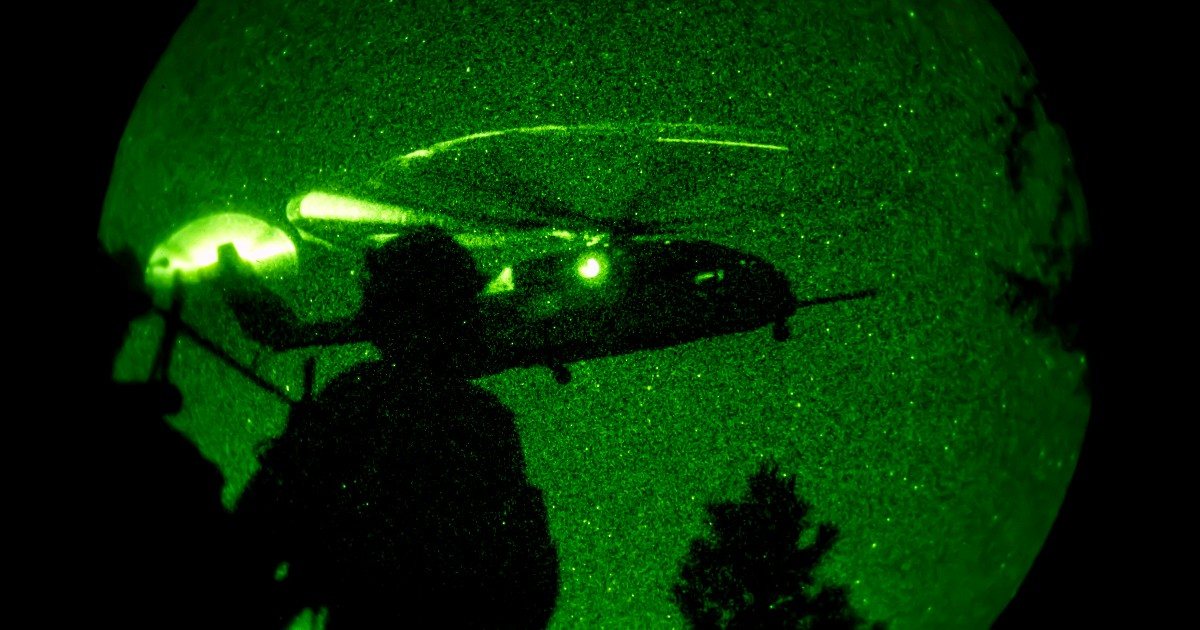
The U.S. Department of Defense released images on Monday of night assault drills conducted by Marines from the 26th Marine Expeditionary Unit (26 MEU) at Camp Lejeune, North Carolina, in a drill that accurately replicates the tactics used nine months ago to capture Nicolás Maduro in Venezuela.
According to the official statement from the Department of Defense, the Marines practiced airborne insertions from a CH-53K King Stallion helicopter and the neutralization of targets under limited visibility, using night vision equipment. The images, captured with the same devices, show the complete sequence: descent from the aircraft and tactical entry into structures in total darkness.
The CH-53K is the most capable heavy-lift helicopter in the Marine Corps: it can transport up to 27,000 pounds over a range of 110 nautical miles, operates with full compatibility for night vision, and maintains a stationary position with an accuracy of about one foot in low light conditions, critical features for high-precision assault operations.
Exercise does not happen in a vacuum. Operation "Absolute Resolution", carried out on January 3, 2026, captured Maduro during a night raid with helicopters from the 160th Special Operations Aviation Regiment and Delta Force commandos.
Months earlier, the 22nd Marine Expeditionary Unit had been operating in the Caribbean for nearly ten months in preparation for that mission, and the U.S. built a replica of Maduro's residence to rehearse the assault.
Now, the 26 MEU is in the final phase of its preparation cycle for an autumn deployment associated with the Kearsarge Amphibious Ready Group, with the USS Kearsarge as the lead ship. The unit had already completed an amphibious assault rehearsal with amphibious combat vehicles on September 16 and live-fire mechanized training earlier that month.
The geopolitical context renders these exercises more than just routine training.
The Trump administration has maintained increasing and multidimensional pressure on the Cuban regime throughout 2026: over 240 sanctions since January, blocking shipments of Venezuelan oil, pressuring Mexico to reduce energy supplies, and deploying the USS Nimitz strike group in the Caribbean in May.
In June, Trump explicitly compared the geographical proximity of Cuba to that of Venezuela to suggest that a similar action would also be feasible.
When asked in April about a possible military action against Cuba, Trump responded with a statement that left all options on the table: «It depends on your definition of military action».
In August, reports attributed to Bloomberg indicated that Washington prioritized financial isolation over a special forces operation. And on September 26, Trump publicly ruled out immediate military action against Cuba, although he did not completely close that option.
The nighttime exercises of the 26 MEU, prominently published by the Department of Defense, can be interpreted as a signal that the U.S. armed forces maintain and refine the necessary capabilities for such operations, regardless of what the ultimate objective may be.
Related videos:
Filed under: