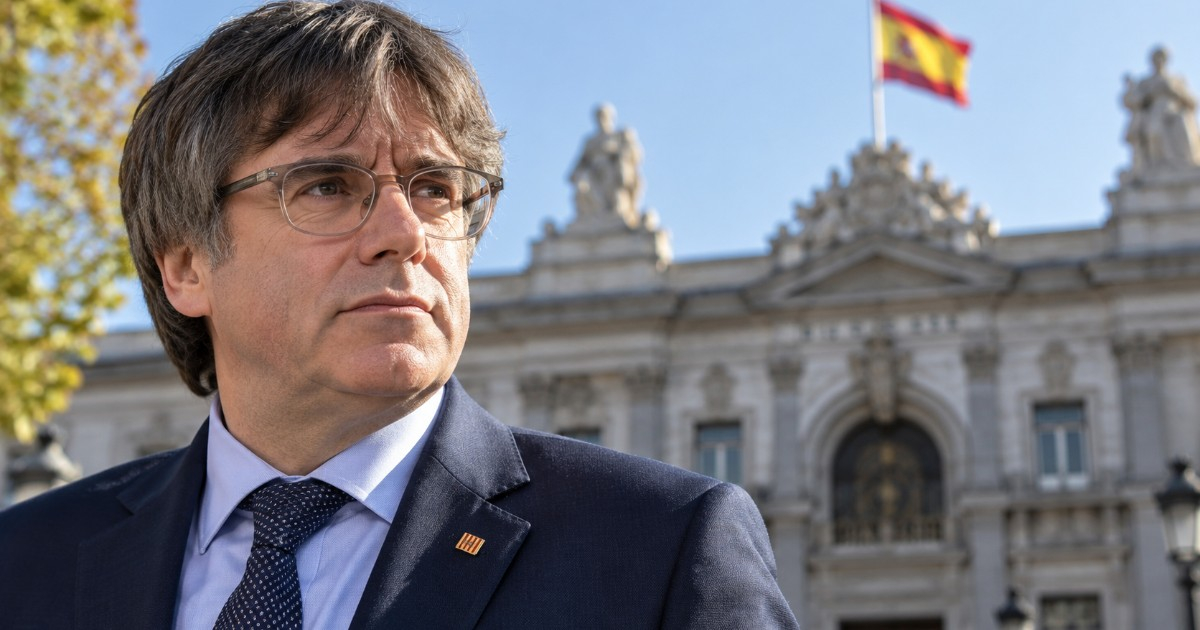
Carles Puigdemont, one of the most well-known and controversial figures in Spanish politics over the past decade, can return to Spain for now without being arrested in connection with the legal case related to the Catalan independence movement of 2017.
The magistrate of the Supreme Court, Pablo Llarena, immediately annulled the national orders for search, capture, and detention that were in effect against the former president of Catalonia, as well as against former councilors Antoni Comín and Lluís Puig.
La decisión llega después de que el Tribunal Constitucional estimara el recurso de amparo de la exconsejera catalana Dolors Bassa contra la negativa del Supremo a aplicarle la Ley de Amnistía por el delito de malversación de caudales públicos.
The Constitutional Court officially confirmed on October 6 that it had sided with Bassa in that legal dispute, a decision that may have direct consequences for other independence leaders whose legal situations stem from the same events.
But there is an important clarification: Puigdemont has not yet received a definitive application of the amnesty in his own case.
Llarena suspended the arrest warrants until a new judicial resolution is issued, while he thoroughly examines the Constitutional Court's ruling and determines how it should be applied to the case of the former Catalan president.
Who is Carles Puigdemont?
Carles Puigdemont was the president of the Generalitat of Catalonia from 2016 to 2017 and became the main institutional face of the movement that sought to separate Catalonia from Spain during those years.
He remains a central figure in Junts per Catalunya, an independentist party that has played an important role in Spanish national politics and was instrumental in securing the votes necessary for Pedro Sánchez's investiture as president of the Government in 2023.
To understand why Puigdemont has been out of Spain for nearly nine years, we must go back to the political crisis of 2017.
The independence referendum of 2017
The Catalan government led by Puigdemont launched a referendum on the independence of Catalonia on October 1, 2017, despite it having been suspended by the Spanish Constitutional Court.
After the vote, Puigdemont argued that the result granted a mandate to establish a Catalan republic. CiberCuba then reported that the independentist leader publicly accepted the mandate to transform Catalonia into an independent state, although he initially requested to suspend its effects in an attempt to open negotiations.
The conflict continued to escalate, and the Catalan Parliament approved a unilateral declaration of independence on October 27, 2017.
The Spanish government, then led by Mariano Rajoy, responded by invoking Article 155 of the Constitution, dismissing the Catalan executive and calling for regional elections.
Why did Puigdemont go to Belgium?
A few days after the declaration of independence, the Prosecutor's Office filed charges against Puigdemont and other members of his government for offenses that at the time included rebellion, sedition, and embezzlement of public funds.
Puigdemont left Spain for Belgium at the end of October 2017, along with several former members of his government.
CiberCuba reported at that time that the former Catalan president had settled in Belgium following the actions of the Spanish Prosecutor's Office.
Since then, Puigdemont has carried out much of his political activity from outside Spain, primarily from Belgium, and he was not tried alongside other leaders of the independence movement because he was not available to the Supreme Court.
Other leaders of the 'procés' were indeed judged
In October 2019, the Supreme Court convicted several independentist leaders who remained in Spain.
Oriol Junqueras received a sentence of 13 years in prison, while other former members of the Catalan government, such as Raül Romeva, Jordi Turull, and Dolors Bassa, were sentenced to 12 years, in those cases for sedition in conjunction with embezzlement.
Spanish legislation was later changed, and the crime of sedition was removed from the Criminal Code, while the regulations regarding embezzlement were also modified.
For Puigdemont, the main criminal obstacle that continued to uphold the arrest warrant ended up being precisely the accusation of embezzlement of public funds.
The Amnesty Law changed the landscape
After the general elections of 2023, the PSOE needed parliamentary support from Junts to secure the investiture of Pedro Sánchez.
One of the central elements of the subsequently reached political agreement was the approval of an Amnistía Law intended to extinguish responsibilities related to the Catalan independence process.
The Organic Law 1/2024 on Amnesty came into effect in June 2024.
However, its application to certain embezzlement offenses sparked a legal battle.
Judge Llarena and subsequently the Criminal Chamber of the Supreme Court understood that the embezzlement attributed to Puigdemont fell outside the scope of the amnesty and upheld their national arrest warrant.
The Supreme Court itself explained at that time that it considered there were exceptions provided for in the law related to asset gains and the financial interests of the European Union.
What just changed?
The turnaround occurred on October 6, 2026.
The Constitutional Court upheld the appeal filed by Dolors Bassa against the resolutions that had denied the application of amnesty for the crime of embezzlement.
Although the resolution directly refers to Bassa, Llarena believed that the legal issue discussed could also affect the basis used to uphold the arrest warrants against Puigdemont, Comín, and Puig.
For this reason, he/she decided to render them invalid immediately.
In practical terms, as long as that decision remains in effect, Puigdemont can enter Spanish territory without the police executing the arrest warrant related to this case against him.
That doesn't mean the case is closed yet
The difference is important.
The judge has not yet definitively declared Puigdemont's criminal liability extinguished nor has he issued a final resolution personally applying the amnesty to him.
The withdrawal of the order will remain in effect until a new judicial decision is made, once the Supreme Court can analyze in detail the complete reasoning of the Constitutional Court.
Therefore, the change currently allows Puigdemont to return without being arrested for the 2017 proceedings, but a definitive legal resolution regarding his situation is still pending.
A decision that comes during the Spanish electoral campaign
The moment also adds a strong political dimension to the case.
Spain will hold early general elections on November 29, after President Pedro Sánchez decided to dissolve Congress and the Senate.
The Royal Decree 806/2026 published in the Official State Bulletin officially confirmed the date of the elections.
CiberCuba reported this week about the advance of the Spanish elections to November 29.
Puigdemont has not yet confirmed when he will return to Spain. His potential return, after nearly nine years living abroad, occurs in a context where Junts once again has a significant role in the national political debate.
Why this matter is also of interest to Cubans
This year's Spanish elections hold particular significance for the Cuban community.
Numerous Cubans hold Spanish citizenship, and others have recently acquired it through the Democratic Memory Law, commonly known as the Grandchildren's Law.
CiberCuba published a guide for Spanish citizens living in Cuba who wish to participate in the elections on November 29.
The potential return of Puigdemont thus introduces another significant element into a Spanish electoral campaign that was already marked by issues such as housing, immigration, the relationship between the central government and the independence parties, and the future of the parliamentary majority that emerged after the 2023 elections.
For now, the immediate consequence is much more concrete: for the first time in years, Carles Puigdemont can return to Spain without being detained for the procés, although the judicial chapter of the amnesty is still not definitively closed.
Related videos:
Filed under: