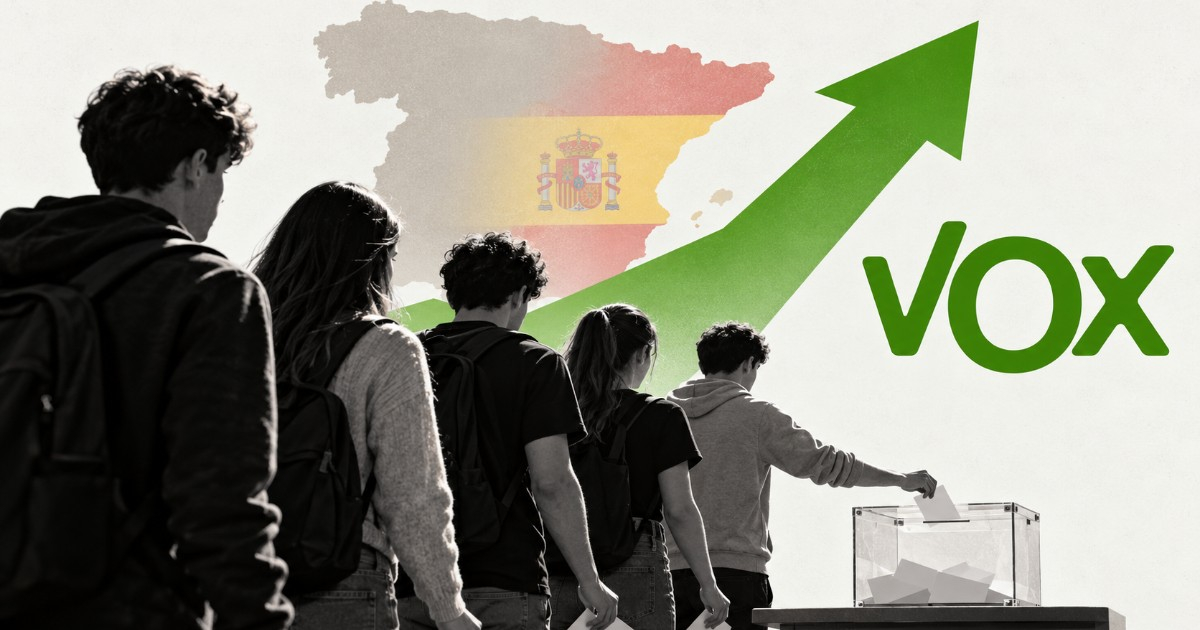
Vox is gaining ground among some of the younger and lower-income sectors of Spanish society, a significant shift in the political landscape of the country less than two months before the general elections on November 29.
For an audience that is not very familiar with Spanish politics, this information requires context: Vox is the party led by Santiago Abascal, positioned to the right of the Popular Party (PP) and focused on, among other issues, severely restricting immigration, reducing taxes and regulations, strengthening the territorial unity of Spain, and establishing what it calls "national priority" in certain public policies.
In the general elections of July 2023, Vox received 3.03 million votes, 12.39% of the total, and 33 deputies in Congress.
Three years later, the surveys show greater support, but the novelty lies not only in how much it has grown but also in who is starting to vote for the party.
Vox is growing especially among those under 35 years old
An analysis published by El País based on the barometers of the Center for Sociological Research (CIS) reveals one of the most striking demographic changes since the 2023 elections.
Among voters aged 18 to 24, Vox would have increased its support by about seven or eight points, standing at around 26%, practically tied with the PP and ahead of the PSOE, which is around 22% in that group.
The progress is even more evident among those aged 25 to 34: Abascal's party approaches 30% support and emerges as the top choice in that demographic in the analysis.
That does not mean that three out of ten young Spaniards will necessarily vote for Vox on November 29. It is an estimate based on surveys, and like any demographic analysis, it may change during the campaign.
The unexpected fact: it is also growing among young women
Vox has traditionally had a more male than female electorate, but the data shows that this picture is also changing.
Crossing age and gender, the analysis of CIS data concludes that Vox has nearly doubled its support among women aged 18 to 44 compared to 2023.
The growth among young women is particularly significant because historically, that has been one of the groups where Abascal's party faced the greatest challenges in expanding its voter base.
The phenomenon does not eliminate the gap between men and women. The latest poll from 40dB. shows that Vox continues to have significantly greater support among men, but it confirms that its expansion is no longer occurring exclusively within that voter base.
Vox is also gaining ground among lower-income groups
Another significant change emerges when analyzing household income.
According to the same study of the CIS barometers, Vox would have increased by approximately eight points among people living in households with incomes below 1,100 euros monthly.
In that group, support for the party would be around 21%.
Among households with more than 5,000 euros per month, on the other hand, the growth would have been about four points, and support would be around 16%.
The trend partially overturns the notion that Vox's growth comes solely from affluent sectors or traditional conservative voters: the party is also making inroads among segments that are directly affected by issues such as low wages, housing costs, or difficulties in gaining independence.
Does that mean that these problems explain the vote for Vox?
Not necessarily.
Surveys allow us to observe that two phenomena occur simultaneously, but they do not, on their own, demonstrate what causes a person to change their vote.
There is indeed a correlation between some of the issues that particularly affect younger generations and the topics that Vox has placed at the center of its political discourse.
Santiago Abascal's platform places a strong emphasis on housing, immigration, taxes, the cost of living, and the challenges young people face in starting a family or buying a home.
In the area of housing, for example, Vox has proposed eliminating taxes associated with the purchase of the first home, liberalizing land, and reducing administrative procedures.
The party also associates part of the pressure on housing and public services with immigration and advocates for policies aimed at the expulsion of undocumented immigrants and what it refers to as "remigration."
After the announcement of the electoral advance, Abascal summarized the main pillars of his party as “national priority, deregulation, and remigration”.
These are positions advocated by the party itself. Explaining all or part of the growth among young voters would require specific studies on the motivations of those voters.
What sets Vox apart from the PP?
For those following Spanish politics from Cuba, it may be helpful to distinguish between the two main forces in the political right.
The Popular Party (PP), led by Alberto Núñez Feijóo, is one of the two major traditional political parties in Spain and has governed the country at various times.
Vox, led by Santiago Abascal, was founded much later and holds tougher positions than the PP on immigration, territorial organization, nationality policies, and various social issues.
It also proposes a deeper reduction in the size of administrations, a significant tax cut, and a recentralization of powers currently managed by the autonomous communities.
The movements between both electorates are now significant. The data from the CIS used in the analysis shows that the PP is losing support especially among individuals who identify more to the right ideologically, precisely where Vox is achieving its greatest gains.
Vox jumps from 12.39% in 2023 to around 17%-18% in the polls
Growth also appears when looking at the overall electorate.
Vox received 12.39% of the votes and 33 representatives in the general elections on July 23, 2023.
The latest barometer from 40dB., conducted through 2,000 interviews between September 25 and 28, currently places the party at a 18.4% voting intention.
In that same survey, the PP registers 31.6% and the PSOE 27.4%.
The CIS offers a different perspective. Its September barometer, based on 4,042 interviews conducted between September 1 and 4, placed the PSOE at 31%, the PP at 25.5%, and Vox at 16.6%.
The difference between the two studies also serves to remind us of something important: a survey is not an electoral result.
The polling institutes use different samples and methodologies, and their estimates can vary by several points. However, in this case, both agree on a basic trend: Vox is performing above the result it obtained in the 2023 elections.
The elections will be on November 29th
Spain will hold early general elections on Sunday, November 29, 2026.
The date is now officially set in the Royal Decree 806/2026 published in the Official State Gazette, which dissolved the Congress of Deputies and the Senate.
In Spain, citizens do not directly elect the Prime Minister as is the case in presidential systems.
In the elections, the 350 members of Congress are elected. Subsequently, Congress must appoint a candidate as the head of government.
The absolute majority is 176 deputies, so when no party reaches that number on its own, agreements, coalitions, or parliamentary support are necessary.
This helps to understand why the voting percentage of a third party like Vox can have considerable political importance, regardless of whether it finishes first, second, or third.
What does all of this have to do with Cubans?
This year's Spanish elections hold special interest for the Cuban community due to the number of individuals born in Cuba who also hold Spanish citizenship, including many who acquired it through the Democratic Memory Law, commonly referred to as the Grandchildren's Law.
Cuban nationals who hold Spanish citizenship have the same electoral rights as any other Spanish citizen, provided they meet the necessary registration requirements.
Precisely, an open consultation by CiberCuba aimed at Cubans with Spanish nationality positioned PSOE and Vox as the two options with the most responses.
At the end of that note, the PSOE accounted for 32.3% of the 1,225 responses counted, while Vox had 28.6%. Vox led the consultations conducted on X and Facebook, while the PSOE held a significant advantage on WhatsApp.
Those percentages cannot be directly compared to national surveys in Spain. The CiberCuba poll was voluntary, conducted among its own audience and without a representative demographic sample.
Its usefulness lies in showing the preferences expressed by a part of the Cuban community with Spanish citizenship, not in predicting how all Spaniards or all Cuban-Spaniards will vote.
CiberCuba also published a guide for Spanish citizens living in Cuba who wish to vote on the upcoming November 29.
The campaign has only just begun
There is another important temporary precaution.
The fieldwork for the latest 40dB survey was completed on September 28, more than a week before the formal call for the snap elections.
Therefore, those data do not yet measure how the electorate has reacted to Pedro Sánchez's decision to call for elections or to the political events that occurred afterward.
What the studies accumulated during 2026 do show is a deeper transformation: Vox has increased its support since 2023, and this progress is particularly intense among young people, young women, and citizens with lower incomes.
It remains to be seen whether this trend will continue over the next few weeks and, above all, how much of it will ultimately translate into votes when the Spaniards head to the polls on November 29.
Related videos:
Filed under: