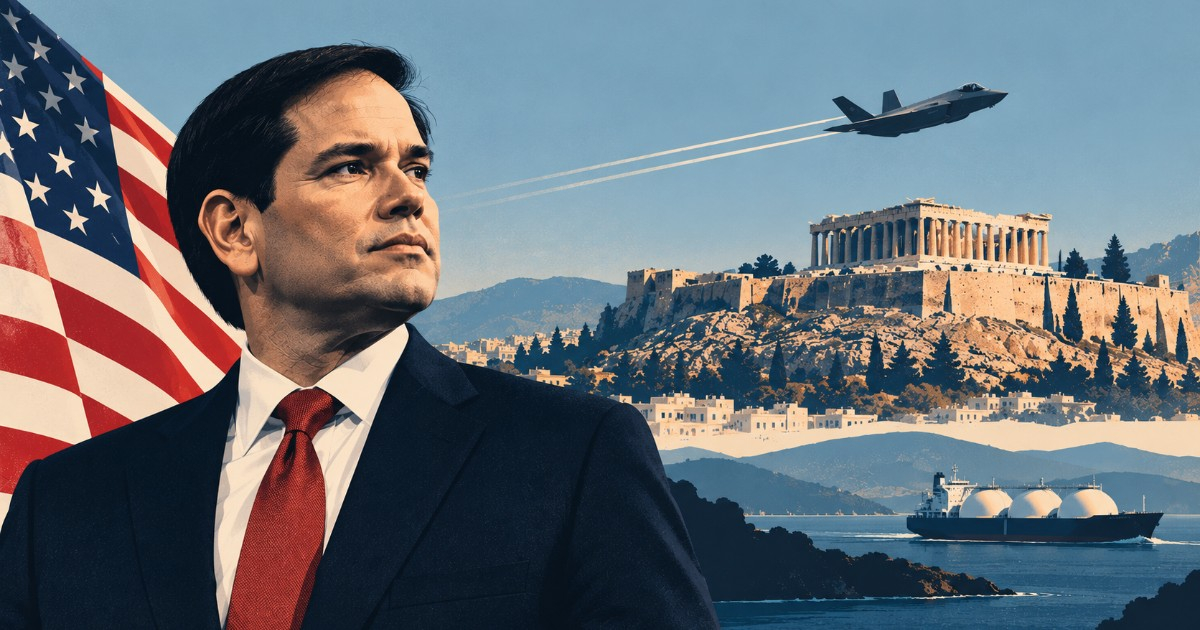
The U.S. Secretary of State, Marco Rubio, began his official meetings in Athens this Wednesday with an agenda focused on defense, energy, regional security, and economic cooperation, before delivering a speech with significant symbolic weight about the future of the West from one of the sites associated with the birth of Athenian democracy.
Rubio was welcomed at the Greek Ministry of Foreign Affairs by his counterpart, Giorgos Gerapetritis, with whom he held a bilateral meeting before the opening of the sixth round of the Strategic Dialogue between Greece and the United States.
The Ministry of Foreign Affairs of Greece officially confirmed that both ministers would lead the meeting and the first plenary session of the bilateral dialogue.
The visit has a practical dimension—military bases, combat aircraft, natural gas, and security in the Mediterranean—but it also has an ideological and political aspect.
Later, Rubio is scheduled to address Americans and Europeans from the Pnyx in Athens to call for what the State Department has defined as a "great renewal of the Western spirit."
What is Marco Rubio doing in Greece?
Rubio, the son of Cuban immigrants and the current head of U.S. diplomacy, arrived in Athens on Tuesday from Iceland as part of a European tour that also includes Portugal.
This is his first official visit to Greece as Secretary of State.
Before arriving, he referred to Greece as a "very important ally" of the United States and emphasized both the U.S. military presence and the strong economic ties between the two countries.
The meeting this Wednesday is part of the so-called Greece-United States Strategic Dialogue, a mechanism created in 2018 to periodically coordinate issues of defense, security, economy, energy, technology, and foreign policy.
This is your sixth round.
Why Greece is so important to the United States
For an audience that is not very familiar with European geopolitics, Greece's significance goes far beyond its economic weight or tourist appeal.
The country occupies a strategic position between Europe, the Balkans, the Eastern Mediterranean, the Black Sea, the Middle East, and North Africa.
Furthermore, Greece and the United States are members of NATO.
The island of Crete is home to the naval base of Souda Bay, used by U.S. and allied forces and regarded as a key facility for operations in the Mediterranean.
Further north, the port of Alexandroupoli has become an important logistical hub for transporting military equipment and supplies to Eastern Europe.
Military cooperation has become even more significant due to the wars and tensions currently affecting Europe and the Middle East.
F-35 and modernization of the Greek forces
One of the symbols of that relationship is the purchase of American combat aircraft.
Greece signed in 2024 for the acquisition of 20 F-35A fighter jets, with the option to request an additional 20 in the future.
The Greek Ministry of Defense confirmed this year that the first F-35 destined for the country will be delivered in the United States in 2028.
Athens is also modernizing its fleet of F-16s to the Viper standard as part of a broader program to enhance its air capabilities.
Military cooperation is not an abstract issue for Washington at this time.
CiberCuba reported this Wednesday that Rubio stated that the United States has confidence in the security of its military bases following recent threats against U.S. facilities in Europe related to tensions with Iran.
This scenario makes Mediterranean allies like Greece important pieces in the U.S. security strategy.
Energy, another focus of the visit
The second major issue is energy.
Greece is trying to establish itself as a hub for the entry and distribution of natural gas to the Balkans and Eastern Europe.
The wars in Ukraine and Iran, along with disruptions affecting energy routes, have strengthened Europe's search for alternative suppliers and corridors.
Part of that strategy involves receiving U.S. liquefied natural gas at Greek terminals and then transporting it to other European countries.
For Washington, this infrastructure opens markets for U.S. gas and helps reduce Europe's dependence on energy sources considered vulnerable from a geopolitical perspective.
U.S. companies are also involved in energy exploration projects in Greek waters.
A message for all of Europe from the cradle of democracy
However, the most symbolic moment of the day is expected to take place outside the official offices.
Rubio is scheduled to deliver a speech at the Pnyx, a hill located opposite the Acropolis where the assembly of citizens of ancient Athens used to gather.
The place is directly associated with the early development of Western participatory democracy.
According to the advance provided by the State Department and reported by Associated Press, Rubio will call on Americans and Europeans to join in a “great renewal of the Western spirit”.
The central idea is to reclaim a heritage that Washington traces from Athens and Rome, through the European Christian tradition, to the founding of the American Republic.
The Secretary of State aims to uphold values such as democracy, intellectual curiosity, political courage, and the ability of Western societies to innovate and compete.
What does "renewal of the Western spirit" mean?
The concept is part of a broader debate within the current U.S. administration regarding relations between the United States and Europe.
Rubio has argued that both sides of the Atlantic share a common historical and cultural foundation, but he has also questioned some European political and social trends.
In previous interventions, issues such as mass immigration, freedom of expression, security, and the loss of trust of Western societies in their own institutions have been addressed.
His speech in Athens aims to place those concerns within an increasingly competitive global landscape with powers like Russia and China.
The expected message is that the United States and Europe may differ on certain policies, but they continue to share strategic interests and fundamental values.
Rubio is betting on strengthening the transatlantic relationship
The intervention will also be closely monitored as it comes after several episodes of tension between Washington and some European capitals.
The Trump administration has pressured European NATO members to increase their military spending and take greater responsibility for their own defense.
At the same time, American leaders have criticized European policies on issues such as immigration, regulation, and freedom of expression.
Rubio has adopted a tone during this tour that combines those criticisms with a defense of existing alliances.
In Iceland, the previous stop on his European tour, he emphasized the importance of diplomatic cooperation and maintaining close relationships with allies.
Greece is also seeking benefits from the alliance
According to the Greek Government, deepening the relationship with the United States offers military, energy, and economic advantages.
Athens seeks to attract investments, establish itself as a regional energy hub, and modernize its armed forces.
It also aims to strengthen its influence in the Eastern Mediterranean, a region characterized by maritime disputes, energy interests, and historical tensions with Turkey.
Washington, for its part, gains access to military and logistical infrastructure in an area that is especially important for operations towards Eastern Europe, the Middle East, and North Africa.
The visit also provokes protests
The presence of the Secretary of State has not been received unanimously in Greece.
Thousands of protesters gathered in Athens on the eve of their official meetings to protest against U.S. foreign policy, particularly regarding conflicts in the Middle East.
The Greek police deployed a strong security presence and implemented traffic restrictions during the visit.
The protests reflect a long-standing tradition among certain sectors of Greek society that are critical of U.S. foreign policy, even as the governments of both countries have progressively deepened their military and economic cooperation.
A visit with two messages
Rubio's journey in Athens thus combines two dimensions.
The first is specific: more military cooperation, regional security, energy, and investments between the United States and Greece.
The second is much broader: to use the historical setting of Athens to pose what the United States and Europe should represent in an era marked by wars, competition among great powers, and internal questioning of their own institutions.
By the time this note was concluded, Rubio had already begun his meetings with Gerapetritis and participated in the opening of the Strategic Dialogue.
His speech from the Pnyx, scheduled for later this Wednesday, will be the moment when he publicly elaborates on that call for the "renewal of the Western spirit."
Related videos:
Filed under: