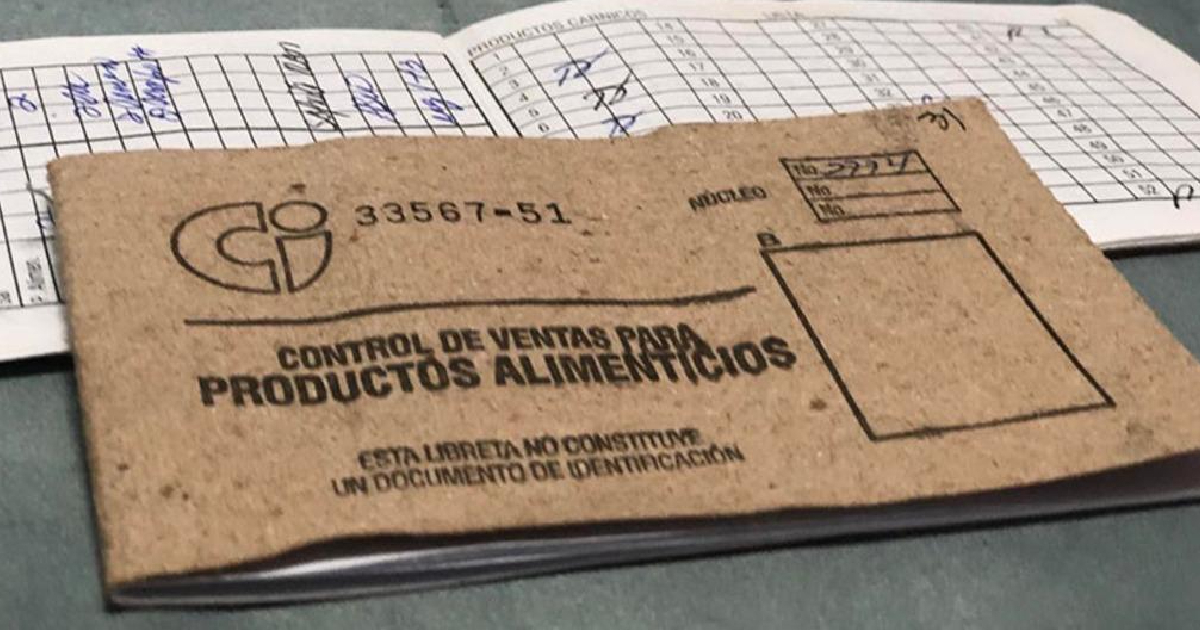
The ration book, for decades one of the most recognizable symbols of the Cuban socialist model, seems to be entering its final phase: an exploration by the AFP agency in different areas of Havana found closed bodegas, practically empty, or transformed into the new "neighborhood markets", while the regime continues to dismantle the system of universal subsidies without formally announcing its disappearance.
AFP visited several points in the Cuban capital this Monday and observed that in recent days consumers had been unable to purchase products using the ration book.
The journey provides a verification on the ground of a process that the regime has been announcing in a fragmented manner: the replacement of universal subsidies with targeted assistance for specific groups considered vulnerable and the conversion of the old state network of bodegas.
In the Havana neighborhood of Cerro, Paula Sonia Santiago, 64, summed up to AFP what she observes around her: “Whether we want to understand it or not, they are burying it”, she said about the traditional grocery store.
"It's a total change," he added. According to his testimony, many Cubans are facing with concern the disappearance of a system they've been accustomed to for practically all their lives.
The concern is especially evident among retirees and low-income individuals. América Guillén, 82 years old, recalled that even during the periods of greatest scarcity, the ration book allowed for guaranteeing “a minimum” of food “for those of us who have very little.”
The expanded version of the report from AFP published in Brazil indicates that Guillén receives a minimum pension of 3,000 pesos per month and claims that the poorest sectors are facing serious difficulties in obtaining food outside the subsidized system.
During the past few months, according to the agency's reports, the stores were offering practically only rice and sugar through the ration book, while the rest of the food had to be purchased at state-run stores in foreign currency, private businesses, or other markets with significantly higher prices.
The gradual disappearance of products from the ration book did not start now. The system has deteriorated over decades, with successive reductions of subsidized items, until it reached its bare minimum in the midst of the current economic crisis.
The Prime Minister Manuel Marrero himself had clearly stated that the official policy is to gradually abandon the generalized subsidy of products and move towards "subsidizing individuals" considered vulnerable.
The change became even clearer this weekend when Marrero announced a monthly food allocation for 883,000 Cubans classified as the most vulnerable: five pounds of rice, one of sugar, and another of grains.
The new scheme breaks away from the logic that governed the ration book for decades, whereby certain subsidized products were allocated to all registered consumers regardless of their income.
Meanwhile, the regime began to reconvert warehouses, butcher shops, and other state establishments into so-called "neighborhood markets", whose management could even be in the hands of private actors.
AFP notes that 24 establishments of that kind were already in operation, selling around twenty basic products at prices that are 10% to 15% lower than those in the private sector. However, this difference proves to be insufficient for many consumers with depreciated salaries and pensions.
«It’s not that it’s cheaper; it’s just that it’s less expensive than in other markets,» summarized a 75-year-old retiree to AFP after buying a dozen eggs in one of these establishments.
Criticism had already begun before the agency's tour. At the end of September, a Cuban found only five products available in one of the new neighborhood markets in Havana and questioned how retirees and pensioners with incomes far below the price of food could buy there.
The situation occurs, furthermore, in a country where an independent study by the Centro Cristiano de Reflexión y Diálogo-Cuba recently estimated that 66% of the population lives in economic poverty, approximately 6.4 million people. The research indicates that their income is insufficient to cover minimum food and other essential needs.
The figure helps to gauge the impact that the transition from a subsidized quota, which is increasingly reduced and irregular, to markets where food is sold at prices close to those in the private sector, may have.
The dismantling is not a sudden decision either. In June, the authorities had already made progress in reducing the rationing system, as part of the official policy to eliminate widespread subsidies and direct resources towards selected sectors.
The ration book was implemented in Cuba in 1962, when the Government legally established the rationing system.
In 1963, the distribution structure was consolidated, which operated for decades through warehouses and control offices. Since then, the ration book became one of the most recognizable economic institutions of the Revolution and allowed for the purchase of predetermined quantities of food and other products at heavily subsidized prices.
Over the years, however, deliveries became increasingly insufficient, incomplete, and delayed, while numerous products gradually disappeared from the regulated basket.
AFP now presents a particularly graphic image of that transformation: closed warehouses, consumers who are no longer receiving practically anything through the ration book, and former state establishments turned into markets where products must be purchased at prices much closer to commercial rates.
So far, the Cuban regime has not officially declared the supply booklet abolished. However, the combination of the extreme reduction of its products, the closure or conversion of stores, and the new scheme directed solely at certain vulnerable sectors indicates that the universal system that has defined the daily life of Cubans for decades is being progressively dismantled.
Related videos:
Filed under: