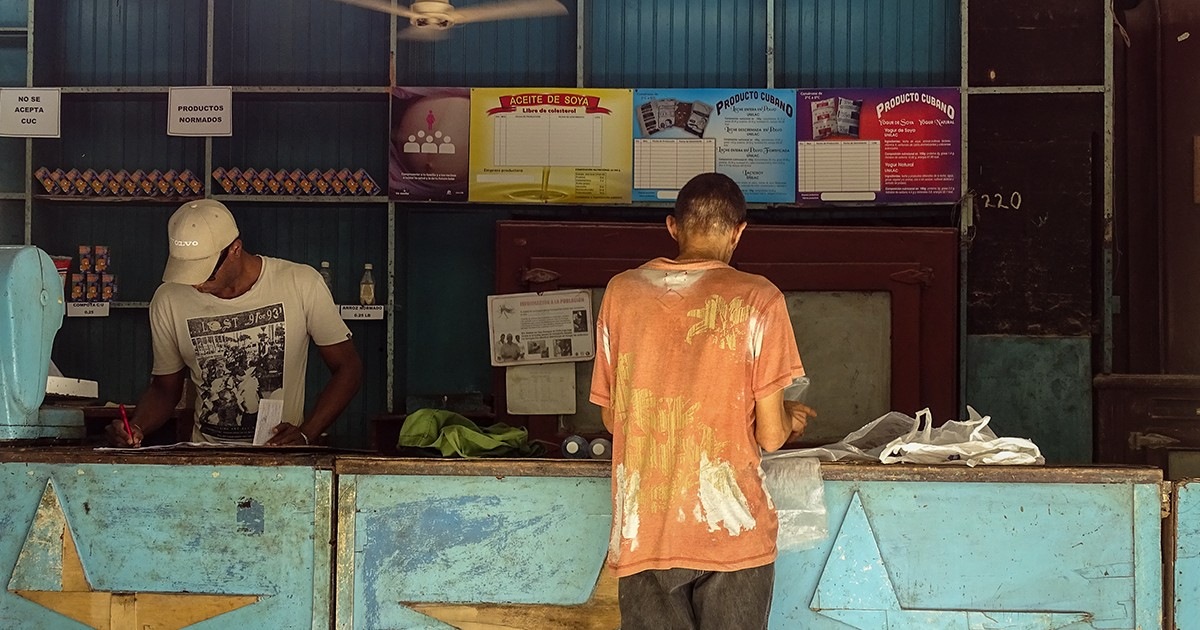
The Cuban government has selected 1,913 stores from a network of over 12,000 establishments to assist those in situations of greater vulnerability, while continuing to promote the transformation of part of the state commerce through the so-called neighborhood markets.
The figure represents approximately 16% of the national network of bodegas and raises an important question for millions of consumers: What will happen to the more than 10,000 remaining establishments?
The information was provided by Marpessa Portal de Villiers, General Director of Merchandise Sales at the Ministry of Domestic Trade (MINCIN), during an intervention on the Haciendo Radio program of Radio Rebelde, as reported by the agency in an official Facebook post.
The official specified that not all bodegas will be converted into neighborhood markets and cited as an example the network of 1,913 selected establishments designated to assist individuals with greater needs.
However, MINCIN did not specify what will happen to the rest of the warehouses, how many will retain their traditional functions, or which ones will be converted under the new commercial modalities.
What will happen to the more than 10,000 remaining bodegas?
The MINCIN statement confirms that there is a selection of establishments to serve vulnerable individuals, but it does not imply that the government has announced the closure of all remaining bodegas.
At the moment, the authorities have not presented a national schedule for reconversion nor a list of the stores that will continue distributing products through the rationing booklet.
Meanwhile, the regime is advancing the expansion of neighborhood markets, a model that allows for the management of state-owned commercial establishments to be handed over to various economic actors.
According to Portal de Villiers, there is currently a network of 47 neighborhood markets in Cuba.
These establishments can be managed by companies, micro, small and medium-sized enterprises (mipymes), non-agricultural cooperatives, self-employed workers, foreign investment modalities, and other authorized actors.
The award of its management is carried out through a simplified bidding procedure, approved by the company that has the property under its use and administration. As the official explained, priority is given to economic actors based in the municipality itself.
The model includes tax incentives and exemptions from rent payments for the managers, related to the marketing of the products included in the officially defined offer.
The Ministry states that these benefits should help increase the variety of goods and reduce retail prices.
The transformation has precedents in various provinces. In September, CiberCuba reported on a call to hand over the management of 16 bodegas in Santa Clara to private managers, with incentives that included up to two years of rent exemptions.
The MINCIN announces the distribution of free rice and other food items
During his speech, Portal de Villiers also provided information on the distribution of a food module that has begun to be delivered in various regions of the country.
According to the official publication from MINCIN, the module contains:
Five pounds of rice from a donation from China, which are being provided free of charge.
One pound of sugar, which must be paid.
A pound of peas, also with a cost to the consumer.
The distribution began in Pinar del Río, Artemisa, La Habana, Matanzas, Cienfuegos, Villa Clara, Sancti Spíritus, Holguín, Santiago de Cuba, and Guantánamo, as well as in the special municipality of Isla de la Juventud.
In the case of Mayabeque, the ministry reported that the delivery has already been completed.
Additionally, the official announced the distribution of one kilogram of black beans from a donation in four provinces: Havana, Holguín, Santiago de Cuba, and Guantánamo.
The statement did not specify the prices that consumers will have to pay for sugar and peas, nor did it outline the delivery conditions for black beans.
It also did not specify a timeline by municipalities, the total number of beneficiaries, or whether these modules will be distributed exclusively among individuals identified as vulnerable.
The information is especially important in a context of food shortages, delays in the distribution of the standardized family basket, and economic difficulties for many Cuban households.
Who will have priority in neighborhood markets?
The General Director of Merchandise Sales explained that neighborhood markets can implement regulated sales mechanisms aimed at individuals in greater vulnerability, prioritized age groups, and pregnant women.
These modalities will depend on product availability, demand, prices, and assessments of territorial and social needs.
This means that the possibility of implementing regulated sales does not equate to guaranteeing a permanent supply of subsidized food in all neighborhood markets.
The new information comes just a few days after Prime Minister Manuel Marrero announced a monthly food distribution program for 883,000 Cubans deemed to be in a state of greater vulnerability.
Marrero's announcement included five pounds of rice, one pound of sugar, and another pound of beans for the beneficiaries identified by the authorities.
However, the MINCIN publication does not explicitly state that the 1,913 selected warehouses are the only establishments responsible for that distribution, nor does it explain how both measures are related.
Neighborhood markets are receiving criticism for their prices
The Cuban regime presents neighborhood markets as an alternative to bring basic products closer to the population and offer lower prices than those of other commercial establishments.
In September, the authorities promised prices that are 15% to 30% lower in these markets, although this difference does not ensure that food will be affordable for those who rely on salaries and pensions in Cuban pesos.
In Contramaestre, Santiago de Cuba, for example, the opening of a neighborhood market showcased products such as rice for 350 pesos, chicken for 750 pesos, and vegetable oil for 2,000 pesos, according to prices published in September.
The experience has also raised questions about the scarcity of goods. In Havana, a consumer documented a neighborhood market with only five products available, in contrast to the image of abundance that authorities promote regarding these establishments.
More recently, an inquiry from official press regarding the markets sparked numerous criticisms from Cubans who questioned the prices, the lack of products, and the absence of these businesses in certain localities.
The complaints reflect a problem that the commercial transformation has failed to resolve: the gap between food prices and the purchasing power of a significant portion of the population.
The uncertainty regarding the supply booklet
The selection of warehouses for vulnerable individuals takes place as the Cuban government continues to modify the food distribution model that operated for decades through the ration book system.
The system, implemented in 1962, allowed for the purchase of certain quantities of products at subsidized prices, although its operation has progressively deteriorated due to shortages and delays in delivery.
Recently, a journalistic tour of Havana revealed closed, empty, or converted bodegas, as consumers voiced concerns over the gradual loss of a distribution mechanism on which many families still rely.
The government is now insisting on concentrating certain resources on individuals identified as the most vulnerable, while promoting new forms of commercial management to try to sustain a deteriorating state network.
However, the information from MINCIN leaves fundamental questions unanswered: how many bodegas will continue to operate, where they will be located, how consumers not included in the assistance programs will be served, and what guarantees will exist to access food at affordable prices.
At the moment, the authorities have not announced the official elimination of the supply booklet or the closure of the more than 10,000 bodegas that are not included in the network designated for vulnerable individuals.
What the new announcement does confirm is that the reorganization of state commerce continues to progress, while millions of Cubans continue to face the same daily problem: obtaining enough food and being able to afford it with their income.
Related videos:
Filed under: