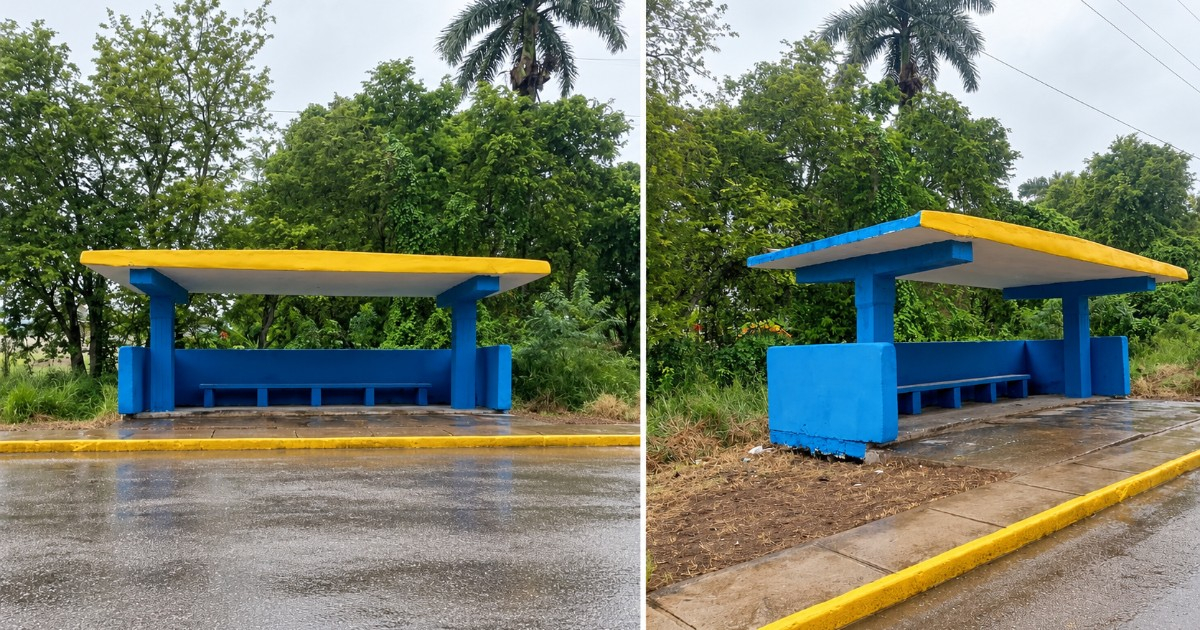
The announcement that bus stops are being repaired in Havana provoked criticism of the authorities' priorities amid the shortage of buses. For many users, improving the facilities where passengers wait makes little sense if the routes and frequencies of public transport are not also restored.
The controversy arose after a post was shared in the Facebook group "Dirección General de Transporte Prov. La Habana." The text, presented as an informative note from the Provincial Transportation General Directorate of Havana, claims that the entity is currently engaged in the "repair of bus stops throughout the city."
The shared announcement does not specify how many facilities will be repaired, which areas will take priority, how much the work will cost, or when it will be completed. It also does not include information about the addition of buses to urban routes, the restoration of frequencies, or the number of vehicles currently in circulation.
Cubans are asking for more buses, not just repaired stops
The response from numerous participants was critical. Some questioned the usefulness of repairing the stops when buses are rarely in service and urged the authorities to prioritize the recovery of vehicles and routes. One commentator asked where the buses that should be using those facilities were.
Another person argued that getting even one bus operational would be more beneficial for passengers than repairing a bus stop. A resident also demanded more transportation and stated that in her area, no buses have been running since mid-2025, presenting this situation as a personal testimony rather than an official statement about that route.
Other comments resorted to irony to question the renovation of facilities where, according to participants, vehicles hardly ever stop. There were also those who requested improvements to the benches, keeping the bus stops clean, and addressing the poor condition of the streets. These observations reflect additional maintenance concerns, although the predominant complaint in the examined comments was the lack of sufficient buses.
A transportation crisis that goes far beyond the stops
The controversy arises in a context of prolonged mobility restrictions in Cuba. The Ministry of Transportation itself acknowledged in May 2026 that state operators had to adjust their services due to the shortage of fuel and lubricants. At that time, Minister Eduardo Rodríguez Dávila indicated that local governments should prioritize essential urban and suburban routes based on available resources.
Plans for vehicle recovery have also been announced. In January, the state press reported on a program to repair one hundred buses intended for transportation in the capital during 2026, including 60 rigid buses and 40 articulated ones. That figure referred to a repair goal, not to a confirmation of one hundred units in operation.
The decline of the fleet was already evident in the images of dozens of abandoned buses at the La Fortuna stop, released in March and reported by CiberCuba. More recently, criticism of an operation against private transporters in Central Havana has reopened the debate on what real alternatives passengers have when state service does not meet their needs.
The problem is not just where to wait, but how to get there
Having safe, clean, and sheltered bus stops from the sun and rain is essential for those who rely on public transportation, especially for the elderly, children, and passengers with mobility difficulties. However, reactions to the announcement indicate that much of the discontent is focused on the lack of vehicles, irregularity of service, and long wait times.
The comments raise a specific demand to the transport authorities in Havana: in addition to informing about the works at the bus stops, they should explain how many buses are in service, which routes are operational, what the frequency is, and what results have been achieved by the fleet recovery programs.
For now, the notice shared on Facebook regarding the repair of bus stops does not answer those questions. The discussion reveals the gap between improving the waiting infrastructure and ensuring the service that Havana residents need for their daily commutes.
Related videos:
Filed under: