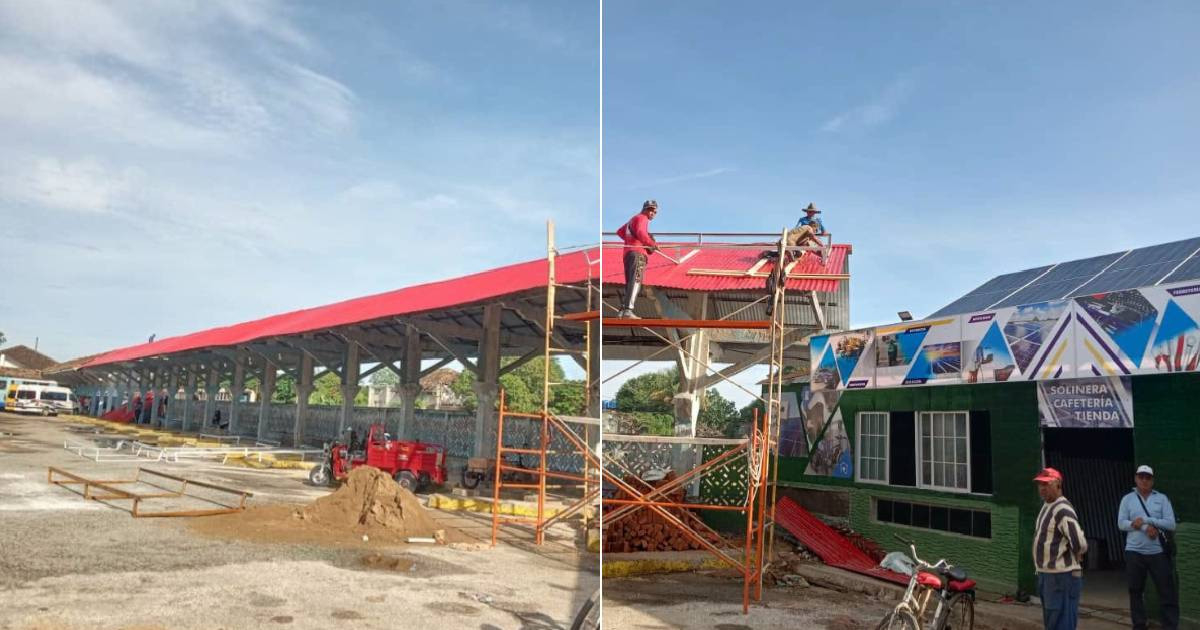
The Ferro-Omnibus terminal in Las Tunas is hosting the construction of the province's first "solinera," while recovery works are progressing in a facility affected by Hurricane Ike in 2008.
The project is jointly executed by the Cardinal Provincial Transport Company and the private micro, small, and medium-sized enterprise Vitalcons, under a collaboration scheme between a state entity and a private actor, reported this Thursday on the Facebook profile of the portal Tiempo 21 of the provincial broadcaster Radio Victoria.
The terminal has not undergone a comprehensive recovery since the damage caused by Ike in September 2008. The hurricane impacted several areas of eastern Cuba and left the facility in deteriorated condition for years.
According to the source, the ongoing investments aim to enhance the conditions of the terminal and the quality of services provided to the public, as well as to incorporate new capabilities for the utilization of renewable energies.
The territory of Tunero has eight photovoltaic solar parks with a theoretical capacity of 64.8 MW, but this infrastructure only provides an average of 2.5 hours of electricity per day per municipality, the provincial Electric Company acknowledged at the end of August.
The situation is even more severe in some territories. Residents in the municipality of Manatí reported outages of more than 24 continuous hours almost every day during September.
The proliferation of "solineras," a Cuban neologism that combines "solar" and "gas station," is part of the official priorities aimed at transforming the energy matrix of the island through the use of clean sources.
They offer basic services such as phone charging and food preparation, sometimes for free, and they charge for refueling motorbikes, tricycles, and cars.
Most of them are operated by private micro, small, and medium enterprises, although the official discourse systematically presents them as part of the state energy policy, while avoiding acknowledgment of the state's share of responsibility that has led to the collapse of the Cuban electrical system.
These facilities are a decentralized response to Cuba's worst energy crisis in decades, worsened since January by the suspension of Venezuelan oil shipments and the halt of Mexican oil exports under pressure from sanctions imposed by the Trump administration.
The model launched in April with the country’s first "solinera," inaugurated in Santa Clara. Since then, it has been replicated with varying intensity in several provinces. The province of Villa Clara already has 50 operational installations, aiming to reach 60 by the end of the year, while Guantánamo has five active points and plans to expand the network to 30.
In eastern Cuba, the province of Holguín was a pioneer in having one of these facilities, the solar charging station El Girasol, whose prices sparked a debate on social media among those who found them fair and others who deemed them excessive compared to the average state salary.
Related videos:
Filed under: