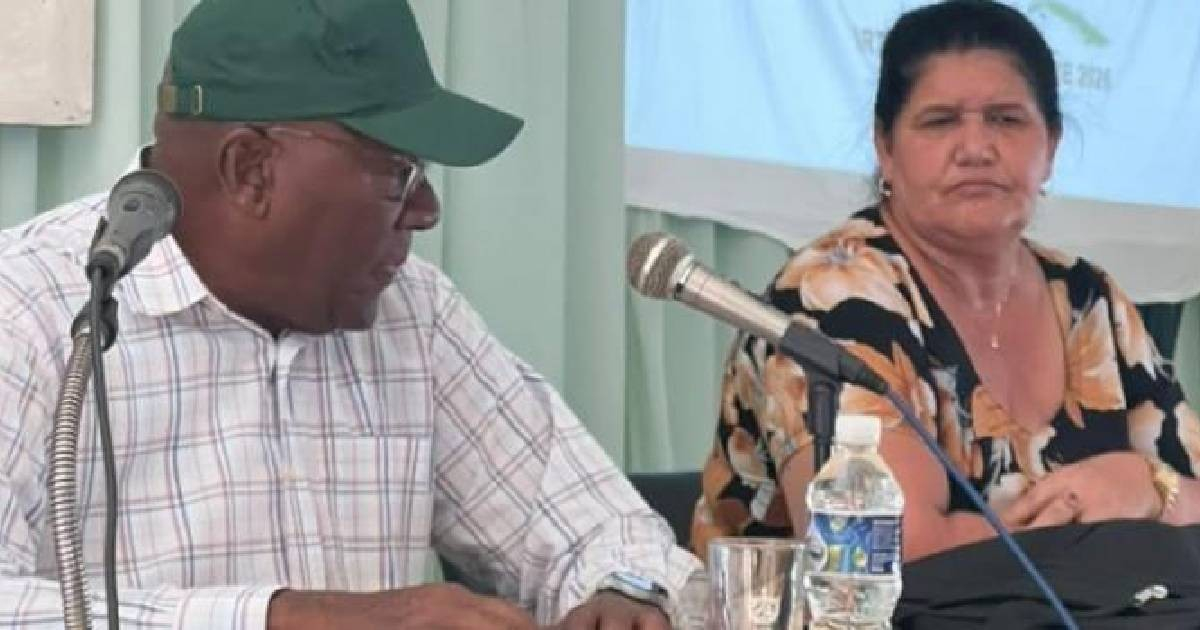
The Cuban vice president Salvador Valdés Mesa chaired a meeting in Matanzas this Wednesday to assess productive strategies and food plans for the remainder of the year, where he urged Cubans to double their efforts in light of the crisis with a phrase that summarizes the state of agriculture on the island: "We must work to overcome the crisis. With creativity, we are resisting and doing well. We will not give up on development and on doing new things, achieving new results in all areas."
The meeting, published by the official Periódico Girón, also featured the participation of Mario Sabines Lorenzo, the first secretary of the Provincial Committee of the Party in Matanzas, who emphasized that state organizations and companies have planted rice for their own consumption as an example that should be extended across the rest of the province.
Valdés Mesa emphasized that all municipalities—not just those that have historically excelled in rice and bean cultivation—must set concrete goals to advance towards food sovereignty.
The data presented in the exchange reveal a picture of systematic noncompliance. For the cold campaign 2026-2027, it was planned to plant more than 500 hectares of beans in Matanzas, but by the end of September, progress had only reached 81%.
The spring corn campaign also fell short of its target, reaching only 80% due to irrigation failures, below-average rainfall, and the producers' inability to afford fuel at current prices.
The obstacles that the regime itself acknowledged are the same ones that recur during every official visit: a diesel shortage, prohibitive fuel prices, blackouts that halt irrigation systems, and pests in crops.
During the meeting, there was also a discussion on how to increase yields in oilseeds such as sesame through the use of scientific talent, and the distribution of products from the ration book to vulnerable groups was reviewed: over a thousand pregnant women, 51,000 people in vulnerable situations, patients on medical diets, and about 55 children with celiac disease.
Valdés Mesa's visit comes in the midst of a structural agricultural crisis that the regime has failed to reverse. Rice production in Cuba collapsed from 304,000 tons in 2018 to just 111,000 in 2025, covering less than 20% of national demand. The country imports between 70% and 80% of the food it consumes, at an estimated cost of 2 billion dollars annually.
Matanzas ranks among the five Cuban provinces —alongside Havana, Cienfuegos, Guantánamo, and Santiago de Cuba— identified at critical levels of food survival. A 2025 survey on food insecurity revealed that 33.9% of Cuban households had at least one member who experienced hunger in the past 30 days, and 94.9% reported some deterioration in access to food.
This is not the first time Valdés Mesa has traveled through Matanzas with the same diagnosis. In April of this year, he oversaw the rice program in Calimete, where over 200 producers had planted around 730 hectares of the almost 3,000 available. Months earlier, in November 2025, an official visit to the same area confirmed that only 557 of the 1,500 hectares planned for the cold season had been sown, due to issues with gates and transformers.
The vice president's words —"we are resisting with creativity"— contrast with a reality that IPS Noticias reported in August: producers in Artemisa reported yields 27% lower than those of 2025, directly attributed to power outages and the inability to pump water for irrigation.
Related videos:
Filed under: