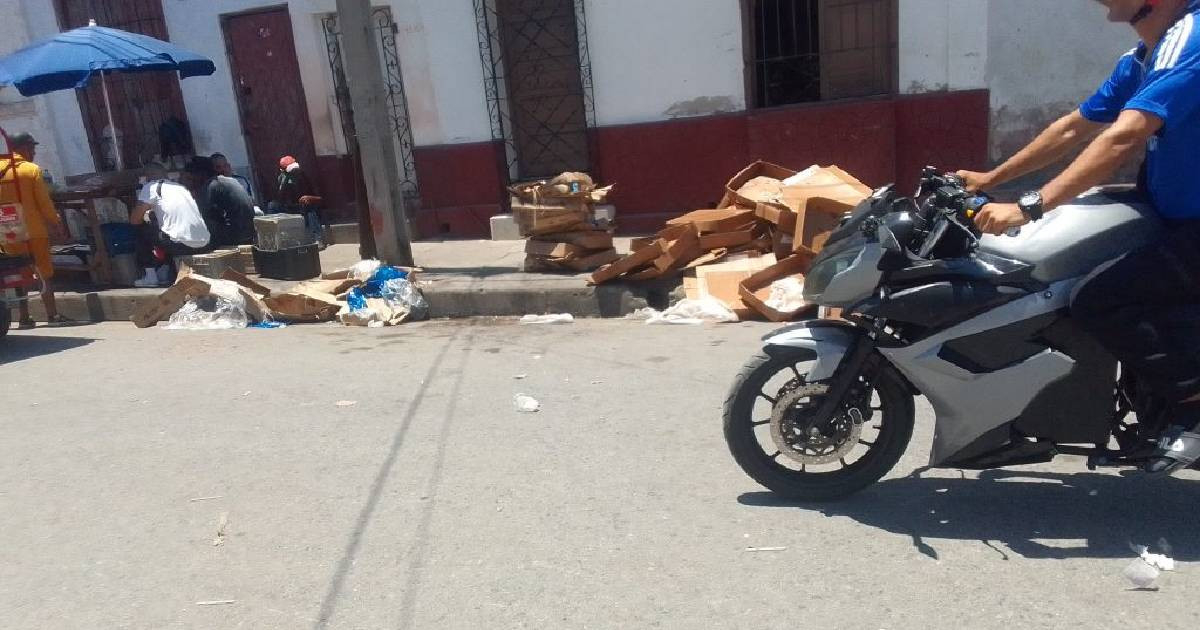
The Provincial Company of Communal Services of Cienfuegos acknowledged that it only has 51 street sweepers out of the 200 required for its staff, which amounts to just 25% of the workforce needed to maintain hygiene in what is known as La Perla del Sur.
This was acknowledged by Oileder Tardío Rodríguez, the general director of the company, during an interview on the radio program El Triángulo de la Confianza, published this Friday on the digital site of the station Radio Ciudad del Mar, where residents from various neighborhoods called in live to report landfills that have gone unattended for months and streets that are practically impassable due to the accumulation of waste.
"We currently have 25% of the street sweeper workforce. I'm not just thinking about that 25%; I'm stating the percentage. Out of 200 street sweepers in the municipality of Cienfuegos, there are only 51," the official stated.
Tardío emphasized that, in his opinion, the sweeping is the most critical task of the service: "Sweeping, in fact, we consider to be the most important activity, more important than collection, because it's what gives closure to this issue of hygiene."
The staffing deficit adds to a chronic fuel shortage that has forced a reduction from two daily collections to just one since the onset of the energy crisis.
The company operates only four regular routes—Punta Gorda, Centro Histórico, La Gloria, and a special route along the main avenues—and currently has just two active electric tricycles, as replacing the batteries for each costs about 960,000 Cuban pesos.
To tackle the accumulation of waste, the company has committed to intensive cleanup operations neighborhood by neighborhood. In the Junco Sur area, they removed over 900 cubic meters of waste in four days; last Friday, they completed work in Pueblo Grifo, from where they had already removed 656 cubic meters. The plan is to continue with San Lázaro over the weekend and then move on to La Juanita.
The listeners' calls illustrated the extent of the problem. A resident of the San Lázaro Popular Council reported that on Avenue 72, between 59th and 61st Streets, in front of a medical office, "there is a garbage dump that hasn't been cleared for over five months. The street is practically closed off. Not even a bicycle can pass through there."
Dulce María Quintana, delegate of constituency 12 of San Lázaro, described the situation in the Pastorita area on air: "The situation is very critical... there is a community kitchen here, and right at the entrance of the community kitchen is the dump."
The director acknowledged that the garbage crisis in Cienfuegos spans over 80 critical points throughout the city, many of which are impossible to clean by hand due to the mixture of debris and waste that residents indiscriminately dispose of.
The deterioration of the equipment park further worsens the situation. Out of the 400 blue containers purchased in 2020, only about 60 remain; the rest have been stolen or burned.
In September, the official newspaper 5 de Septiembre documented the rise of vandalism and the buildup of waste in emblematic spaces such as José Martí Park.
As a partial solution, the company is managing the support of non-state economic actors under the so-called "transformation 49," approved in June, which authorizes the hiring of private businesses for community hygiene services.
Tardío confirmed that they already have proposals from two private actors and have received specific donations of fuel from that sector.
Cities like Havana, Matanzas, Las Tunas, and Holguín also exhibit a landscape dominated by numerous makeshift dumpsters in the streets, posing a risk for the proliferation of vectors and contagious diseases.
Related videos:
Filed under: