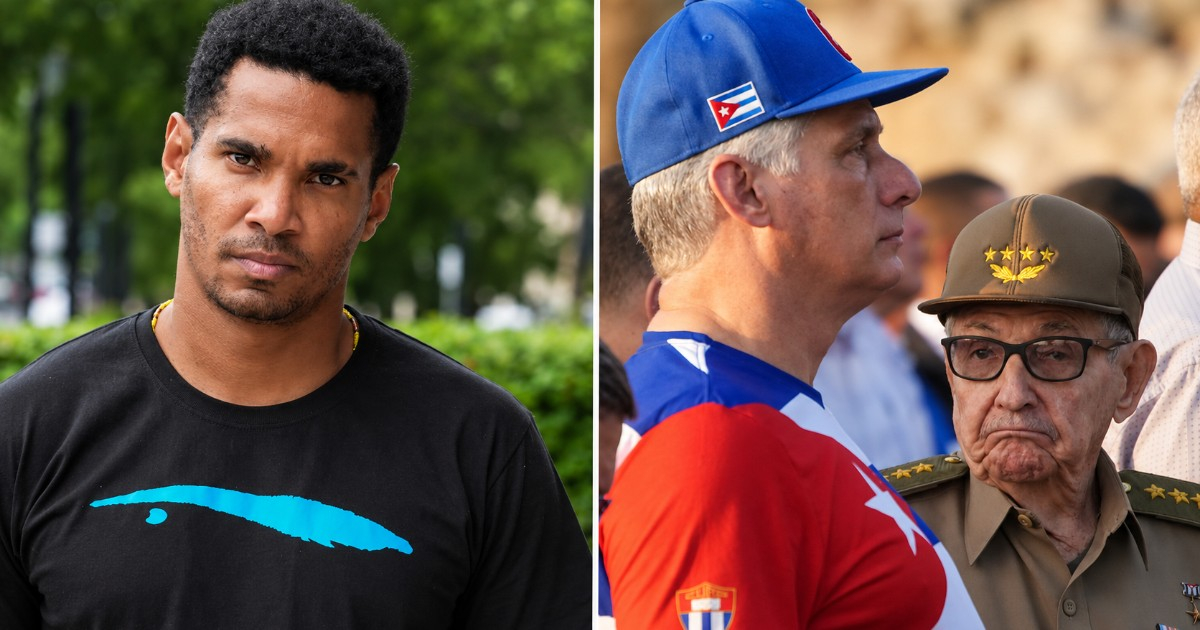
The artist and political prisoner Luis Manuel Otero Alcántara stated that corruption is the main problem of the Cuban regime and denounced the privileges of its leaders in contrast to the hardships faced by the population. In an interview published this Saturday, October 10, by the Argentine newspaper LA NACION, the leader of the San Isidro Movement also recounted the abuses suffered during his imprisonment and expressed his hope for political change.
The privileges of power and the daily crisis
Otero Alcántara criticized the luxurious lives he attributes to relatives of Miguel Díaz-Canel and other members of the ruling elite while many Cubans struggle to obtain food, clean water, and medicine. He stated that the lack of resources has encouraged corrupt practices even in accessing healthcare, as those who can offer money or incentives have a better chance of receiving it.
The activist described hospitals without electricity, schools struggling to provide classes, and families resorting to potentially contaminated water sources. He went so far as to label the situation as "a true genocide", a phrase he used to denounce the severity of the shortages that, he argued, the population is facing.
He also rejected the idea that the U.S. embargo is the reason for the Cuban crisis. He noted that political repression was already present when the Soviet Union was providing significant resources to Havana. However, he argued that the sanctions have also been ineffective in bringing an end to the regime and called for international pressure that does not rely solely on the United States, but also involves Europe, Latin America, and Africa.
The punishments he reported during his imprisonment
Otero Alcántara told journalist Daniel Helft that he spent his first months in prison in a punishment cell. According to his testimony, the guards would take away a makeshift mattress during the day and repeatedly wake him up in the early morning to force him to undress. He claimed that his family members and his partner were also subjected to searches that involved strip searches during visits.
The artist, arrested during the protests of July 11, 2021, stated that the conditions of his confinement improved as international attention on his case increased. After serving nearly five years of his sentence, he was released from prison in July 2026 and had to leave Cuba. He currently resides in Miami.
His hope for a democratic change
From exile, the founder of the San Isidro Movement asserted that Cuban civil society has gained prominence since July 11 and that protests are no longer limited to known activists: ordinary citizens with no prior political experience are also participating. Although he believes the regime is weakening, he acknowledged that a democratic transition would be complex and would require oversight and support from international institutions.
The interview took place in Washington, where Otero Alcántara went to receive the 2026 Democracy Award from the National Endowment for Democracy (NED), a recognition that CiberCuba reported on in September. Among the honorees is also the rapper and political prisoner Maykel Osorbo, who remains incarcerated on the island.
Related videos:
Filed under: