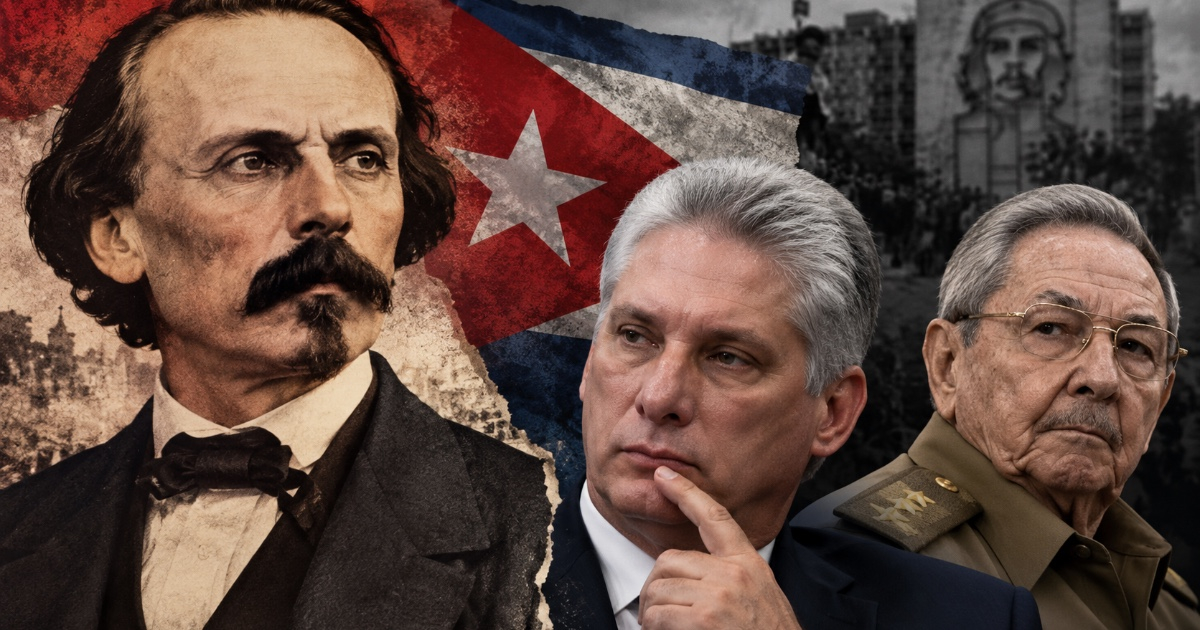
"No other recourse is granted but to remain silent and obey." The phrase with which Carlos Manuel de Céspedes denounced the submission of Cubans to Spanish colonial power on October 10, 1868, takes on an uncomfortable meaning 158 years later: in the Cuba governed by Miguel Díaz-Canel, where there is no political competition among parties, a young woman has just been sentenced for posting a video of a police officer, and two creators of critical content are facing prison sentences of up to ten years.
The Manifesto of the Revolutionary Junta of the Island of Cuba, signed by Céspedes in Manzanillo, denounced that Cubans were deprived of the freedom of assembly, that they could be treated as rebels for claiming their rights, and that they could not even "speak" or "write" freely. It also demanded national representation, universal suffrage, freedom of trade, and respect for individual rights. The uprising that began at the La Demajagua sugar mill opened the Ten Years' War, not the Republic, which was established in 1902.
Written rights, single party, and a system declared irrevocable
The proclaims in its article 54 the freedom of thought and expression; in article 55, the freedom of the press; and in article 56, the rights to assemble, demonstrate, and associate. However, article 5 declares the Communist Party of Cuba (PCC) as the "only" and superior guiding force of society and the State. Article 4 makes the socialist system irrevocable, and article 229 prohibits altering that irrevocability.
The regime acknowledges individual freedoms in the constitutional text, while preventing an alternative political organization from competing for state leadership and enforcing penal provisions against expressions of dissent. Human Rights Watch documented arbitrary detentions, intimidation of opponents, censorship, and penalties for public criticism in its World Report 2026, referring to events from 2025. The organization also denounced the subordination of the courts to political power and the challenges of exercising independent journalism.
Anna Bensi and El 4tico: consequences of criticizing power
One of the most recent cases is that of the Cuban creator Anna Bensi and her mother, Caridad Silvente. On October 1st, the Popular Municipal Court of East Havana sentenced each of them to two years of liberty limitation following the recording and dissemination of a meeting with an agent from the Ministry of the Interior, who came to their home to deliver a summons.
The court argued that the video exposed the agent's personal data and violated their privacy, a claim disputed by the defense and by organizations such as Cubalex, which believe that recording the actions of public officials can be a legitimate form of citizen oversight. Bensi described the sentence as unjust. The imposed penalty does not equate to two years in prison, but it does restrict both his and his mother's freedom.
In Holguín, the Prosecutor's Office has requested eight years in prison for Ernesto Ricardo Medina and ten for Kamil Zayas Pérez, founders of the independent audiovisual project El 4tico. Both have been detained since February 6. The charges against them include alleged crimes of propaganda against the constitutional order, defamation of institutions, and incitement to delinquency due to content shared on social media. These are prosecutorial requests, not sentences handed down by a court.
In a statement released on October 8, Cubalex raised concerns about the legal foundations of the charges and argued that the process criminalizes the expression of critical opinions. The two cases demonstrate how publishing images or raising questions about the Government can lead to restrictions on freedom or the threat of lengthy sentences.
Political prisoners and punishments for protest
The issue goes beyond these cases. Prisoners Defenders recorded 1,339 individuals for political reasons as of the end of August 2026, including citizens in prison and others subjected to restrictions on their freedom according to their methodology. This figure should not be interpreted as 1,339 people physically incarcerated in prisons. The organization also documented cases related to protests over the lack of water and electricity, as well as public complaints of abuses.
Human Rights Watch reported in April 2026 that over 700 political prisoners remained behind bars, including the artist Luis Manuel Otero Alcántara, and questioned the government's announced releases, which excluded individuals imprisoned for dissent. The organization also noted that some released individuals remain under surveillance or restrictive conditions.
The power of the Castros beyond the presidency
Miguel Díaz-Canel holds the presidency and the first secretary position of the PCC, but the political influence of Raúl Castro and his family circle remains present in the power structure. In July, Elier Ramírez Cañedo, an official of the PCC's Central Committee, defended the decision for Raúl Guillermo Rodríguez Castro, Raúl's grandson known as "El Cangrejo," to act as an interlocutor with the United States by order of "the highest leadership of the country." This is not a position of popular representation obtained through elections.
This familial prominence adds to the influence of the Armed Forces in the economy through the GAESA conglomerate, which manages strategic businesses and whose former chief, General Luis Alberto Rodríguez López-Calleja, was Raúl Castro's son-in-law and the father of Raúl Guillermo. Economists consulted by CiberCuba have described how this business network has consolidated around military leadership. Its significance raises questions of accountability regarding decisions and resources that affect the entire population.
Without full economic freedom and with unmet basic needs
The constitutional framework itself also limits economic autonomy: its article 18 establishes the planned direction of the economy, and article 22 acknowledges private property with a "complementary" role. In 2026, the Government expanded some opportunities for private businesses, but still maintains numerous prohibited activities, reserved for the State or subject to licensing. The lifted prohibitions on 46 activities and reorganized other restrictions, without establishing general freedom to operate in any sector.
Economic limitations are developing as many households are unable to meet their essential needs. Human Rights Watch documented prolonged blackouts, shortages of food and medicine, and serious difficulties in accessing healthcare. It cited a survey by the Cuban Observatory of Human Rights conducted between June and July 2025, which found that seven out of ten respondents skipped meals daily. These are data from that period, not a new measurement from October 10, 2026.
The manifesto of 1868 demanded that a free nation, "more broadly represented," decide its political organization. In contrast, Cuba in 2026 retains an express constitutional prohibition on reforming the irrevocability of its socialist system, while courts and security bodies act against citizens who demand changes or publicly question their rulers.
Related videos:
Filed under: