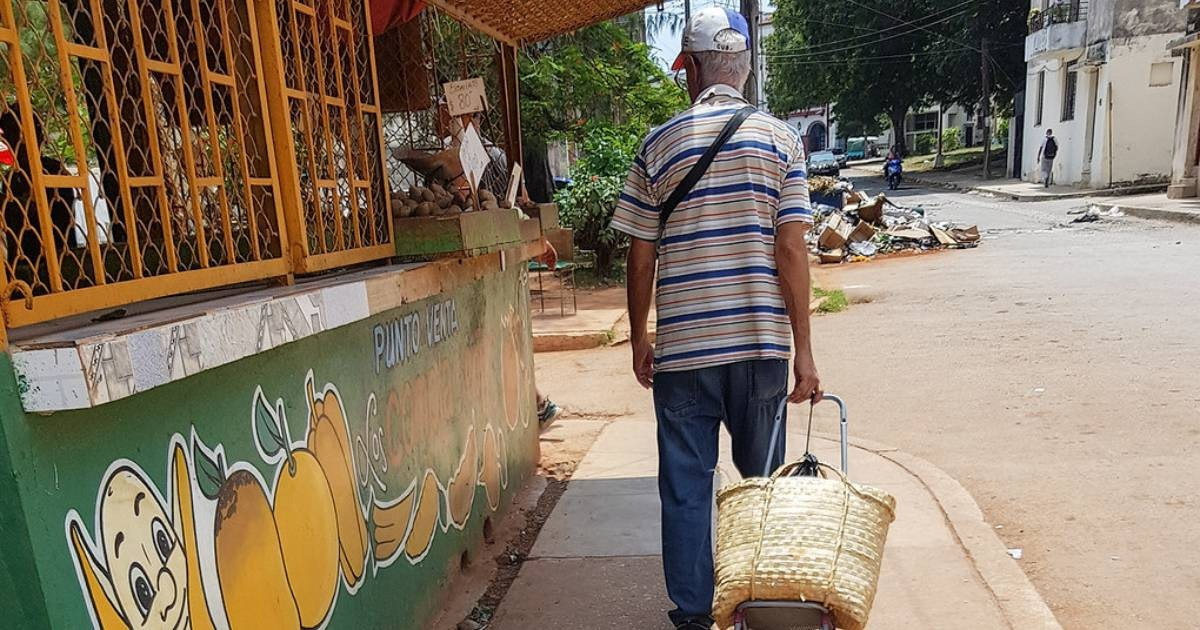
A Cuban identified as Ida Ortiz posted on Facebook this Saturday a testimony that depicts the food crisis on the island: she left the hospital, where her son is hospitalized for dengue, to buy two pounds of chicken and two pounds of malanga to prepare him a broth, and in just 20 minutes, the price of the chicken had already increased.
Ortiz walked down Mariana Grajales Street to the nearby non-state market. At one point of sale along the way, the price for a pound of chicken was 900 pesos. He decided to buy it on the way back to avoid it thawing. However, when he returned to the store, the price had already increased to 950 pesos. "When I asked, the young seller's response was clearer than water: the chicken didn't come from the same place," he wrote. Additionally, there were no malangas available: the market had very few offerings.
The narrative does not stop at that anecdote. Ortiz, who according to her social media profile lives in Moa, Holguín, and works as a university professor, directly points to the effect of the salary increase decreed by the regime in July: “After it was decided to raise salaries a bit in July, prices have increased three times for some products, [...] while others, like the 2-liter soda or less, went up by 70%. And although this is the 'salvation' for many families with children, the chosen moment to spike its price was September 1st, coinciding with the start of the school year.”
The context surrounding this testimony is devastating. In June 2026, Resolution 150/2026 from the Ministry of Finance and Prices eliminated price caps on cut chicken, oil, powdered milk, pasta, and sausages. Following this measure, the package of chicken, which cost between 2,000 and 3,000 pesos in June, escalated to 7,000 pesos or more in some areas.
Almost simultaneously, the regime raised the minimum wage from 2,100 to 3,210 pesos, but this increase was immediately absorbed and surpassed by inflation. At the informal exchange rate, those 3,210 pesos are equivalent to less than five dollars a month. Independent estimates indicate that covering the basic needs of a single person on the island requires around 96,000 pesos per month, of which more than two-thirds would be allocated solely to food.
The year-on-year inflation in the formal market reached 25.19% in August 2026, with food and non-alcoholic beverages rising by 36.01%. The 2025 National Food Security Survey from the Food Monitor Program, based on 2,513 responses, revealed that 94.9% of respondents had lost some degree of access to food purchases and that 33.9% of households had at least one member who went to bed hungry.
The dengue that has hospitalized Ortiz's son adds another layer of distress. Cuba had accumulated over 11,000 dengue cases as of October 4, a figure 9.2 times higher than the historical average of the last five years, according to the Global Dengue Observatory of the London School of Hygiene & Tropical Medicine.
The comments under Ortiz's post reflect collective exhaustion. "This is our sad reality; we are reinventing ourselves every day, almost without strength and without desire [...] the greatest pain is seeing a sick child needing proper food and medication and being unable to do much," wrote a netizen.
Another summarized the situation like this: "Eating in Cuba has become a luxury; it seems to have ceased being a necessity. Our homeland hurts, and it seems no one cares anymore." A third person was more succinct: "They force us to be magicians, because it takes magic to be able to eat."
Ortiz concluded his post with a question that encapsulates the exhaustion of millions: "Where will the life that is being consumed in bills that can’t be covered go? Today’s Cubans are forced to be economists because there’s no other choice. No one has ever been able to do more with what they don’t have."
Related videos:
Filed under: