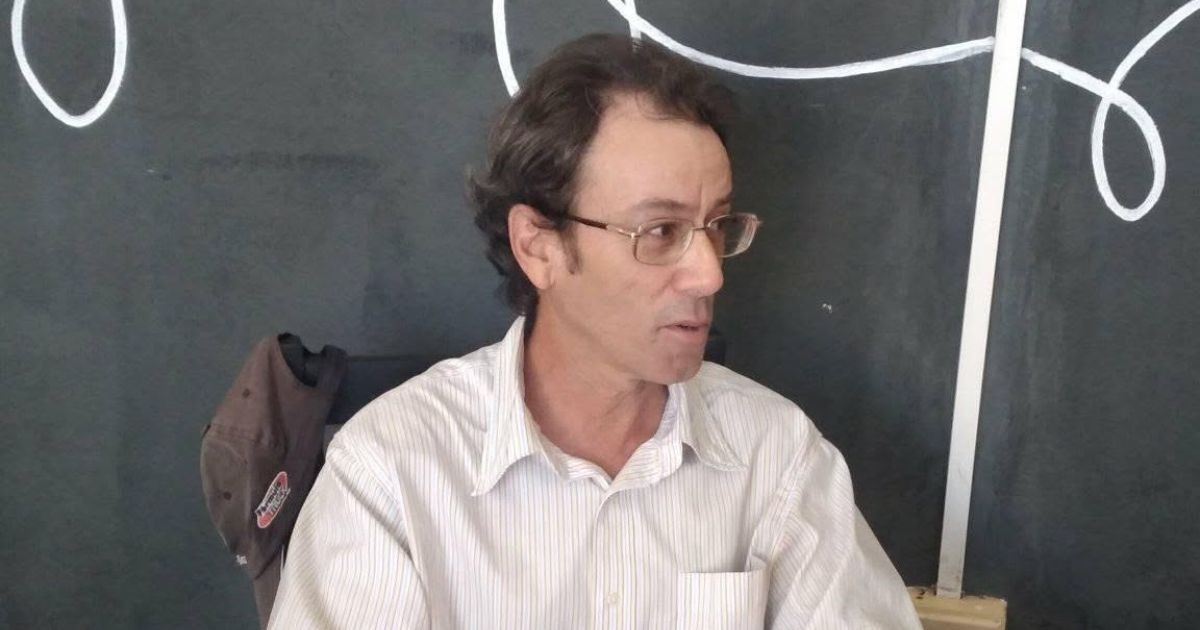
The writer and independent journalist José Gabriel Barrenechea Chávez is serving his sentence in isolation under conditions of physical risk in the Guamajal prison, in Villa Clara, to which he was transferred at the end of September from La Pendiente penitentiary, as reported by pastor Mario Félix Lleonart, director of the Patmos Institute, to Martí Noticias.
Lleonart specified that the transfer occurred around September 26, and since then the writer has been in total isolation, without the possibility of receiving calls, books, or notebooks.
"From Guamajal, calls cannot be made. The excuse is that the phones are broken or that there is no coverage," the pastor reported.
Correspondence is also effectively blocked: "Letters hardly circulate because they are read, and if something seems off, they don't let them through," Lleonart added.
What worries the director of the Patmos Institute the most is the physical safety of the intellectual: according to the information he has received, Barrenechea has been placed in a cubicle with about twenty people, including inmates described as violent, and he fears that he may be attacked, with the suspicion that other prisoners might be incentivized to do so.
"What troubles Gabriel the most right now is that he is not allowed to receive books or notebooks; they don't want him to write. They are taking away his voice," stated Lleonart.
Guamajal is classified as a maximum-security prison. Former inmates have reported extreme overcrowding in that facility, and Prisoners Defenders has documented forced labor among its prison population.
Lleonart links the transfer and restrictions to the publication of two texts that Barrenechea managed to take out of La Pendiente in early September: “Varela, the father of the Cuban nation,” in which he advocates for the role of priest Félix Varela and questions the narrative of revolutionary nationalism, and “Testimony of a favor during a critical moment,” a personal account of a spiritual experience during his confinement.
The pastor recounted that the writer requested both texts to be published "despite the consequences he himself knew this could have."
Barrenechea was arrested on November 8, 2024, a day after participating in the protests in Encrucijada, where hundreds of residents gathered in front of the headquarters of the Communist Party and the municipal government demanding electricity after more than 48 hours without power.
In January 2026, the Provincial Court of Villa Clara sentenced him to six years in prison for "public disorder," alongside Rafael Javier Camacho Herrera, Yandri Torres Quintana, and Rodel Bárbara Espinosa Rodríguez, with sentences ranging from five to eight years. The Supreme Court later rejected the appeal for cassation, closing the ordinary appeal pathway. He is expected to remain incarcerated until approximately 2030.
During his incarceration, his mother Zoila Esther Chávez passed away on May 4, 2025, at the age of 84. Barrenechea was transferred under military custody for the wake, but he arrived after her death. The Patmos Institute awarded him the Patmos Prize 2025 for his "testimonies of genuine faith and visions of hope," an honor that was also posthumously awarded to his mother.
Lleonart was emphatic in assessing the judicial process: "The process has been rigged from the very beginning. José Gabriel Barrenechea should not have been imprisoned for even a single day."
"They can take away his pencil, they can move him to another prison, they can cut off his phone, but they will not silence the voice of José Gabriel Barrenechea," concluded the pastor.
Related videos:
Filed under: