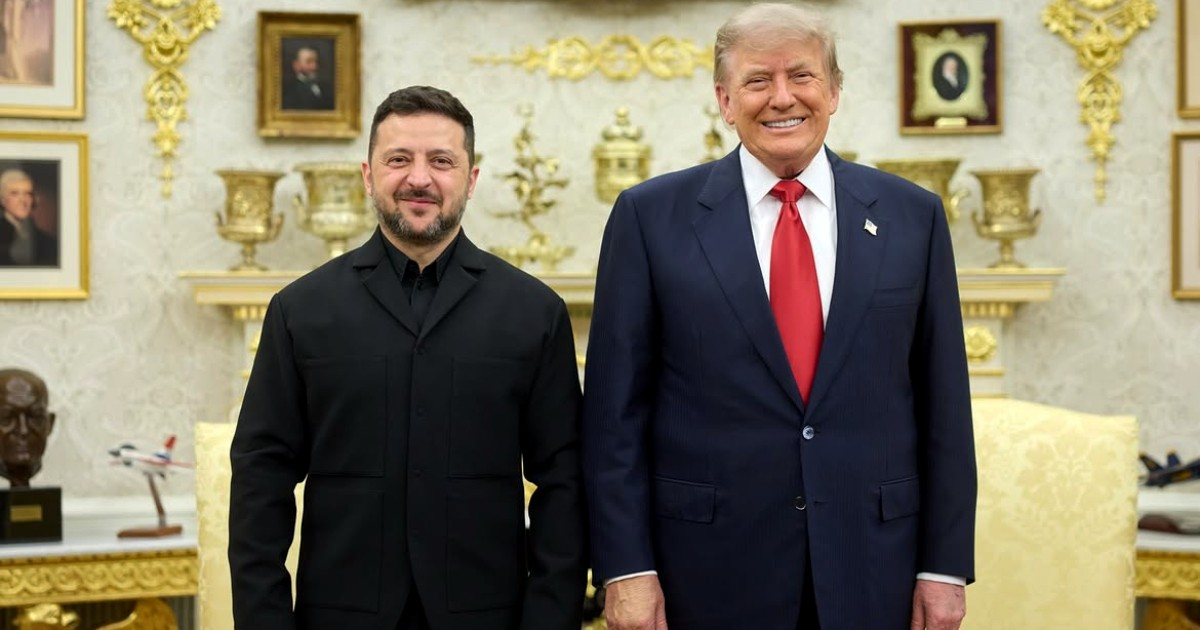
The American president Donald Trump demanded a change of leadership in Kiev on Saturday, stating that "the time has come for Ukraine to have a new president." This direct attack on Volodímir Zelenski escalates the tension between Washington and Kiev to its highest level in months.
The statements were made as Trump was leaving the White House and responded to the criticisms from the Ukrainian leader regarding the energy deal that Washington concluded on Friday with Moscow to release Russian diesel to the U.S. and global markets.
Trump accused Zelensky of "wanting to create problems for the world" by continuing to authorize Ukrainian attacks on Russian refineries. "For God's sake, stop," warned the U.S. president, adding that Ukraine should "get a new leader who can make a deal." He also stated that Zelensky "could have closed many agreements and for some reason he never does."
The immediate trigger was the agreement announced on Friday between Trump and Putin to suspend U.S. sanctions on Russian diesel exports until April 7, 2027. Under this pact, Russia would initially supply 300,000 tons of diesel, followed by 500,000 tons in November, one million later, and up to three million additional tons in a short timeframe, depending on the condition of Russian refineries.
Zelensky rejected the agreement, labeling it as "unjust and dishonest" and a "gift for Putin," warning that the funds generated would finance the Russian war machine. "It allows Moscow to obtain new funds to acquire military equipment and continue the war," the Ukrainian president said.
On the same day that Trump defended the pact, Russian airstrikes with bombs over Zaporizhzhia resulted in at least 15 deaths, including three children. Zelenski directly linked the bombings to the lifting of sanctions, stating that it was Russia's "gratitude" for the agreement, and that Moscow interpreted it as a signal that "it can continue fighting, it can continue dropping bombs on the cities."
The head of European diplomacy, Kaja Kallas, supported Ukraine's position and rejected the pact with Moscow. "This is not the time to ease pressure on Russia, and Europe will not do so," she stated, adding that suspending sanctions "provides Moscow with more revenue to finance the war." Kallas also announced that the foreign ministers of the European Union will approve on Monday the largest sanctions package against Russia since the onset of the invasion, with around 1,600 individuals and entities on the list.
Trump's motivation is clearly electoral: the price of diesel in the United States is around $6.28 per gallon, compared to $3.68 the previous year, a rise largely driven by the war between Washington, Israel, and Iran that began in February 2026. With the legislative elections on November 3 on the horizon, the president is seeking to ease fuel prices before voters head to the polls.
The paradox of the agreement did not go unnoticed: it was announced just 21 days after Trump signed a law intended to increase economic pressure on Russia, which was passed by the Senate with 86 votes in favor.
It is not the first time Trump has called for a change in Kiev. In February 2025, he called Zelenski a "dictator without elections." In December of that year, he again pressured for elections in Ukraine. However, the martial law in effect since the Russian invasion in February 2022 legally prohibits the holding of elections while it is in place, and Zelenski's mandate, which expired in May 2024, continues for that same institutional reason.
Related videos:
Filed under: