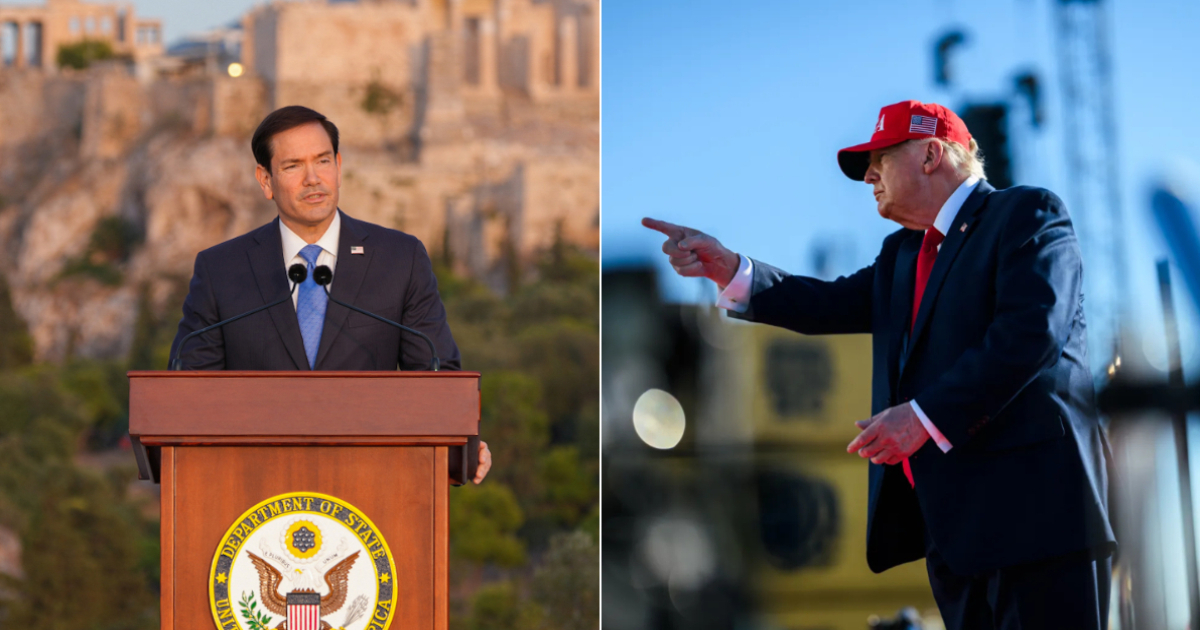
Marco Rubio called on October 7 from Athens to reclaim the values that, according to his speech, made Western civilization great: honor, duty, the pursuit of truth, and fidelity to principles even when defending them requires sacrifices.
Two days later, Donald Trump announced an agreement with Vladimir Putin to bring millions of tons of Russian diesel to the U.S. and international markets.
The sequence contrasts the moral proclamation with a concrete decision: to facilitate energy sales to the ruler who continues to invade Ukraine, a country that struggles to survive as an independent nation and link its future to Western democracies.
Principles for Discourse, Exceptions for Putin
Rubio did not limit himself to calling for more factories, technology, or military capacity. He praised those who remain faithful to their duty precisely when it is difficult and painful to do so. He also stated that institutions and alliances must defend the sovereignty of nations, not abolish it.
Ukraine provides a concrete example of these principles. Defending its sovereignty means maintaining its capacity for resistance and limiting the resources of the invader. Opening a trade route to Russia, without a withdrawal or a ceasefire among the announced conditions, weakens that pressure without demonstrating progress toward peace.
Putin is an autocrat against whom an arrest warrant has been issued by the International Criminal Court for alleged war crimes related to the deportation and illegal transfer of Ukrainian children. Diplomatic negotiations with him may be necessary; granting him economic relief without verifiable counterparties demands a justification that the rhetoric regarding Western values does not provide.
Rubio praises the willingness to pay a price for principles. Trump eases pressure on Moscow with the promise to lower fuel costs. The contradiction surfaces precisely where discourse should transform into action.
Congress seeks pressure; Trump facilitates sales
The turn also contradicts the orientation of the Lindsey O. Graham Law, signed by Trump on September 18 to strengthen sanctions against Russia. The measure received 86 votes to 11 in the Senate and 262 to 159 in the House of Representatives: a bipartisan majority in favor of increasing economic pressure on Moscow.
The connection with Rubio is direct. In a letter sent on October 6 and made public on the day of his speech, the Democrat Jeanne Shaheen and the Republican Roger Wicker, along with the Secretary of the Treasury, Scott Bessent, urged him to cut the revenues and technological supplies that sustain the Russian war machine.
Two days later, the Treasury issued General License 135, which allows operations with Russian diesel, including its importation to the United States, until April 7, 2027.
The law includes presidential exceptions, so that authorization alone does not demonstrate a legal violation. However, it does reveal a political contradiction: Trump opens a source of income for the country whose ability to finance the war Congress wants to restrict.
Ukraine pays the price for the gap between words and actions
The agreement reinforces the criticism of condescension towards Putin: Moscow gains tangible flexibility while the Russian concessions regarding Ukraine remain unproven.
The benefit claimed by Trump is also not guaranteed. Experts consulted by Associated Press warn that redistributing Russian fuel among buyers may have a limited effect on prices. Clayton Seigle from CSIS considers a significant decrease in the United States or Europe unlikely, but sees a potential relief for Moscow's revenues.
Rubio stated in Athens: "We must win together." For Ukraine, that promise loses credibility when Washington facilitates business with the invader without showing what it has obtained in return for the invaded country.
The defense of sovereignty remains in discourse; the authorization to sell Russian diesel is already in writing.
Related videos:
Filed under: