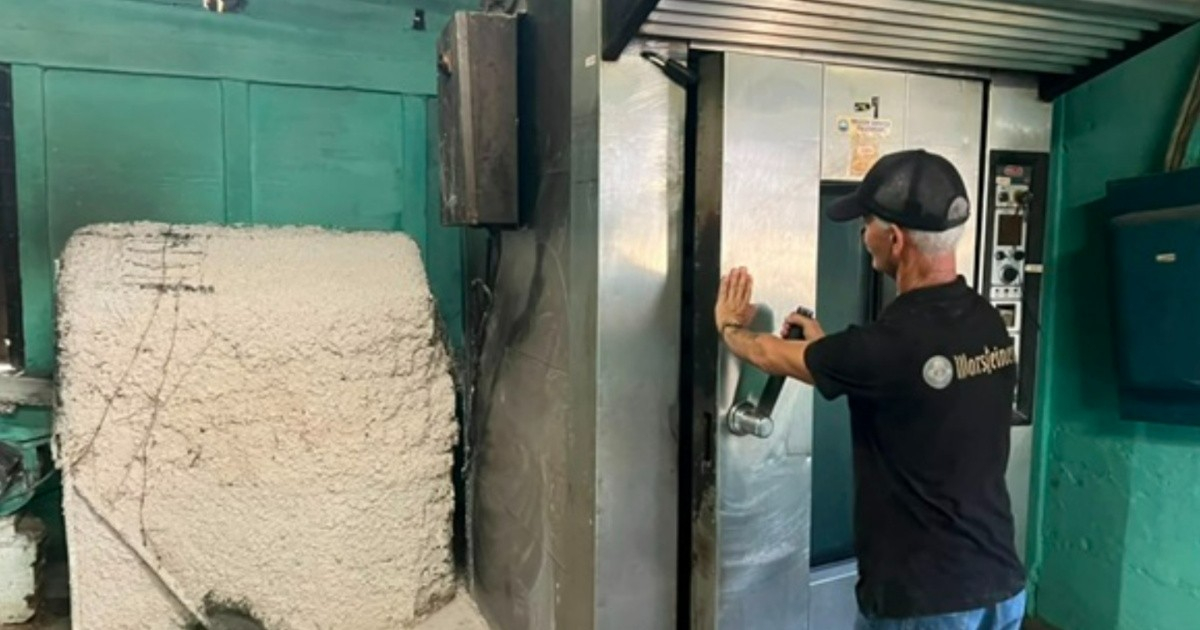
The state medium Cubadebate presented this Saturday as an "innovation" what is actually a survival measure in the face of Cuba's energy collapse: a bakery in the municipality of San Cristóbal, in Artemisa, has replaced diesel with marabú—an invasive plant—in order to continue baking bread amid a complete lack of fuel.
The unit, located in the José Martí community next to the old sugar mill of the same name, built an external artisanal forge that generates steam directed into the oven through a duct with a fan, without altering the original structure of the equipment.
The administrator, Damarys Trujillo Hernández, explained the reasoning behind the design: “The idea was to create a forge that we could work with using firewood, while maintaining the original structure of the oven, so we could resume its use when conditions improve regarding fuel. That’s why it’s a rustic system that generates steam outside the oven and does not affect it in any way. What we did was remove the burner and install a duct with a fan to direct the steam into the interior.”
Reaching that result was not easy. The workers initially experimented with clay alone, then with mud bricks, and neither could withstand the temperatures. Finally, they discovered a mixture of fiberglass, clay, and cement that worked as a refractory material.
What the government celebrates as ingenuity is, in fact, a symptom of an unprecedented energy crisis. In May 2026, the Minister of Energy and Mines, Vicente de la O Levy, publicly admitted that Cuba had “absolutely nothing” in diesel or fuel oil for electricity generation. The country consumes between 90,000 and 110,000 barrels daily but only produces about 40,000, a structural deficit that worsened when Venezuela interrupted its oil shipments at the end of 2025 and Mexico nearly completely cut back its supplies at the beginning of 2026.
In this context, bakeries across Cuba returned to wood-fired ovens starting in February 2026. In Guantánamo, flour arrived on mules and bread was baked with firewood; in Holguín, ovens that had been unused for over thirty years were reactivated; in Camagüey, the government itself inaugurated a wood-fired oven in September 2025 and presented it as "science and innovation." The narrative is always the same: what is an emergency response to the collapse of the energy system is marketed as revolutionary creativity.
The marabou —an invasive plant of African origin that covers millions of hectares in Cuba— has a high calorific value of approximately 4,654 kcal/kg, making it a widely used emergency resource. However, its charcoal is also scarce and is sold on the informal market for between 3,500 and 5,000 pesos per 20 kg bag, significantly above the official price.
The bakery in San Cristóbal produces 15,000 loaves of bread daily intended for school snacks, the hospital, the maternity home, and the orphanage in the municipality, in addition to supplying several neighboring popular councils. It has been taking over the production of other bakeries facing operational issues in the area for about two years. In light of the shortage of flour and sugar, the manager confirmed that negotiations are underway with an independent contractor and possibly a small and medium-sized enterprise to secure raw materials: “We have already signed a contract, we have prepared the cost sheet, and everything is well defined on both sides to start with the supplies and sales.”
While the regime's press celebrates the "ingenuity" of baking bread with firewood in 2026, in Villa Clara, for example, subsidized bread has been restricted for months to those under 13 years old and over 65, another sign of how far the deterioration of a system has reached that cannot even guarantee the most basic food of the Cuban diet.
Related videos:
Filed under: