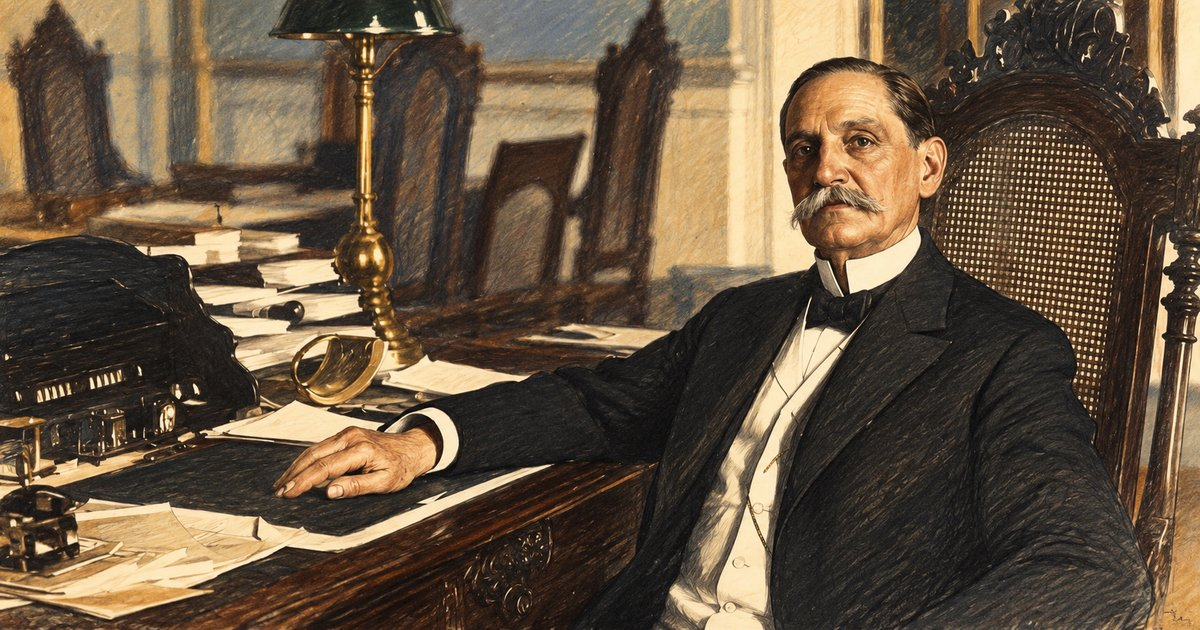
There are events that official history turns into dates and others that deserve to be examined as wounds. The August War of 1906 belongs to the latter.
It wasn't a great war. It lasted barely a few weeks. But its importance is not measured by the number of battles, but by what it revealed: just four years after the birth of the Republic, Cubans demonstrated that they still had not learned how to resolve their political differences within the institutions.
And here begins the uncomfortable question: who was responsible? The easy answer would be to point exclusively to Tomás Estrada Palma. The other easy answer would be to blame solely the liberals who took up arms. History, however, is rarely that straightforward.
The first crack
Estrada Palma came to the presidency with enormous prestige. He had been a delegate of the Cuban Revolutionary Party after Martí's death and was regarded as an austere man, honorable and with rigorous administrative habits.
His government achieved financial stability and promoted public works and education. The president himself was able to present favorable figures of the national finances before Congress. In his message of September 1906, he defended this image of orderly administration and accused the insurgents of endangering republican institutions.
But one thing is to manage correctly, and another is to know how to build a democracy. That was one of Estrada Palma's major problems. His distrust of party politics, his tendency to prioritize stability over political competition, and ultimately his decision to seek re-election led to a confrontation with many of those who had been his allies.
The Constitution permitted reelection. That should be clear. However, just because something is constitutional does not mean that its political execution is necessarily healthy for a Republic.
The liberal opposition reported irregularities and ultimately withdrew from the electoral race. Documentation preserved by Johns Hopkins University describes the conflict as a result of the contested election and the exclusion of liberals from positions of power.
The Republic thus began to lose a fundamental piece: trust in elections. But the liberals were not innocent either. Here, another myth must be broken. The opposition could denounce irregularities. It could challenge the results. It could mobilize public opinion. It could organize politically.
What I could not do, if I intended to build a democratic Republic, was to replace the ballot boxes with rifles. And that is exactly what happened.
In August 1906, armed uprisings began, initially in Pinar del Río and later in Havana and Las Villas. A U.S. diplomatic report from August 21 recorded between 1,000 and 1,500 men led by Faustino “Pino” Guerra in Pinar del Río and about 250 under Quintín Banderas in Havana.
Therefore, historical responsibility must be shared without turning it into a collective absolution. Estrada Palma contributed to closing institutional pathways. The liberals contributed to their destruction when they chose insurrection. And both ultimately harmed the Republic.
And then Quintín Banderas appeared. Here, tragedy takes on a face. Quintín Banderas was not a cabinet politician. He was a veteran of the wars of independence, a man who had fought for years for Cuba and who ended up living modestly in the Republic he had helped to conquer.
In August 1906, he took up arms again. On August 22, he was captured near Arroyo Arenas and died at the hands of the Rural Guard, after sustaining gunshot wounds and machete injuries. His death warrants particularly careful examination.
For decades, it has been asserted that Estrada Palma personally ordered the assassination of Banderas. However, the available documentation does not allow this claim to be presented as a definitively proven fact. Even recent investigations caution that there is no conclusive documentary evidence of a direct presidential order. Nonetheless, this does not absolve the government of political responsibility for the repressive context in which the death occurred.
This distinction is fundamental for a historian: political responsibility does not automatically equate to individual criminal responsibility. However, there is something that is hard to ignore. The Republic had reached the extreme of killing one of its former generals of independence.
Estrada Palma: Villain or Misguided President?
Neither one thing nor the other. Portraying Estrada Palma as a mere tyrant would be historically superficial. Presenting him as an exemplary president, a victim of irresponsible liberals, would also fall short.
He was a man of personal and administrative virtues, but with a political vision that revealed serious limitations. His greatest mistake was not just wanting to be reelected; it was failing to understand that a young Republic needed political legitimacy as much as financial balance.
And when the crisis became unmanageable, he made an even more significant decision: he requested U.S. intervention. The diplomatic documents are conclusive. On September 12, 1906, Estrada Palma formally requested U.S. military assistance in the face of the advancing rebellion. Shortly thereafter, he resigned.
On September 29, the second U.S. military government in Cuba began. The Republic that had been born in 1902 was once again under American control.
The true consequence
This was perhaps the greatest tragedy of the August War. It wasn't simply that Estrada Palma abandoned the presidency. It wasn't just that the liberals failed in their rebellion. It was that the young Republic showed Washington that it still could not resolve its political conflicts peacefully.
The intervention planned by the Platt Amendment ceased to be an abstract possibility and became a reality once more. The Americans established a provisional government and remained in Cuba until 1909. Official U.S. documents indicate that Estrada Palma's resignation left the country without an effective executive, and Washington justified its intervention on the grounds of the need to restore order and ensure institutional continuity.
The August War, therefore, did not destroy the Republic. But it profoundly weakened it.
The lesson that still makes one uncomfortable
Perhaps the most important question is not who won the August War. No one really won. Estrada Palma lost. The liberals lost. Quintín Banderas died. The opposition ended up defeated. The government lost legitimacy. And Cuba was once again placed under U.S. military oversight.
Therefore, when we study those events, we must avoid two temptations: turning Estrada Palma into a monster and making the liberals into heroes.
A Republic is not built solely with honest men. It is built with institutions capable of surviving disagreements among honest, ambitious, mistaken, and even dishonest individuals.
The great tragedy of 1906 was that Cuba had still not learned that lesson. The August War was brief in duration. But it was enormous as a warning. And perhaps that is where one of the most persistent ailments of republican Cuba began: the inability to accept that losing an election should be less painful than losing a Republic.
Related videos:
Filed under:
Opinion article: Las declaraciones y opiniones expresadas en este artículo son de exclusiva responsabilidad de su autor y no representan necesariamente el punto de vista de CiberCuba.