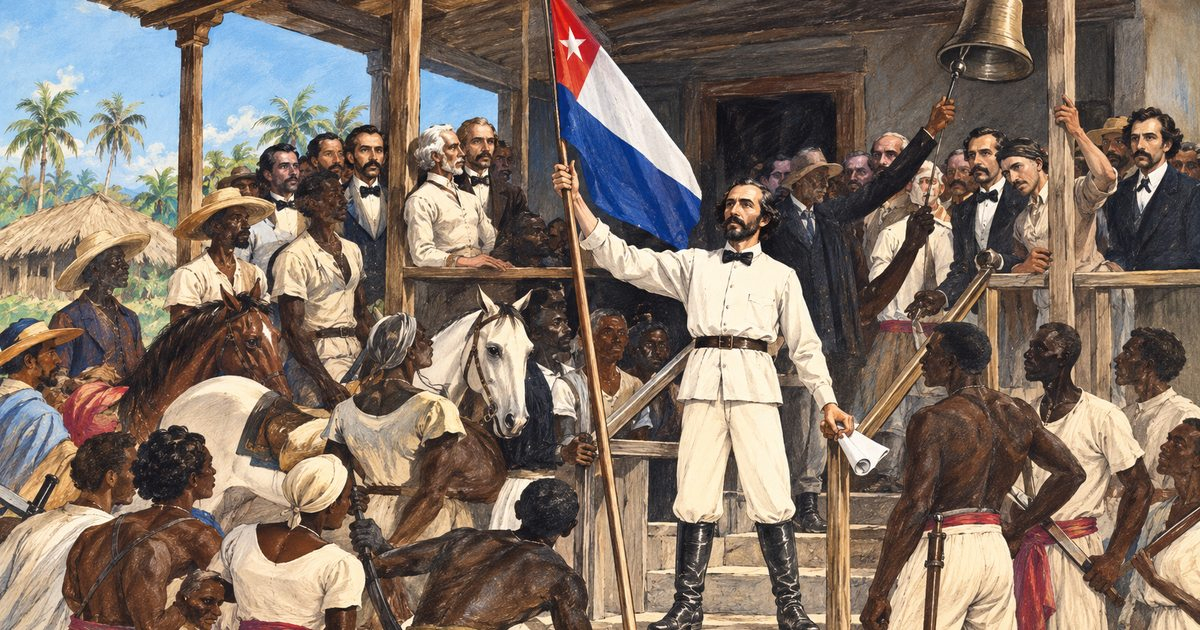
“Where there is no freedom on earth, everyone must go out in search of it on horseback!” (José Martí, "The Two Nightingales"). And that is what Carlos Manuel de Céspedes did on October 10, 1868, when he took up arms in La Demajagua and initiated the Ten Years' War in the pursuit of Cuba's freedom.
One hundred and fifty-eight years later, what does freedom mean for a society that knows its name and its meaning, but has grown up in Cuba without being able to experience it?
Cubans know the word freedom. They find it in books, in Martí, in songs, in conversations, on social networks, even the system that restricts freedoms speaks of it.
Freedom can be conveyed through stories, family memories, and aspirations. However, knowing what others have experienced does not equate to having that experience oneself.
Although living without freedom does not prevent us from imagining it, the experience can influence what we consider possible and the alternatives we envision for our own lives.
That lack of experience can become evident in everyday life: in the words left unspoken, in what is said in public and reserved for private moments, in the need to calculate the consequences of a decision or to gauge how far one can express an opinion. Over time, some individuals learn to live this way to avoid problems or simply to move forward. Not everyone reacts the same way, but these behaviors can come to seem like a natural part of life when, in reality, they stem from the lack of freedom in which people live.
There is another issue that we should not overlook: Is freedom a conscious aspiration for everyone? Not necessarily. Many people first seek to escape hunger, obtain medication, have electricity, find opportunities, or secure a future for their children. Wanting a different life does not always mean identifying the lack of freedom as one of the reasons for what they wish to change.
Understanding that difference does not imply judging those who remain in Cuba, nor measuring their awareness based on their willingness or reluctance to confront the risks of demanding their rights. It also does not mean ignoring those who do demand them and have paid a price for doing so. It means recognizing that people live under different circumstances and that not everyone can bear the same costs.
Therefore, talking about freedom requires going beyond simply knowing its definition. Freedom is not just about the removal of a prohibition. It also means having the ability to make decisions about fundamental aspects of one's own life, to express oneself without fear, to associate, to act, and to build a personal project within a society that acknowledges and protects those possibilities.
Freedom is knowledge, but it is also experience and practice. Additionally, it is a culture that is continually built and defended: through respect for others' decisions, the ability to express disagreements, the acceptance that not everyone thinks alike, and the recognition of others' rights.
158 years after Demajagua, the aspiration for freedom remains present in Cuba, although not everyone expresses it in the same way or ascribes the same significance to it in their lives. This date also invites us to reflect on what it means to turn that aspiration into a reality that can be experienced and passed on to future generations.
What will happen the day Cubans are told they are free? Will it be enough for the restrictions to disappear, or will that society also need to learn how to decide what to do with freedom, how to exercise it, and how to defend it?
Between knowing freedom and living in freedom, there is a distance that no word alone can bridge.
Related videos:
Filed under:
Opinion article: Las declaraciones y opiniones expresadas en este artículo son de exclusiva responsabilidad de su autor y no representan necesariamente el punto de vista de CiberCuba.