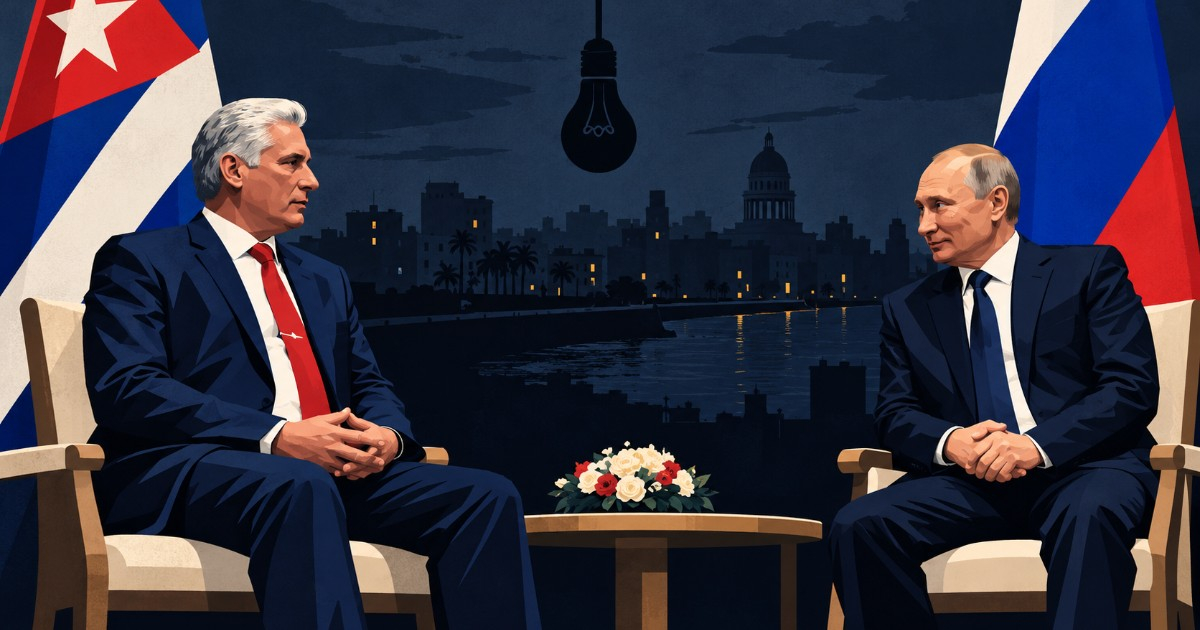
Even the official press of Russia, one of the main allies of the Cuban dictatorship, acknowledges the seriousness of everyday life in Havana. A report published on October 6 by Rossiyskaya Gazeta describes daily blackouts that sometimes exceed 20 hours, garbage accumulation, difficulties with water supply, and gasoline sold in the informal market for nearly three dollars a liter.
The contradiction is evident: the official newspaper of Vladimir Putin's government, a political and energy ally of Havana, depicts the deterioration of a capital that Miguel Díaz-Canel's regime has been promising to recover for years. Correspondent Dmitri Kulemiakin tries to highlight the adaptability of Cubans but reaches a conclusion that dismantles any sense of triumphalism: it cannot be said that the crisis has been overcome.
More than 20 hours without electricity and gasoline at luxury prices
According to the Russian report, power outages are part of the routine and at times last more than 20 hours. The fuel shortage affects both transportation and waste collection, as well as other municipal services. This is compounded by water supply issues and the health consequences of garbage piling up in the streets.
The correspondent notes that more cars are on the road than during the spring, but not because the supply has normalized. He describes informal spots where gasoline is sold for between $2.50 and $2.80 per liter. This is the price reported for that parallel market, not an official rate or an average verified for the entire country.
One of the entrepreneurs interviewed expresses his fear that the restrictions from the United States will reduce that informal supply. This reflects the concern of one interviewee, not a comprehensive explanation of the crisis. For those who depend on a vehicle for work or transporting goods, purchasing fuel through those means involves taking on extraordinary costs in an economy characterized by low incomes and scarcity.
Small businesses are also affected by the problem. The newspaper describes cafés and restaurants that need diesel generators or solar panels to continue operating. The owner of an establishment in Old Havana claims that in his area, outages are less frequent: a contrast between areas of the capital that prevents generalizing the situation of the entire historic district, but reveals how the place where one lives or works can determine the ability to withstand the crisis.
The scenario described by Moscow is supported by reports from the Cuban electric company itself. In the early morning of October 8, the Electric Company of Havana reported 91 circuits without service and 235 megawatts affected due to generation deficits, as documented by CiberCuba. Several circuits had accumulated more than eight hours of interruption. It was a snapshot from a specific moment in the early morning, not a constant figure for the entire day.
The ally Putin promises aid, but the blackouts continue
Russia is not an outsider to this crisis. Moscow has been strengthening its relationship with the Cuban regime for years through political, energy, and military cooperation agreements, while defending it in international forums. However, this strategic alliance has not prevented the population from continued suffering from extreme outages and a lack of basic services.
On March 31, the Russian tanker Anatoly Kolodkin arrived in Matanzas with approximately 100,000 tons of crude oil, equivalent to about 730,000 barrels. The cargo was processed to obtain gasoline, diesel, and other derivatives, but Díaz-Canel himself acknowledged in April that it was enough to cover around ten days of fuel needs. It was a temporary relief, not a structural solution.
The political alignment, on the other hand, remains intact. On October 7, a day after the Russian report, Díaz-Canel publicly congratulated Putin on his 74th birthday. While both governments showcase their friendship, Cubans continue to look for ways to cook, transport water, preserve food, and keep their businesses open.
The responsibility of a system built by the Castros
The framing of external "restrictions," common in the speeches from Havana and Moscow, avoids a central responsibility: that of the political and economic model established by Fidel Castro in 1959, which Raúl Castro maintained for decades and which Miguel Díaz-Canel now administers. Trade and financial restrictions have consequences, but they are not enough to explain the accumulated deterioration of thermoelectric plants, the lack of sufficient investment and maintenance, state inefficiency, and the inability to ensure basic services.
For decades, the Castro family concentrated political power and directed military structures that also played a decisive role in the economy. GAESA, the business conglomerate linked to the Armed Forces, expanded under Raúl Castro's leadership and was managed for years by Luis Alberto Rodríguez López-Calleja, who was his son-in-law. The concentration of strategic economic activities within military structures and the lack of transparency regarding their finances raise an inevitable question: how are these priorities justified when the State fails to ensure electricity, water, or waste collection?
The report from Rossiyskaya Gazeta is not an opposition denunciation nor can it be read as an exercise in independent journalism from Russian power. Precisely for this reason, it is revealing. Even an official media outlet of the country that diplomatically protects the Castro regime describes a Havana with prolonged blackouts, black market gasoline, and overwhelmed municipal services.
The regime can continue to receive congratulations, oil, and political support from Moscow. What it cannot demonstrate, after more than six decades of power held by the Castros and their successors, is a system capable of reliably meeting the most basic needs of its citizens. This is the reality that even the official newspaper of its ally cannot hide.
Related videos:
Filed under: