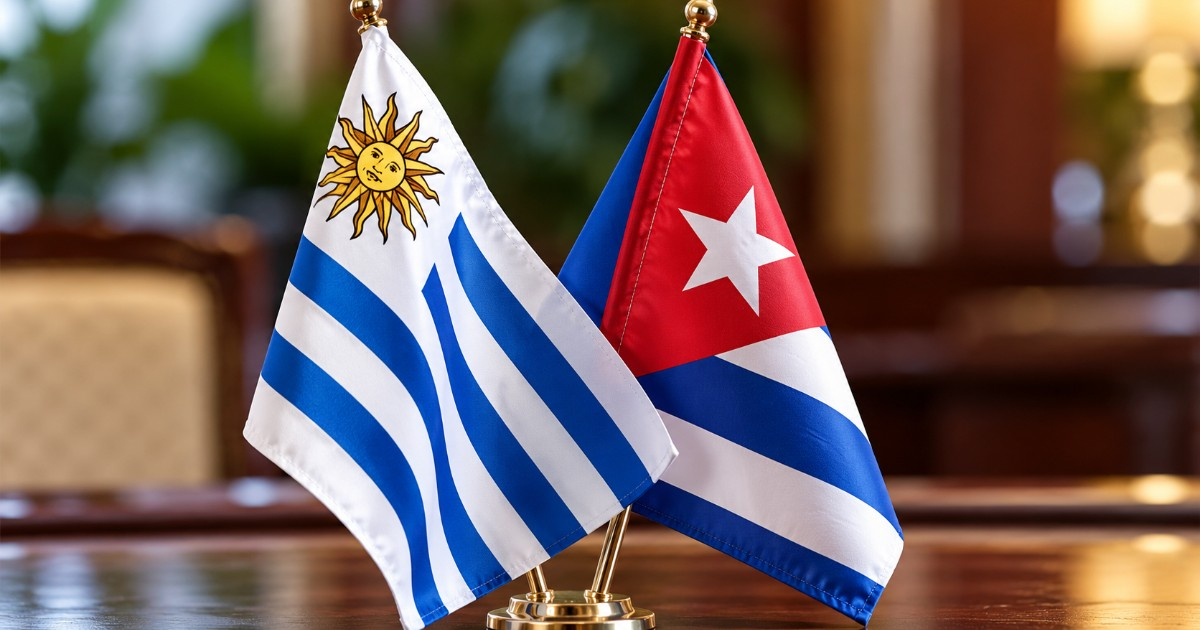
Uruguay has approved a new special mechanism for accessing permanent residency that could benefit thousands of Cubans who have been waiting for years for a response to their asylum applications in the South American country.
The official decree, dated October 8, 2026, establishes permanent residency by root for foreigners who entered Uruguay before January 1, 2026 and are in one of two situations: they have a pending asylum application and explicitly choose to withdraw it, or they have received a final denial of their application.
The measure is particularly significant for the Cuban community. As of the end of June 2026, there were 30,715 pending asylum cases in Uruguay, with approximately 89% belonging to Cuban citizens, according to data from the Refugee Commission (CORE).
The extent of the delay had sparked public demands for authorities to provide answers to those who have been waiting for years for a decision.
The new regime does not grant residency automatically. Among the established conditions are having legally entered Uruguay through an authorized immigration control point, not having any impediments to remain in the country, and not having another avenue to regularize one's immigration status as a temporary or permanent resident.
Those who meet these conditions will have a period of 12 months from the entry into force of the decree to apply for residency based on ties. The National Migration Directorate may extend this period, once only, for another 12 months.
Applicants must present a passport-sized photo, a valid and undamaged identification document, as well as criminal record from the country in which they have resided during the five years prior to entering Uruguay, provided that the stay there has been longer than 180 days.
They must also demonstrate a means of living for themselves or their family unit residing in Uruguay. For this, one can submit the work history from the Social Security Bank or a notarized certificate that verifies the activity carried out and a monthly income exceeding the national minimum wage. The decree also requires the corresponding certificate for the Uruguayan vaccination scheme.
The regulation, however, provides for exceptions for individuals who have justified difficulties in obtaining documents from their country of origin. Migration may assess humanitarian circumstances, the lack of consular representation, the high costs of procedures, or the absence of relatives who can assist in obtaining documentation.
Similarly, the authorities may establish a rapid response procedure for individuals in conditions of special vulnerability who are unable to meet certain requirements.
One of the central points for those currently awaiting refuge is that they must formally withdraw that application when initiating the residency process. The decision will be recorded in the file and communicated to the CORE, while the responsible official must first explain the consequences of that withdrawal to the interested party.
The decree also states that once the procedure has started, the individual may obtain the necessary certificate to manage a provisional identity document as a resident in process. If they ultimately receive permanent residency due to established ties, they may apply for the definitive document.
Renouncing the current asylum application does not permanently close that possibility: the regulation itself clarifies that those who obtain residency through local ties will retain the right to apply for asylum again in Uruguay if there are reasons to do so in the future.
The decree will come into effect 90 days after its official publication.
The decision comes at a time of significant pressure on the Uruguayan immigration system. Despite the large volume of applications, only 52 Cubans have been officially recognized as refugees, while numerous applicants have been left with unresolved cases for years.
Meanwhile, Uruguay has established itself as an increasingly important destination within the Cuban exodus. A route that traverses Guyana and Brazil to reach the Uruguayan border has gained prominence: between January and October 2025, more than 11,000 Cubans passed through the joint immigration control of Santana do Livramento-Rivera.
Related videos:
Filed under: