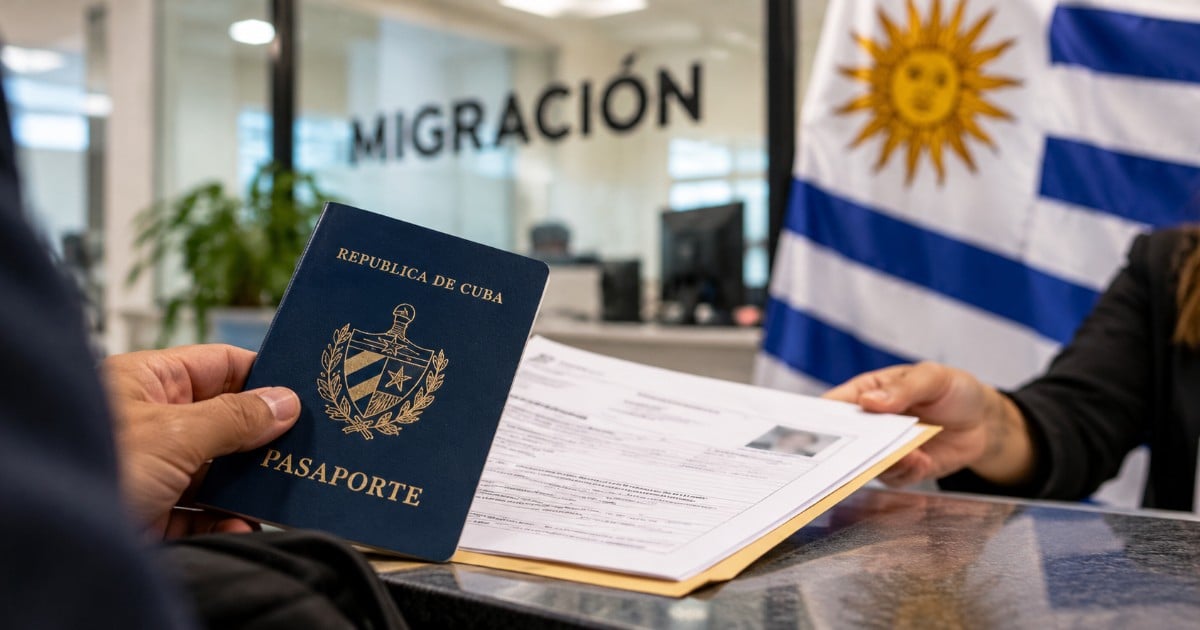
Cuban nationals with a pending asylum application in Uruguay now have a new pathway to regularize their status through a permanent residency based on ties, but they must meet a set of conditions and submit specific documentation to the National Migration Directorate.
The new mechanism was approved by the Uruguayan government through a decree dated October 8, 2026 and is aimed at foreigners who entered the country before January 1, 2026.
Those who have a pending asylum application and decide to expressly waive that process may take part, as well as those who have already received a final denial of their application.
The decree establishes that the residency obtained through this means will be permanent.
To be admitted to the new regime, the applicant must have entered Uruguay in a regular manner and through an authorized immigration control point.
Additionally, you must not have any legal impediments to enter or remain in the country, and you should not have any alternative ordinary means to regularize your status as a temporary or permanent resident.
Once those general conditions are met, these are the main documentary requirements:
1. ID photo. The person must present a photograph for the immigration file.
2. Valid identity document. The decree requires a valid identity document that is in good condition.
3. Criminal record certificate. The corresponding certificate from the country where the individual resided for the five years prior to their entry into Uruguay must be presented, provided they stayed there for more than 180 days. The document must be issued in accordance with the required legal formalities.
4. Proving means of livelihood. The applicant must demonstrate personal income or that of the family unit residing in Uruguay. To do this, they may present the nominated work history from the Social Security Bank or a notarized certificate that verifies the activity they perform and their monthly income.
The norm establishes that these earnings must be higher than the national minimum wage. When using a family member's income, it will also be necessary to legally verify the corresponding relationship.
5. Vaccination certificate. It will also be necessary to present the vaccination schedule certificate from Uruguay or the corresponding document required by health regulations.
In the case of children and adolescents, the authorities must evaluate each case considering the best interest of the child and ensure the effective exercise of their rights.
One of the most important points for Cubans who are still waiting for a response to their asylum request is that they will not be able to simultaneously maintain both processes. Anyone who chooses to apply for the new residency must renounce their asylum claim at the time of starting the residency procedure.
The official who receives that resignation must inform the applicant of its consequences and document it in the file. The decision will also be communicated to the Refugee Commission (CORE).
The decree also addresses situations in which obtaining certain documents from Cuba or another country of origin is particularly challenging.
The National Migration Directorate may, on an exceptional basis and for justified reasons, waive the requirement for the applicant to present documentation issued by the authorities of their country of origin.
To make that decision, you may consider, among other factors, the humanitarian situation in the country, the absence of a consulate or embassy in Uruguay, the high costs, or the lack of family contacts in the country of origin.
The regulation also allows for a rapid response mechanism for individuals in situations of special vulnerability who are unable to meet certain requirements.
At the beginning of the process, Immigration will issue the necessary certificate to manage a provisional identity document as a resident in process. Once permanent residency is granted due to ties, the corresponding certification will be provided to obtain the definitive document.
The possibility of opting for this mechanism will not be indefinite. Interested parties will have 12 months from the entry into force of the decree to apply for residency. The National Migration Directorate may extend that deadline only once for an additional 12 months.
The decree does not take effect immediately: it establishes that it will come into force 90 days after its official publication.
The measure holds particular significance for the Cuban community.
As of the end of June, there were 30,715 pending asylum applications in Uruguay, with approximately 89% belonging to Cuban citizens, according to previously released data from the Refugee Commission (CORE). The delays had resulted in public complaints regarding the situation of thousands of applicants.
Related videos:
Filed under: