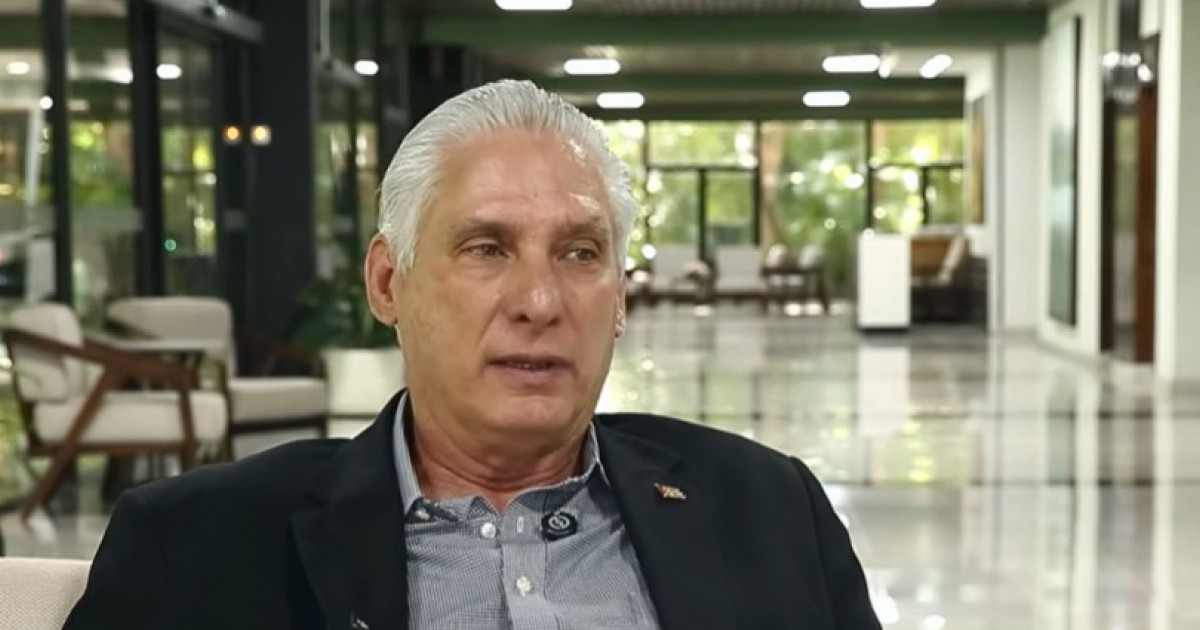
In the midst of one of the worst electrical crises in its recent history, Miguel Díaz-Canel declared that he has "great confidence" in the officials of the Ministry of Energy and Mines (MINEM) and assured that Cuba is undergoing an "energy transition" whose magnitude "we still haven't realized."
"We do have confidence in the professional ability, in the political commitment, and in the responsibility with which tasks are undertaken in this ministry," the president stated in a video shared on social media following his two-day visit to the ministry and to three business groups in the sector.
The statements made on Thursday during that visit stand in stark contrast to the reality faced by millions of Cubans: on that same day, the actual maximum impact on the system reached 1,886 MW, and by this Saturday—the 158th anniversary of the Grito de Yara—the Electric Union predicted an impact of up to 1,680 MW during peak hours, with only 1,250 MW available against a demand of 2,900 MW.
On the same day that Díaz-Canel praised his officials, the failure of the 220 kV Nuevitas-Las Tunas line caused a partial disconnection of the system in the eastern part of the country, leaving Las Tunas, Holguín, Granma, Santiago de Cuba, and Guantánamo without electricity for more than two hours.
The pattern over the past few months is alarming: between September 3 and October 2, 23 out of 28 days exceeded a maximum impact of 2,000 MW, according to data from the Unión Eléctrica itself.
The National Electroenergetic System experienced eight total collapses during 2026, with the last one occurring on September 18, from which it took approximately 32 hours to recover.
In some areas of Mayarí, blackouts have lasted for more than 60 consecutive days, while in Puerto Esperanza, Pinar del Río, residents receive only about two hours of electricity per day.
Díaz-Canel supported the figures showing progress in renewable energies: over 1,000 MW of installed solar photovoltaic capacity during 2025, 144 solar parks in operation, and a renewable participation that reportedly rose from 3% to 10% in one year.
However, solar generation does not meet nighttime demand nor does it compensate for the collapse of thermal generation, which has been deteriorated by years of neglect and chronic fuel shortages.
The minister Vicente de la O Levy himself acknowledged in July that “the road is long” and that there were not enough resources to quickly stabilize the grid, also admitting that some communities had gone without electricity for as long as 105 consecutive days.
This is not the first time that the president has turned to institutional praise while the crisis worsens. In July, Díaz-Canel called for "better organization" of the blackouts instead of providing structural solutions, and in August he promised "equity" in their distribution.
This time, in addition to expressing his confidence in the ministry, the leader urged the officials themselves to make a change: “The first thing that needs to be transformed energetically is this ministry,” he said, a phrase that Cuba arrives at this October 10 in the dark which implicitly acknowledges that something is not working in the institution that has been in charge of the worst energy crisis in the island's recent history for years.
Related videos:
Filed under: