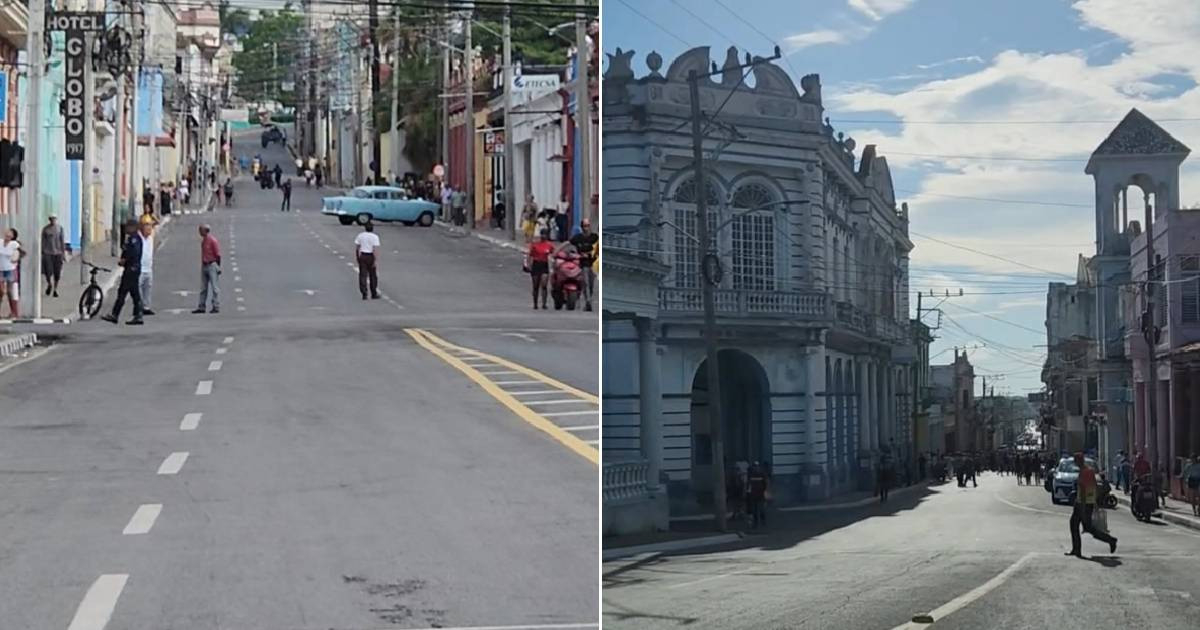
The lack of drinking water for more than 50 days on Calle Real, in the heart of Pinar del Río, prompted the playwright Irán Capote to make a proposal on Saturday that questions the state management of the service and demands that the aqueduct be handed over to a small and medium enterprise (mipyme) in an effort to address a crisis that forces families to ration even water for basic hygiene.
"No matter how much I tell it, it's hard for anyone to believe that on the main street of a city, we have been without potable water service for over 50 days. And I am talking about the very heart of the city, not a peripheral area. I am talking about Calle Real," Capote wrote on his Facebook profile.
He, also a theater director and screenwriter, explained that three people live in his home, and each has two five-liter jugs of water per day. One is reserved for basic hygiene, cooking, and washing dishes, while the other is designated for drinking water, making coffee, and handling emergencies.
"Carrying two empty gallons to fill up wherever I'm allowed has become part of my daily routine. The key is not to do it every day in the same places so as not to take advantage of those who can help you," he recounted.
The trigger for his publication was a pleasant surprise during one of those trips to fetch water. Capote found the queue for the tricycles almost empty because the Route 6 urban bus had returned, reactivated at the end of September through a partnership between the Business Group for Transportation of Pinar del Río and the mipyme On Bazar. The fare is 15 pesos.
The experience led him to propose that a similar formula could be applied to water supply services. "I was very pleased because I have faith that at any moment, they will also provide water supply services to a small or medium-sized business, or to a country, or even to Cangrejo himself, who is said to have a lot of big businesses 'on the side,'" he wrote with irony.
Capote also criticized the Pinar del Río Water and Sewer Company for focusing its publications on political slogans while numerous residents report a prolonged lack of drinking water.
"Water supply! Give in already, my dear, we need water, not patriotic posts. Take a lesson from the folks at Transport, come on..." he concluded.
The comments on the complaint expanded the scope of the impacts. One neighbor stated that Cuarteles Street had been without service for almost two months, while another claimed that the area around the pediatric hospital had been without water for 75 days, since July 25.
A resident of Retiro Street also supported the possibility of handing over management to a small business. "Maybe they'll give it to a small business and we could have water, because nothing state-run works," he remarked.
Other users questioned the company's priorities. An internet user recalled a post from Acueducto featuring workers engaged in beautification efforts under the slogan "Social Responsibility," an image they deemed disconnected from the more urgent needs of the residents.
"I didn't know whether to laugh or cry. We live —or I don't know if I should say, we die— only on political fanfare and appearances," he wrote.
The complaints shared by users highlight shortages as one of the everyday concerns in various neighborhoods of Pinar del Río.
Capote's proposal, presented with dark humor, questions the state's ability to provide a basic service and demands answers regarding a situation that, according to testimonies, has been ongoing for weeks.
The provincial PCC acknowledged in September that the concerns regarding water "are reiterated" session after session and that over 100 million pesos invested have not resolved the issue.
By the end of September, 159,171 inhabitants of the province were affected, and only 50% of pumping time was guaranteed in the capital, according to the official newspaper Granma.
Weeks ago, authorities acknowledged that 2.7 million Cubans have total or partial access issues to drinking water, while about 85% of the pumping stations rely on the National Electric System, meaning that each blackout directly halts the supply.
Pinar del Río is also facing three active outbreaks of hepatitis A, a public health consequence that the authorities have not been able to control despite recommending manual chlorination of water in homes.
Related videos:
Filed under: