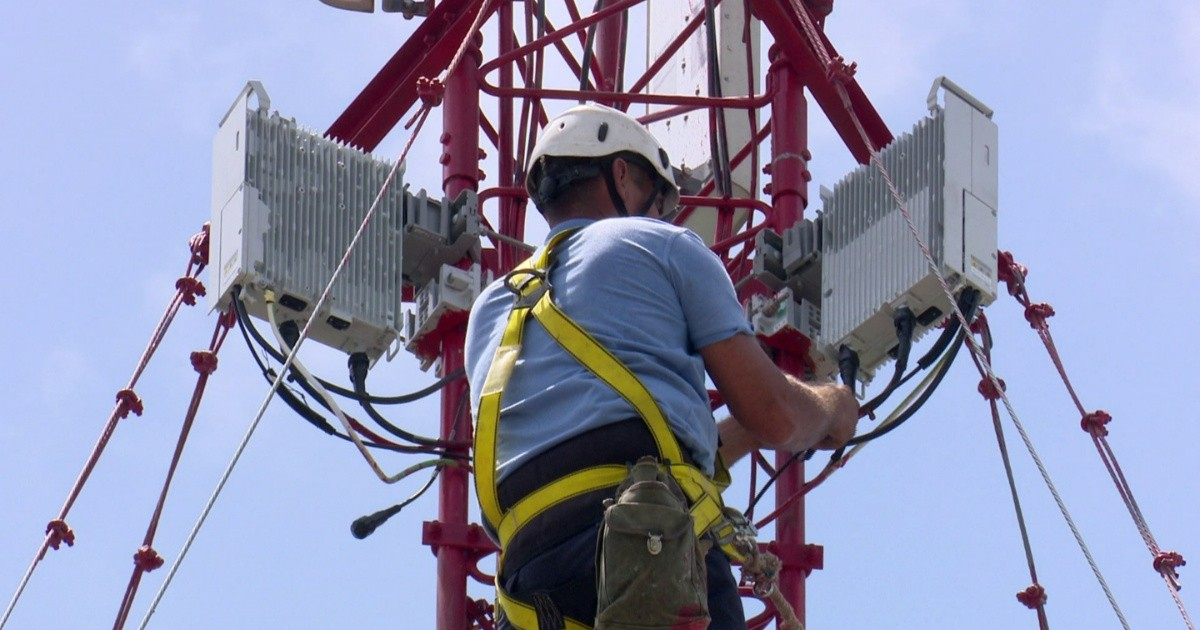
The territorial director of ETECSA in Camagüey, Luel García Lorenzo, acknowledged this Sunday that more than 100 of the 179 radio bases in the province could be turned off at the same time due to the energy deficit, according to a report published by the official Granma.
The official was direct in pointing out the cause: "The main impact is due to the energy deficit."
When more than half of the provincial antennas go offline, those that remain operational become overwhelmed and cannot handle the user traffic, leaving residents and their relatives abroad unable to communicate normally.
The situation is worsened by the state of the fixed network infrastructure: García Lorenzo warned that 75% of this technology is outdated, that there are still 12 km of lead cable in service, and that between 60% and 70% of the wiring has been in use for more than 30 years.
To reduce dependence on the electrical grid, ETECSA is implementing an investment plan in Camagüey that is about 300% of the planned amount for this year, with an emphasis on changing the energy matrix.
Between March and September, 28 photovoltaic solutions were installed: eight 2 kW systems from a Chinese donation and ten 7.2 kW systems that ensure cellular phone service in towns such as Sibanicú, Guáimaro, Jimaguayú, Najasa, Esmeralda, the tourist area of Santa Lucía, and Vertientes, among other locations. During the daytime, some of these systems even allow for 4G service.
Three larger-scale projects are currently underway: the one in Guáimaro is 70% complete, the one in Sierra de Cubitas is 25% complete, and the one in Nuevitas already has the necessary equipment available.
In mobile telecommunications, new sites were activated in Martí, Guáimaro, and Cayo Cruz, and two radio bases upgraded from 3G to 4G in Lugareño and Cándido González. Additionally, 29 radio bases were upgraded in the 900 MHz band and eight in the 2100 MHz band.
The deterioration of batteries adds another challenge: in 2025, more than 60 banks were replaced, mostly made of lead-acid or gel, technologies that do not tolerate deep discharges like those caused by prolonged blackouts. This year, it is planned to replace around 50 additional banks.
The situation in Camagüey is not an isolated case. At the end of September, ETECSA acknowledged in a national statement that the lack of electricity is shutting down dozens of technological sites across the country and that "it is not feasible to continue investing in expanding the access network if there is no capacity to energetically support the infrastructure."
In Santiago de Cuba, the territorial director stated that between 140 and 150 sites were out of service daily due to a lack of electricity or fuel.
The day before the diagnosis in Camagüey, a shot on the 220 kV Nuevitas–Las Tunas line partially disconnected the eastern National Electric System and affected more than three million people for approximately four hours, demonstrating that the electrical infrastructure supporting telecommunications remains the most fragile link in the chain.
García Lorenzo acknowledged that the results of the investments "will be perceived by the population as they consolidate," an implicit warning that any improvement, if it comes, will not be immediate.
Related videos:
Filed under: