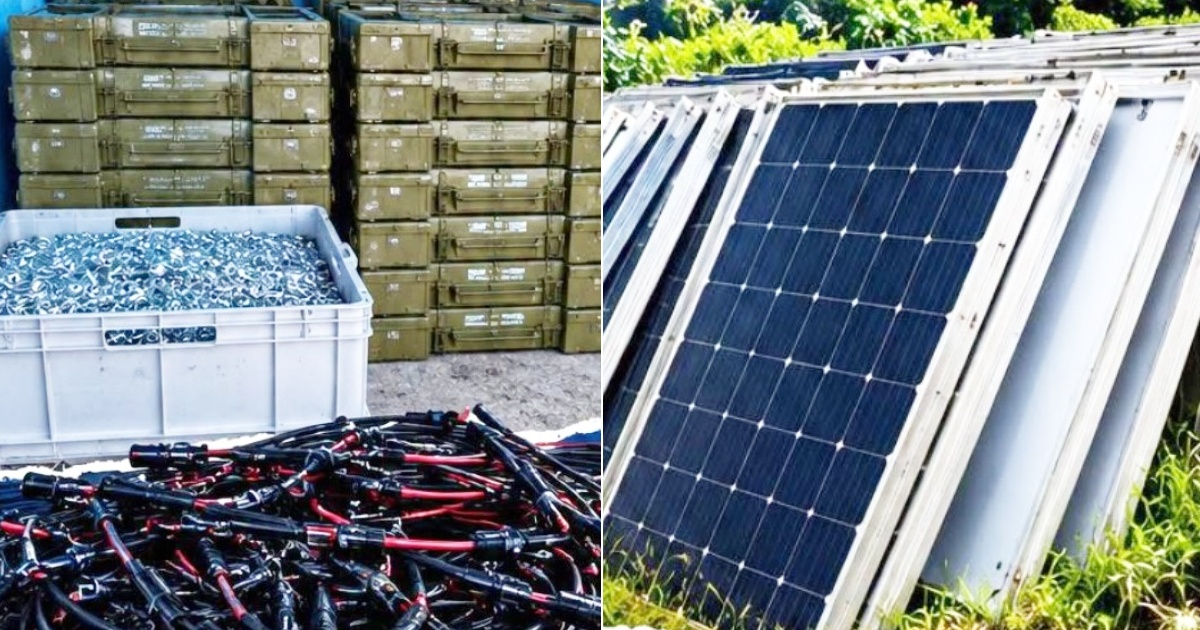
The authorities of Guantánamo recovered about 50 solar panels that were taken from the Santa Teresa 4 solar park, following a search of a house in the municipal capital.
The finding, reported by the official Facebook profile "Guantánamo y su Verdad," has drawn attention due to the scale of the theft and the involvement of workers from the park itself among those arrested.
"Not just one or two!", emphasized the post, which also described how alongside the panels, there were boxes containing screws, washers, cables, and connectors, meaning all the necessary components to assemble and operate a complete photovoltaic system.
"The investigations revealed that these panels were taken to be sold in the informal market," the source specified.
Missing cables and detained individuals with privileged access
The theft was not limited to the panels. Authorities are also investigating the disappearance of approximately 700 meters of cables from the installation, although it has not yet been specified how much of that material has been recovered.
Among those arrested, the exact number of whom was not specified by the official source, are workers from the solar park itself, indicating an operation with insider access.
"According to what is known, the case is being processed for a charge of sabotage.", stated the publication.
That charge carries severe criminal penalties.
Article 125 of the Cuban Penal Code establishes penalties ranging from seven to 15 years for sabotage of the electrical system, which can escalate to between 10 and 30 years, life imprisonment, or even the death penalty if severe consequences are proven.
The Cuban regime has increased the penalties for electrical sabotage this year specifically to curb a wave of thefts that have been rising in recent months.
The preventive talk that was of no use
One of the most awkward details of the case is the timeline: just days before the robbery, executives and employees of the park had participated in awareness sessions with officials from the Ministry of Interior (MININT), representatives from the Electric Company, and the Prosecutor's Office.
The official publication itself could not avoid self-criticism: "Prevention cannot remain just a discussion."
That sentence summarizes what many citizens noted in the comments: that an informational meeting does not replace the effective control of resources, nor the daily monitoring of the facilities.
Citizen outrage and suspicions of complicity
The reaction on social media was one of strong outrage.
"Let the full weight of the law fall," "Zero tolerance for crime," and "It's unforgivable, it's sabotage and that must be paid dearly" were some of the expressions noted in the comments.
However, alongside the support for police actions, uncomfortable questions arose.
«Such a number of panels was not stolen by a thief», «That amount of panels cannot be stolen in one night», and «There was a lack of control, prevention, and oversight of state and public resources», highlighted other users, demanding that the investigation also encompass those who were responsible for safeguarding the seized materials.
A phenomenon that spreads throughout Cuba
Between 2025 and mid-2026, the Attorney General's Office admitted more than 460 criminal investigations for crimes against the National Electric Power System.
In Pinar del Río, a man was sentenced to 12 years in prison for stealing screws from a solar power park.
In Matanzas, three individuals were arrested for the theft of 28 solar panels intended for water pumping.
In response to the increase in criminal activities of this nature, authorities in Las Tunas have begun to implement an invisible chemical marking method, detectable with ultraviolet light, to identify those who handle the panels.
The Electric Company of Havana has also resorted to chemical traps in substations to catch those stealing dielectric oil.
What is at stake
Guantánamo is especially vulnerable: it relies on a single 110 kV transmission line from Santiago de Cuba, the failure of which left the entire province without electricity in June of this year, resulting in outages of up to 33 consecutive hours in some areas.
The solar parks provided about 32 MW during daylight hours, a critical source for a population that is all too familiar with what it means to be left in the dark.
"Every panel counts! And so does every cable, every connector, and every piece that allows us to generate electricity. Protecting them is taking care of a service that is essential for all of us," concluded the post that revealed the case.
Related videos:
Filed under: