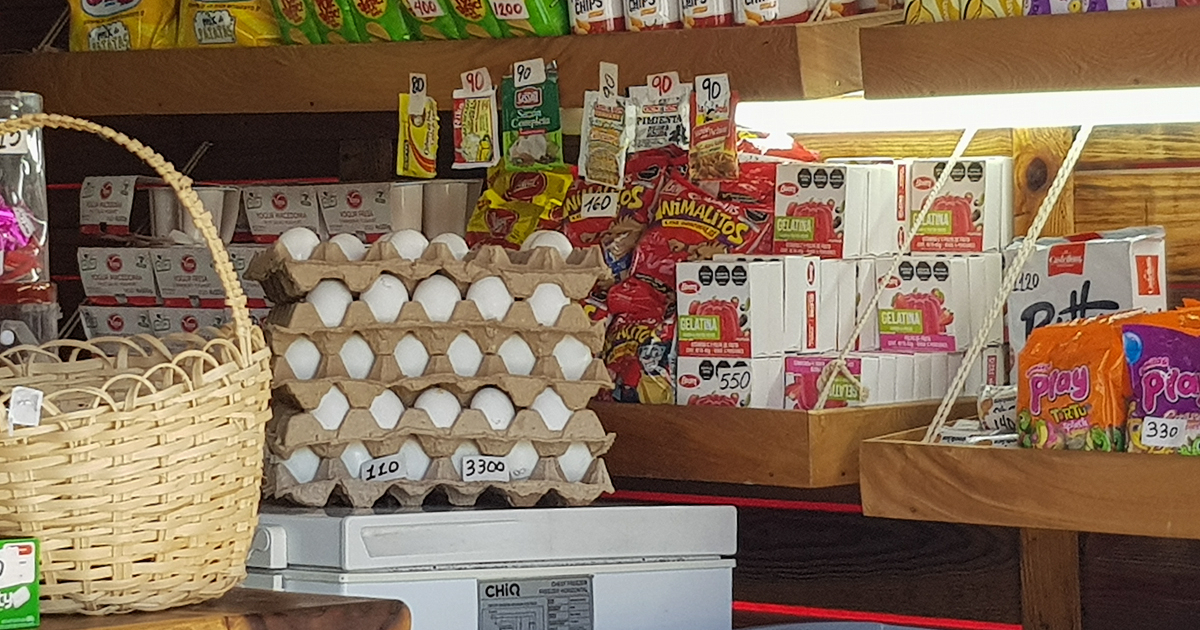
The price ceilings enforced in Cuba have fostered corruption, shifted products to the black market, and failed as a mechanism to contain inflation, according to an analysis by economist Ayuban Gutiérrez Quintanilla published this Tuesday on the official site Cubadebate.
The article titled "Should Prices Be Freed or Capped in Cuba? Ten Necessary Questions" questions the outcomes of administrative restrictions on trade and warns that the government's own decisions could exacerbate the economic imbalances they aim to correct.
Gutiérrez argues that controls require a high level of institutional oversight and that when applied in the context of scarcity and income disparities between the state and private sectors, they create conditions that encourage irregularities.
"These restrictions ultimately lead to a transfer of goods and services to informal markets," the author points out, adding that this scenario "results in an increase in corruption."
According to their explanation, merchants can choose to move regulated products to the informal market or continue selling them in authorized establishments without adhering to the established prices.
In both cases, the consumer is exposed to a more limited offer and to prices that the authorities cannot manage.
"In Cuba, price controls have not yielded results beyond a few weeks," claims the economist, who attributes this failure, among other factors, to the weakening of institutional capacity to enforce measures that contradict market dynamics.
The analysis also warns that the widespread non-compliance with regulations undermines trust in institutions, as it highlights the difficulties faced by the State in enforcing its own decisions.
The criticism targets the so-called reference prices, adopted by various local administrations after the national government removed certain caps during the summer.
For Gutiérrez, the reference prices are "a euphemism" and essentially represent, in practice, "capped prices or a caricature of these" . He also believes that these measures are unlikely to be sustainable in the medium and long term.
The author points out another contradiction: while national authorities are modifying their pricing policy, some local governments continue to impose similar restrictions.
In his opinion, these differences undermine the credibility of economic management and the trust in the government's ability to lead it.
Regarding the causes of inflation, it identifies internal and external factors. Among the internal factors, it highlights sustained fiscal deficits and their financing through monetary emission without sufficient backing in production, which it considers a fundamental source of demand-driven inflation.
It also mentions the decline in national production, shortages, the negative expectations of economic actors, the rising international costs of imports, and U.S. sanctions.
His conclusion is that setting prices by administrative decision does not address these structural causes.
The economist does not present liberalization as an immediate solution for families. He acknowledges that removing controls can lead to significant social costs, particularly in terms of inequality, and emphasizes the need for protective measures for the most vulnerable sectors.
However, the technical explanations contrasted with the concerns expressed by many Cubans in their reactions to the publication, centered around a much more immediate question: how to survive on salaries and pensions that are losing purchasing power while food prices continue to rise.
One of the reactions lamented that economic decisions never seem to benefit ordinary citizens: "The truth is that there is nothing that benefits the common people; a retiree cannot live like this, and no one thinks or creates anything that helps the people."
Another person questioned why the authorities focus on providing explanations for the causes of the problem when what families need are concrete answers: "Basic needs take precedence over any explanation, urgent solutions are needed."
The decline in income was one of the recurring complaints. One response noted that salaries and pensions are increasingly insufficient and described the difficulties of covering daily expenses such as feeding children who attend school.
The post mentioned the price of bread bags, which must be purchased every few days, and the price of a soda pack that, according to their testimony, had reached 250 pesos. "We really have to work magic to survive," they expressed.
Other comments resorted to irony to question the gap between economic explanations and the needs of the population. "A tongue twister that only salary and stomach fail to understand," wrote one person.
In another reaction, it was questioned why citizens should continually accept new difficulties: "There are so many things to understand in this, our beautiful and incomparable country. And not just understand, but to ACCEPT."
Frustration was also directed towards the Government's responsibility. "What I have to understand is that the country's leadership needs to resolve the issue; that's what I need to understand. I don't know how, but they have to find a solution, whether with price caps or without them," remarked a commentator.
Another reaction summed up the distrust in the authorities with a phrase: "What I understand is that the solution is in the hands of the problem."
The rejection of economic justifications also appeared in comments that criticized the emphasis on so-called objective causes. "It's incredible how they like to blame external factors," wrote one person, while another questioned why those in charge of the economy did not take greater responsibility for their outcomes.
There were also those who rejected the liberalization of prices, believing it particularly harms workers and retirees. One reaction argued that removing price caps and circulating high-denomination bills contributes to the rising cost of goods and the impoverishment of those who depend on fixed incomes.
The debate extended to micro, small, and medium-sized private enterprises (mipymes). Some participants accused them of mainly engaging in the resale of imported goods rather than producing items, while others reported obstacles to making payments via bank transfers.
One of the most extensive interventions stated that certain businesses refuse transfers, set schedules or limits for receiving them, and force customers to seek cash, a particularly challenging situation for those who receive salaries or pensions through banking methods.
We are starving because they refuse to accept the transfers, money earned through sweat and sacrifice," that person reported. The accusations reflect experiences shared by commenters, not individual violations proven by economic analysis.
Other interventions highlighted the lack of domestic production and bureaucratic restrictions. One person called for agricultural plans that allow for the sale of food at prices compatible with wages, while another suggested correcting the import procedures faced by non-state management forms.
The reactions indicate that the disagreement is not limited to the convenience of setting or freeing prices. There is also concern about the actual ability of Cubans to acquire food and other essential products, regardless of the mechanism chosen by the authorities.
The diagnosis published now is not the first to acknowledge the ineffectiveness of the price caps. In June 2026, Miguel Díaz-Canel himself admitted that those measures had not managed to contain inflation and that they had led to shortages, a shift towards illegal activities, and higher prices.
Shortly after, the Ministry of Finance and Prices removed the national retail limits on chopped chicken, cooking oils, powdered milk, pasta, and sausages.
However, the removal of those national controls did not end administrative interventions. In August, Cuban economists criticized the decision of several provinces to re-establish price ceilings, despite the negative results acknowledged weeks earlier by the Government itself.
The difficulties in implementing these restrictions were also highlighted by journalists from the state press. In Ciego de Ávila, professionals from the newspaper Invasor described the price caps as "a dead letter", noting that the official rates announced for agricultural products never effectively appeared in the markets.
While the debate over controls continues, the official year-on-year inflation reached 25.19% in August 2026, according to data collected in a report from the Center for Cuban Economy Studies at the University of Havana. For households reliant on salaries and pensions in Cuban pesos, this trend continues to diminish their purchasing power.
Related videos:
Filed under: