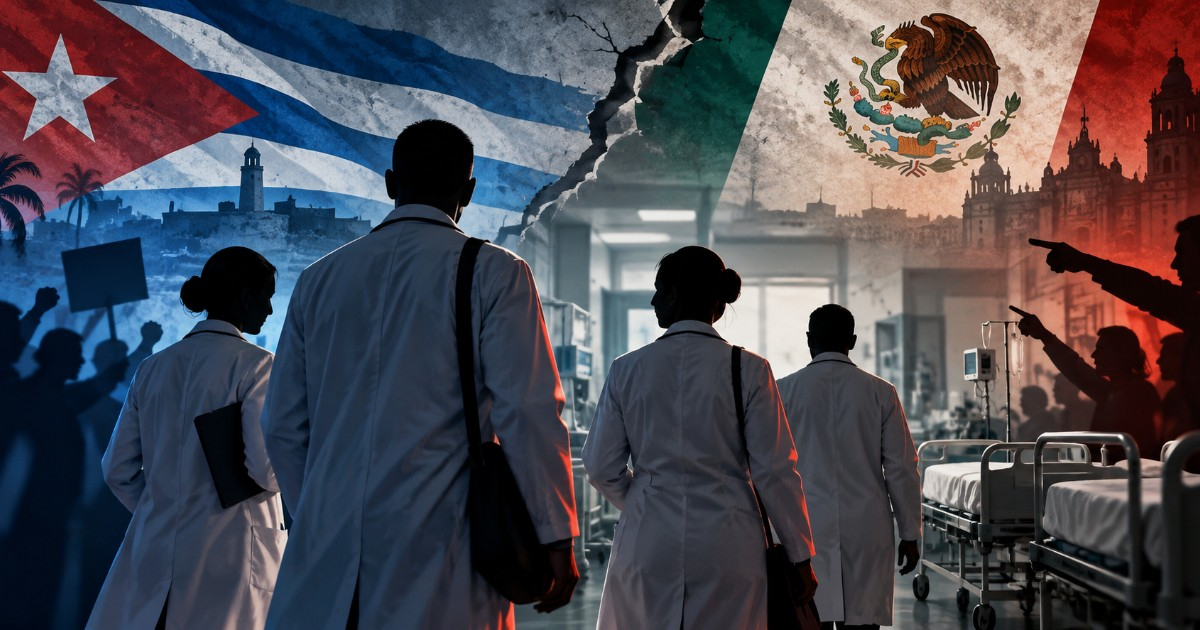
The hiring of Cuban doctors has returned to the forefront of political confrontation in Mexico after the opposition party National Action Party (PAN) accused the government of Claudia Sheinbaum of favoring professionals from the Caribbean island while Mexican doctors and nurses protest over labor conditions and the shortcomings of the public health system.
The vice-coordinator of the PAN in the Chamber of Deputies, Federico Döring, demanded the resignation of Zoé Robledo, director of the Mexican Social Security Institute (IMSS), and called on the Mexican president for a change in the leadership of the organization, according to the media Latinus.
In an interview, the legislator questioned the priorities of the Executive and contrasted the official support for Cuban doctors with the complaints from Mexican workers about shortages of medications, labor issues, and cuts in benefits.
“President, I wish you valued the Mexican doctors and nurses who work at IMSS, and granted them a hundredth of the budgetary support, affection, and recognition that you give to Cuban doctors”, Döring stated.
The deputy was even more straightforward in questioning the treatment that, in his view, different professionals receive: "Why do you only have hugs for Cuban doctors, Madam President, while for the Mexican doctors and nurses from IMSS, you only have beatings?"
The statements come amid a growing conflict between Social Security workers and their executives, with protests that began on October 8 and a national megamarch called for this Tuesday, the 13th.
Employees have voiced grievances regarding labor and economic issues, while the public discussion about the state of the healthcare system also includes reports of medication shortages and deficiencies in hospital facilities.
Döring stated that the medical and nursing staff feel disadvantaged by the decisions of the current management of the IMSS and by the lack of union support.
"The issue of the eleven babies who have lost their lives in the last month is present, along with this crisis where doctors and nurses feel undermined by the current leadership of the IMSS and the lack of union support," affirmed the legislator.
For the opposition leader, Zoé Robledo's departure is a necessary condition to attempt to resolve the conflict. Therefore, he urged Sheinbaum to consider his replacement.
"If you truly want to resolve the conflict, you need to change the interlocutors," he stated.
The criticism is particularly significant because Zoé Robledo has been one of the main advocates for the medical cooperation agreements between Mexico and Cuba.
Under her leadership, Mexican authorities promoted the integration of Cuban specialists into public hospitals, particularly in regions where the government claims there are challenges in filling positions with national staff.
In April 2024, and to reach 1,200 Cuban specialists in units and hospitals across 23 Mexican states.
The recruitment of these professionals has remained one of the most visible cooperation policies between both governments, but it has also faced criticism regarding its costs, the working conditions of doctors, and the resources transferred to the Cuban authorities.
In March 2026, Sheinbaum confirmed that she would uphold the agreement with Havana despite American pressures and the cancellation of similar programs in other countries.
The president then defended the usefulness of Cuban specialists in expanding healthcare, particularly in remote areas where, as she explained, there are not enough Mexican specialist doctors available.
His government has also denied the allegations regarding possible irregularities in the program. In March, the Mexican Embassy in the United States denied that the agreements involved the exploitation of Cuban doctors and stated that the health cooperation respects labor rights.
Mexican authorities assert that the program addresses medical coverage needs and that foreign professionals receive appropriate conditions to perform their duties.
However, the hiring and compensation conditions for the members of the Cuban brigades continue to be a subject of controversy.
At the beginning of October, three Cuban doctors working in Mexico reported that they had not been paid for over two months and that they had not received clear answers regarding when the outstanding payments would be made.
One of the professionals assured that the delays affected both the funds channeled through Banjército and those corresponding to the Bank of Wellbeing. He also reported that the members of the mission were prohibited from making public complaints.
Related videos:
Filed under: