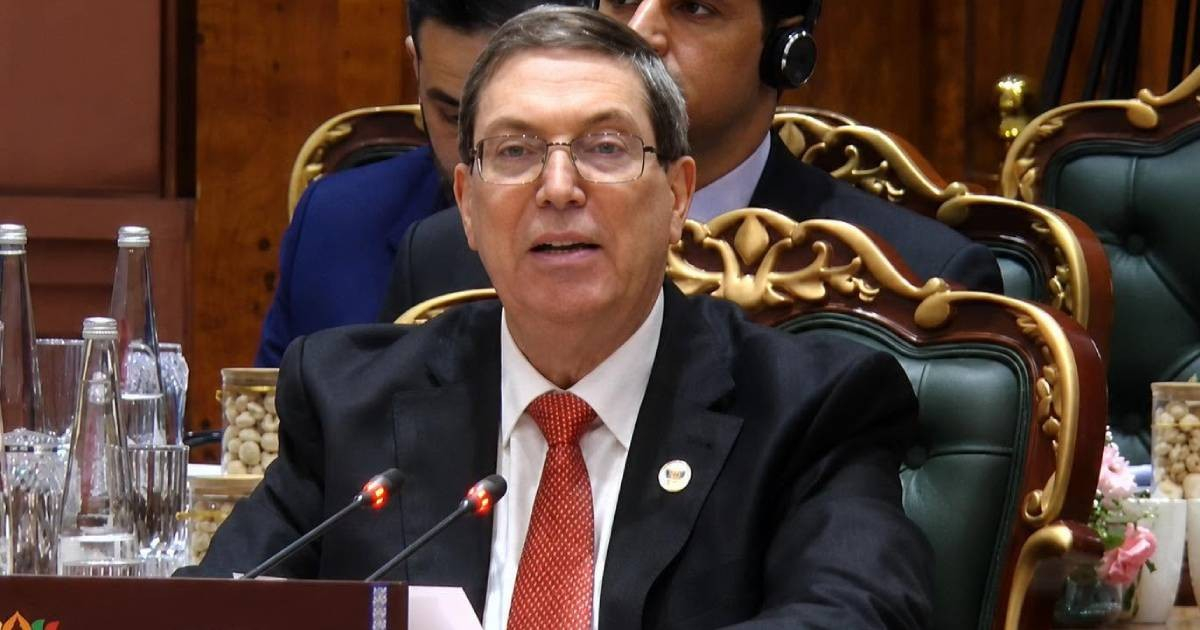
The Cuban Foreign Minister Bruno Rodríguez Parrilla rejected the 2026 Trafficking in Persons Report from the U.S. State Department this Saturday, describing it as "unilateral and false" and accusing Washington of using it to "justify its aggressive policy" against Cuba and to carry out a "sick persecution" of Cuban medical cooperation.
The report, published on Thursday by the State Department, kept Cuba at Tier 3 —the most severe category— for the seventh consecutive year since 2019, concluding that the regime implements a “government policy or pattern” of forced labor in its labor export program.
Rodríguez Parrilla described it as "cynical" for the report to openly acknowledge the pressures that the U.S. exerts on governments receiving Cuban cooperation: "It is cynical to explicitly recognize the harsh pressures and the blackmail that are applied against governments that receive cooperation from our country, regardless of the consequences for the populations that have benefited from the presence of Cuban medical personnel."
The chancellor concluded his message with a direct accusation: "Once again, the U.S. government insists on the lie to try to manipulate international public opinion."
What the Cuban regime calls cooperation, the State Department report describes as a scheme in which the State retains between 50% and 95% of the salaries that the recipient countries pay for these services, while subjecting the workers to surveillance, curfews, and restrictions on movement, and threatening their families in Cuba to prevent them from leaving the missions.
At the beginning of 2026, about 18,000 Cuban workers were deployed in 52 countries, compared to the 24,000 registered at the start of 2025. The decrease is attributed to diplomatic pressure from Washington and the withdrawal of four countries from their bilateral agreements with Cuba during the previous year. Healthcare professionals comprise 75% of the exported civilian workforce.
The report also includes, for the second consecutive time, the recruitment of Cubans as mercenaries to fight in Ukraine on behalf of Russia, labeling it as a form of human trafficking.
According to the document, Cuban citizens were lured by false job offers in construction or other trades in Russia and, upon arriving in Moscow, were coerced into serving on the Ukrainian front. The organization Citizenship and Freedom estimated that up to 25,000 Cubans were recruited for the Russian army, according to data from Ukrainian intelligence.
In September 2026, Amnesty International documented this recruitment through deception and urged Ukraine to assess whether some Cuban prisoners of war are victims of trafficking, not voluntary combatants. The Cuban MINREX had denied any state responsibility upon the initial mention of the issue in the 2025 report, claiming that the Cubans who participated in the conflict did so "on their own".
International pressure on medical missions has notably intensified this year. In April, the Inter-American Commission on Human Rights published a 199-page report based on 71 testimonies that concludes there are serious indications of forced labor, human trafficking, and “contemporary forms of slavery” in Cuban missions, and recommended that American countries withdraw from the program.
In Mexico, for example, the government paid about 3,750 dollars per month for each doctor, while the professional received only around 200 dollars.
In July, the U.S. sanctioned the managing entities of the program —the Cuban Medical Services Marketing Company and the Central Unit for Medical Cooperation— as well as the Minister of Health, José Ángel Portal Miranda, and the director of the UCCM, Gretza Sánchez Padrón.
The State Department estimates that the military conglomerate GAESA, which controls approximately 40% of the Cuban economy, could manage up to 20 billion dollars in assets, some of which may come from labor exports.
Cuba is among the 12 countries in the world with a documented "policy or pattern" of state-sponsored human trafficking, alongside North Korea, Russia, China, and Iran, among others.
The attendance restrictions associated with Level 3 took effect on October 1, at the beginning of the U.S. fiscal year.
Related videos:
Filed under: