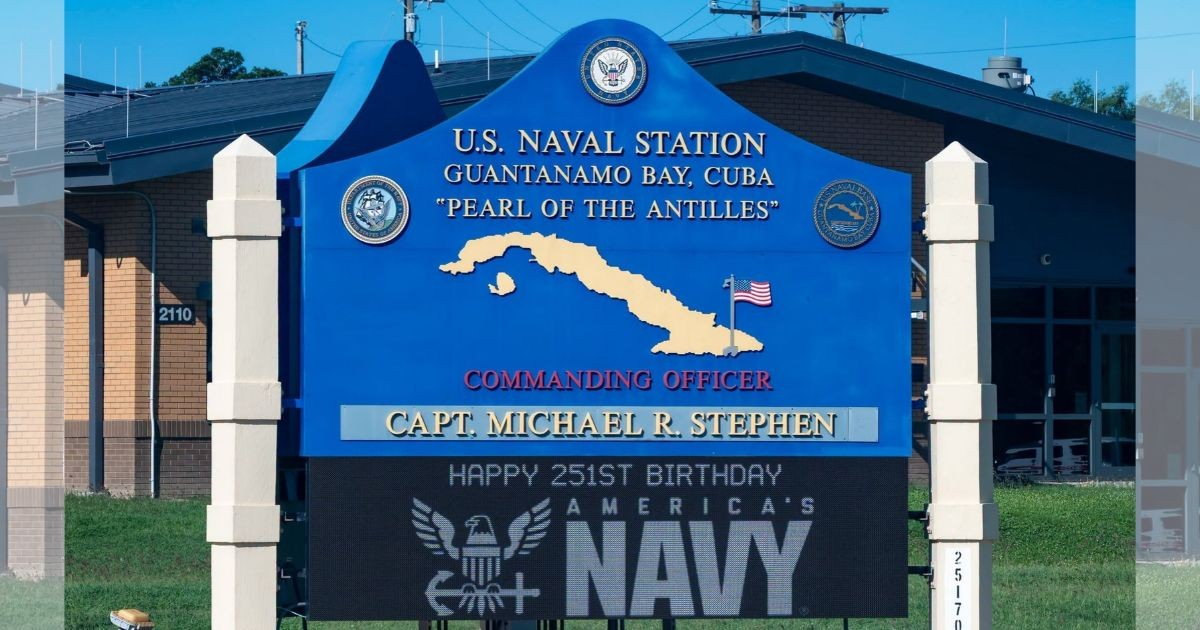
The United States Navy is celebrating its 251st anniversary this Tuesday, and the Guantanamo Naval Base took this opportunity to highlight that it is the oldest U.S. military installation abroad, with a permanent presence in Cuban territory dating back to 1903.
In a message posted on their official Facebook page, the military installation congratulated the U.S. Navy and reviewed its origins, linked to the 1898 war against Spain and the subsequent lease of land and waters in Guantánamo Bay.
"Happy 251st Anniversary of the United States Navy!" the post begins, highlighting that the base has maintained its mission of surveillance and military support for over 120 years.
«As the oldest American military installation abroad, we have upheld our surveillance mission since 1903,» the statement notes.
The anniversary date corresponds to the founding of the United States Navy, whose origins trace back to October 13, 1775, when the Continental Congress authorized the creation of a naval force during the American Revolutionary War.
According to the United States Naval History and Heritage Command, October 13 was officially recognized as the commemorative date of the institution in 1972, although its historical origins date back nearly two centuries earlier.
The publication of the Guantanamo Naval Base reminds us that the American presence in the bay began in 1898, when U.S. forces and their Cuban allies occupied the area to use it as a forward operating base in the war against Spanish colonial rule.
Five years later, in 1903, the newly established Government of the Republic of Cuba agreed to lease to the United States an area of approximately 45 square miles of land and water in Guantánamo Bay, intended to support the operations and supply of the growing U.S. Navy fleet.
"In 1903, the United States leased 45 square miles of land and maritime territory in Guantánamo Bay from the newly independent Cuban government, to support the maintenance of the growing U.S. Navy," explains the statement.
In its anniversary message, the base also emphasizes that it continues to perform essential functions for the preparation of military operations and the logistical support of various units of the U.S. Armed Forces.
"The Guantánamo Bay Naval Base, Cuba, is a strategic military facility of the United States that contributes to mission readiness and operational excellence," states the publication.
Among the services provided, it mentions facilities, security, and support for deployed units, military personnel, U.S. civilian employees, foreign citizens, and their families.
The report also indicates that it works in coordination with the Department of State, U.S. Southern Command, the Fourth Fleet, and the Seventh District of the Coast Guard.
Its current functions include supporting joint military operations, hosting the Military Commissions Office, and conducting humanitarian operations related to migrants.
The Office of Military Commissions is linked to the system of military courts established to process certain cases related to terrorism and armed conflicts. The facility also houses the well-known detention center opened in 2002, following the events of September 11, 2001.
The anniversary statement also highlights the size of the community that relies on the military installation. According to their data, more than 5,000 people, including U.S. personnel and foreign citizens, are part of the base community.
"We are committed to supporting a diverse community of over 5,000 military personnel, staff members, and foreign citizens," the publication states, presenting the facility as part of U.S. missions for security and humanitarian assistance in the Western Hemisphere.
The existence of this military base is due to the agreement linked to the Platt Amendment, incorporated into the framework of relations between both countries at the beginning of the 20th century, and constitutes one of the most controversial chapters in the history of Cuba and the United States.
The facility continues to operate under U.S. control, although Cuba retains ultimate sovereignty over the leased territory, while the United States exercises jurisdiction and control over the area, in accordance with the historical agreements that govern its presence.
The Cuban government considers the U.S. presence in Guantanamo to be illegitimate and has repeatedly demanded its return. Washington, on the other hand, maintains the validity of the legal framework that allows the base to remain.
In its recent history, the base has served as a reception and custody facility for migrants. In February 2025, the United States deployed Marines in Guantánamo to support the expansion of facilities designated for migration operations, as part of the measures initiated by the Donald Trump administration.
The strategic importance of Guantánamo has taken on a new dimension in 2026, amid tensions between Washington and Havana and the incorporation of advanced military technologies.
At the beginning of October, South Command announced that Guantánamo would host the first regional training and support center for its Autonomous Warfare Command, a facility dedicated to integrating drones, unmanned systems, and new operational capabilities.
Later on, details were revealed about the autonomous systems and artificial intelligence technologies associated with that deployment, which strengthens the role of the base as a U.S. military platform in the Caribbean.
Related videos:
Filed under: