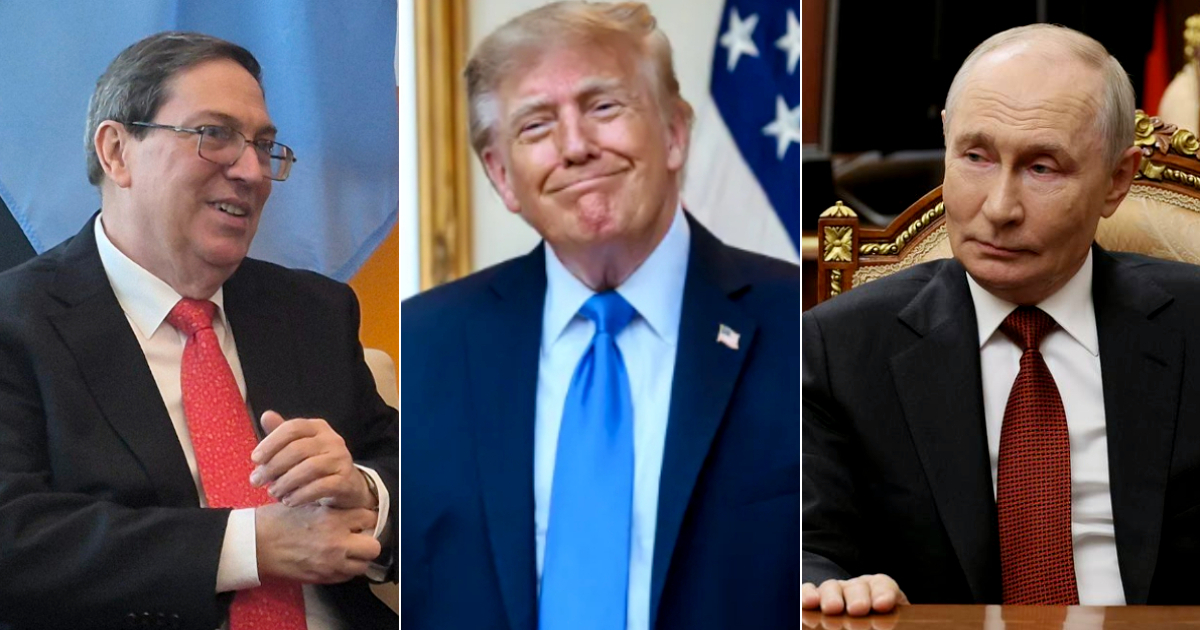
The Cuban Foreign Minister, Bruno Rodríguez Parrilla, launched a strong criticism this Saturday against the Trump administration for its attempt to impose the term "superintelligence" instead of "artificial intelligence."
In his message, he amassed accusations against Washington but omitted the agreement announced hours earlier between Donald Trump and Vladimir Putin to trade millions of tons of Russian diesel.
The omission contrasts with his repeated praises for Moscow: the ally that Havana presents as support against U.S. pressure has just made an agreement with the U.S. president whom Rodríguez accuses of aggression and blackmail.
"The government of #USA is no longer satisfied with military aggression, usurping foreign territories and resources, extrajudicial killings at sea, energy and naval blockades, punishing entire populations by threatening the rest of the world, or changing geographical names for political whims. Now they are trying to impose a new technical name for #ArtificialIntelligence through new threats and blackmail, seeking a legacy that will be remembered for barbarism, ignorance, and chaos," wrote the Minister of Foreign Affairs on X.
Rodríguez questioned the executive order signed by Trump on September 29 to replace the term "artificial intelligence" with "superintelligence" in federal government communications. The president had defended that designation before the UN on September 22 and on October 8 warned that the White House would consider anyone who continued to use the previous term as an "enemy."
The threat provides a specific reason for criticism. What is revealing is that Rodríguez accompanied it with a list of reproaches directed at Washington without addressing the energy deal agreed upon this Friday between Trump and the regime's main political ally.
Moscow is negotiating with Havana's adversary
The agreement announced by Trump includes more than 300,000 tons of diesel immediately, an additional 500,000 tons in November, and one million shortly thereafter. There could be three million more added, depending on the condition of the Russian refineries. The supply is intended for the U.S. and international markets.
The Department of the Treasury issued General License 135 to temporarily authorize certain operations for the sale, delivery, unloading, and importation of Russian diesel, including its entry into the United States, until April 7, 2027. The authorization does not generally lift sanctions against Russia.
The pact introduces an uncomfortable element in the contrast that underpins the chancellor's discourse: Moscow as a fraternal ally and Washington as an aggressive power. Russia can maintain its relations with Cuba and negotiate with the United States, but that autonomy of interests is left out of Rodríguez's message.
The brotherhood that Bruno does celebrate
In February, Putin received Rodríguez at the Kremlin and promised that Russia would "always" stand by Cuba in the face of U.S. sanctions. The chancellor then described the bilateral ties as "historical, fraternal, special, and strategic."
In April, Rodríguez publicly thanked Moscow for a shipment of oil during a meeting in Havana with Russian Deputy Minister Serguéi Riabkov. In September, Rodríguez and Foreign Minister Serguéi Lavrov met in New York and reaffirmed the "excellent state" of their strategic relations.
Also, Miguel Díaz-Canel congratulated Putin on his 74th birthday while Cuba was experiencing a serious energy crisis.
Rodríguez can denounce Trump's verbal excesses without questioning Moscow. The recent oil agreement demands a less convenient response: to explain how it fits into his narrative that the ally presented as a defender of Cuba provides fuel to the country whose government is accused of imposing energy blockades.
His message does not address that tension: he reserves his reproaches for Washington and leaves the Kremlin's decision unexamined.
Related videos:
Filed under: