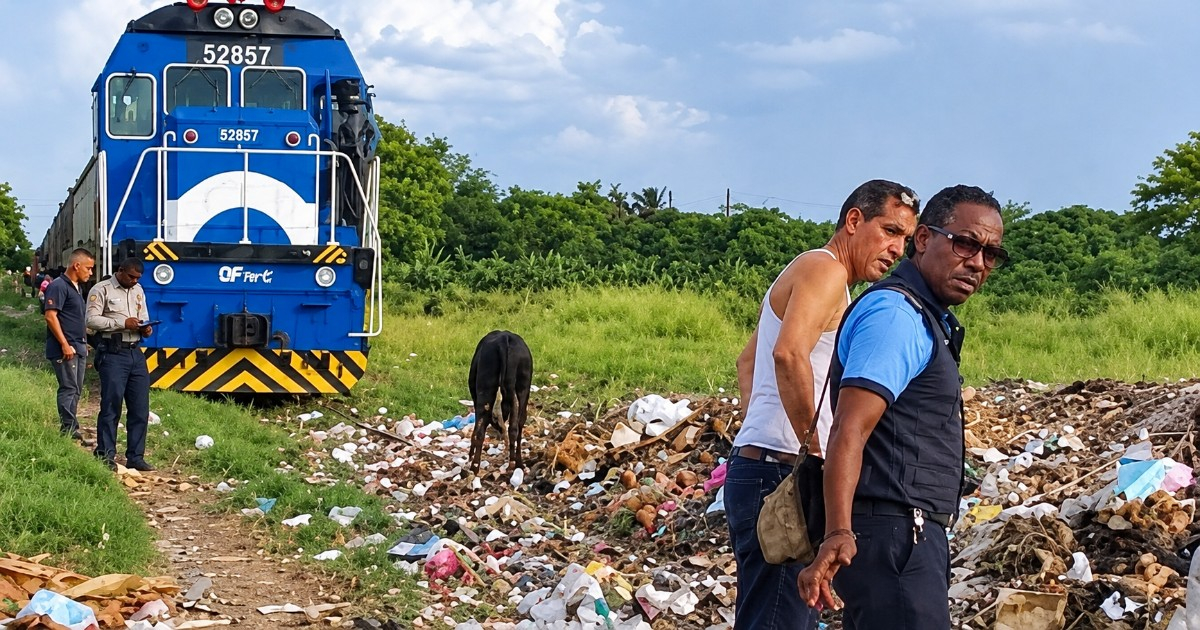
The passenger train Havana-Guantánamo had to halt its journey once again in the Aguilera district, in the city of Las Tunas, after encountering garbage and debris piled up on the tracks of the central line, according to a report by the local media outlet Periódico 26.
The convoy crew, with the help of local residents, had to manually clear away the debris in order to continue on their route.
The incident is not an isolated event. In September, a mountain of garbage had already blocked the same train at the same location in the Aguilera district, forcing the engineer to activate the emergency brake to prevent a possible derailment; on that occasion, the passengers themselves got down with makeshift shovels to clear the tracks.
The provincial media acknowledged that in the days leading up to this new incident, some institutional actions had been taken to eliminate the landfills, but warned that "there is still a lot of garbage to collect."
The underlying cause, according to the report itself, is structural: "an inadequate waste collection system, resulting from the lack of workers, waste collection vehicles (both motorized and animal-drawn), and the shortage of fuel that keeps the existing fleet out of service."
The waste crisis in Las Tunas has been deteriorating for years. In February of this year, the official provincial newspaper 26 acknowledged the existence of hundreds of micro-dumps next to homes, schools, and health centers. The province needed 657 cart drivers and only had 229 active, of which just over 60 operated in the provincial capital. That same month, the service reached a point where it operated with zero fuel for the motorized vehicles.
In the absence of state action, it was a private company —the small and medium-sized enterprise Asfaltunas S.U.R.L.— that began voluntarily collecting waste in August, according to a report on the waste crisis in Las Tunas.
When the city celebrated its 230th anniversary at the beginning of October, waste remained the most pressing issue highlighted by residents, with dump sites reaching up to 15 meters in front of buildings and piles burning in the middle of public streets.
The official response has ranged from inaction to blaming citizens. In September 2025, local leaders pointed to the residents themselves and private businesses as responsible for the situation, evading institutional accountability. The newspaper Las Tunas Cuba echoed this argument in its most recent report, stating that "irresponsible attitudes from the citizens contribute to this situation."
The neighbors, however, have a different perspective. "Now the problem is with the government, which does not have the resources to collect the solid waste from the city, and we have turned into a huge dump," wrote a resident on social media in September.
The Havana-Guantánamo train operates under already precarious conditions: since June, its frequency has been reduced to one departure every 16 days due to a fuel shortage. At the time of this report, the service was temporarily canceled due to the impact of Hurricane Melissa, according to the Ministry of Transport.
Related videos:
Filed under: