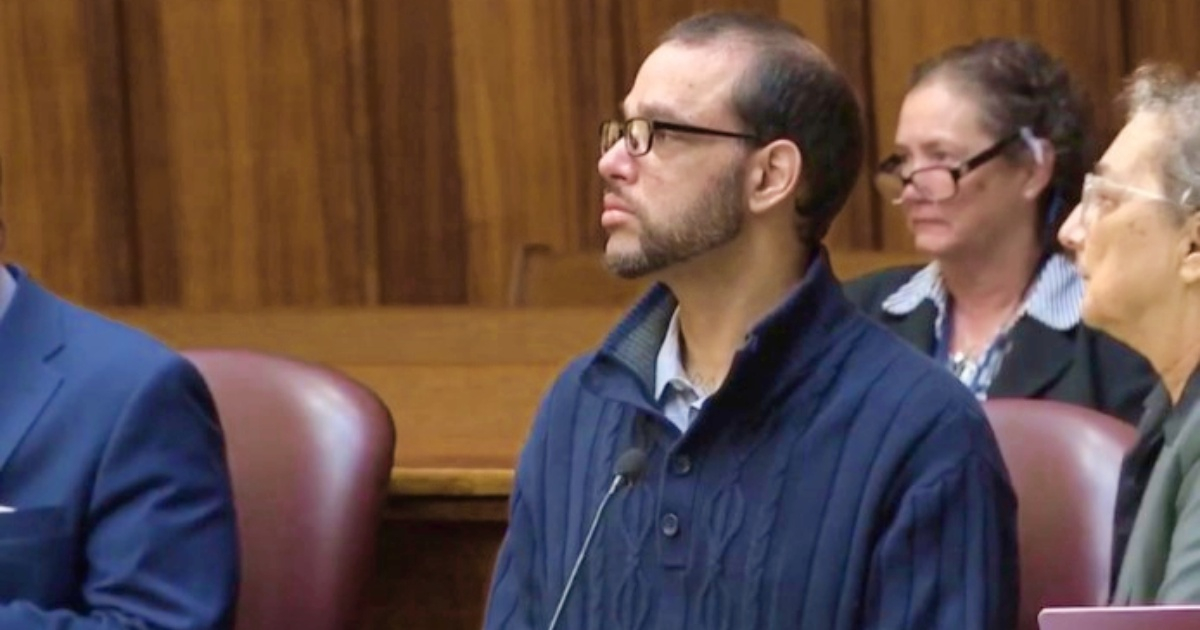
A juror was dismissed this Wednesday from the sentencing trial of Alberto Sierra, the 42-year-old Cuban who pleaded guilty to murdering his wife and her two daughters in Miami in 2012, after informing the judge that the proceedings were causing him severe emotional and physical distress.
The incident occurred on the tenth day of the trial when Judge Marisa Tinkler Mendez received an extensive email from the jury detailing their concerns, according to local press.
The magistrate said that she had never faced a situation like this in her career, not even in capital cases.
The jury: cancer survivor overwhelmed by the weight of the case
The juror in seclusion was a cancer survivor and was still recovering from surgery.
During the proceedings, he admitted to the judge that he couldn’t sleep and that the case was affecting him beyond the courtroom.
“My mind doesn't rest. At two or three in the morning, I'm thinking about what the future holds after this case. At the same time, it's affecting me emotionally as well as my spouse, who has been suffering from migraines,” stated the juror.
The man also raised questions that the judge described as unprecedented: he wanted to know if he could bring a Bible and a copy of the Constitution into the deliberation room. The judge explained that this is not allowed.
He also asked how much taxpayer money was being spent on the process and whether it would be appropriate to create an online fundraising page to help the victims.
"In general terms, would it be acceptable to do something like this?" he asked, according to Local 10.
The jury explained that they had never been in a courtroom and that the panel members had formed a bond.
Tinkler Mendez has officially excused himself: he will not be part of the final group of 12 people who will recommend whether Sierra receives life in prison or the death penalty.
The prosecution challenges the defense's neurology expert
On the same day, prosecutor Lara Penn continued the cross-examination of Dra. Erin Bigler, a neurologist and brain imaging expert presented by the defense, who had testified that Sierra suffered extensive brain damage—including loss of tissue in the left frontal lobe—after being hit by a car on Mother's Day in 1996, when he was 12 years old and had only been in the U.S. for a few months.
Penn focused his questioning on whether Sierra's actions during the crimes—separating the girls from their mother, tying up Machado, and torturing her to obtain the password to her phone—showed planning and executive function, contradicting the defense's main argument.
"Yes, if after the crime they can devise and plan how to conceal their traces, that requires executive function, right?" Penn asked.
"That's right," Bigler replied.
The expert acknowledged that those actions were "completely inappropriate, but certainly" showed planning, although she insisted that Sierra might have acted with a compromised executive system.
“I am not trying to justify that behavior in any way, shape, or form. I am just trying to explain what may be happening in their brain,” he stated.
Bigler did not personally evaluate Sierra; he only reviewed his brain scans.
A crime that shook Miami more than a decade ago
Sierra confessed to having killed his wife Gladys Machado, 29 years old, and her daughters, Julia Padrino, six years old, and Daniela Padrino, three, in November 2012 in the Flagami neighborhood.
They suffocated them with plastic bags from a Sedano's supermarket. The three bodies were found in a closet three days later.
The defendant pleaded guilty in August 2026 to three counts of first-degree murder and other offenses, without a plea deal with the prosecution.
The trial has been emotionally devastating: the jury listened to his recorded confession, the surviving son of Machado confronted him directly in court, and Sierra's mother testified in tears about her childhood in Cuba.
Under Florida's reformed law in 2023, only eight out of the 12 jury votes are needed to recommend the death penalty.
The final decision rests with the judge. The closing arguments are scheduled for next Monday.
Related videos:
Filed under: