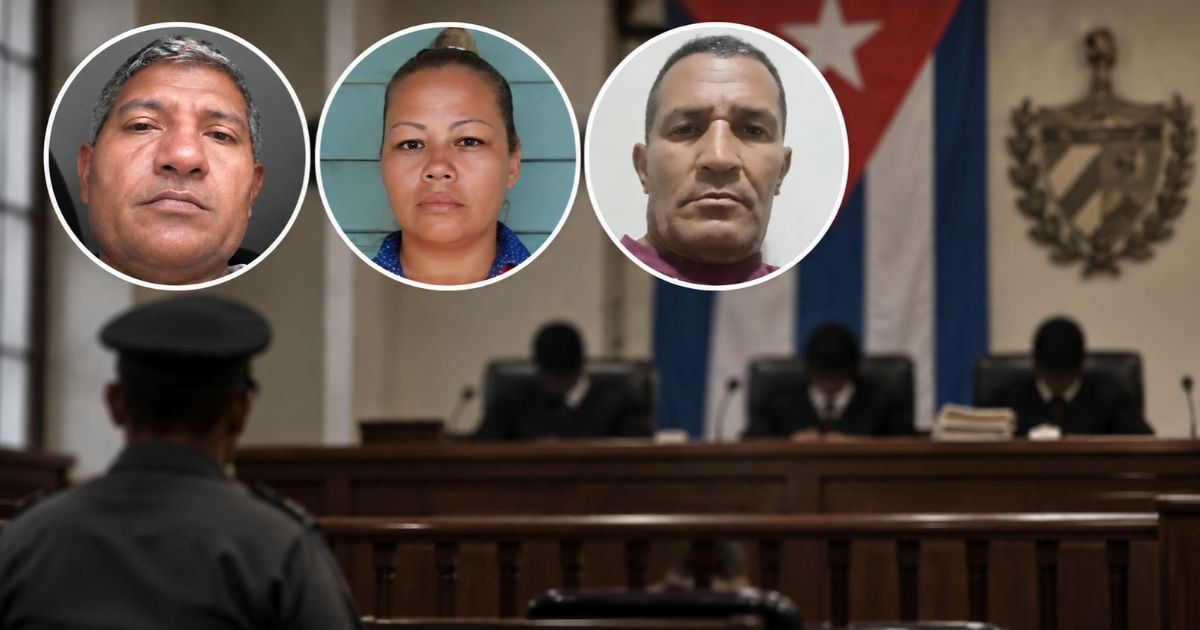
The Provincial Prosecutor's Office of Granma is requesting sentences ranging from five to ten years in prison for four Cuban dissidents, in a process that includes among its accusatory elements critical videos of the regime, WhatsApp messages, and phone top-ups, according to an investigation published this Wednesday by the independent outlet elTOQUE.
The information comes from the provisional conclusions of the Preliminary Phase Report 45/2025, dated July 21, 2026, which the news portal claims to have accessed.
The document reveals the individual requests of the Prosecutor's Office, but it does not constitute a ruling nor does it mean that the requests were made this week.
According to the investigation, the requested sentences are ten years in prison for Ariel Eugenio Arzuaga Peña; nine years for his wife, Yaquelín García Jaén; seven years for Daniel Barrios Figueredo; and five years for Yoalis Mayelin Figueredo Carbonell.
The four are accused of the alleged crimes of "propaganda against the constitutional order" and "public disorder".
The Prosecutor's Office also attributes to them links with Cuba Primero, an opposition organization founded in Miami and included by the Cuban Ministry of the Interior in its national list of alleged terrorist organizations.
The affiliation of the accused with that organization is one of the claims noted in the file and should not be presented as a judicially proven fact. Likewise, the prosecution's requests do not equate to convictions.
The events described by the prosecution took place between October and November 2024. According to elTOQUE, the document mentions recordings shared through the social media program Cántalo TV, exchanges in WhatsApp groups, and videos related to a protest.
One of the episodes used against Arzuaga is a recording from October 23, 2024 in which he questioned the hunger, misery, and shortages of food, water, and electricity in Cuba, as well as calling on the population to unite to demand political changes.
The Prosecutor's Office interprets these statements as part of alleged calls to commit crimes. However, the analysis by elTOQUE indicates that the expressions reproduced in the document consist of criticisms of the Government and appeals for unity, without concrete instructions to commit violent acts.
The media emphasizes that in the pages of the file to which it had access, none of the four accused are attributed acts of violence or material damage.
Another recording mentioned by the Prosecutor's Office captures a complaint made by Arzuaga after the arrest of his wife, related to a police raid at a family home.
According to the investigation, the accusatory document presents that public complaint as an indication of its alleged intention to disclose information against the authorities.
Digital communications also hold an important place in the accusation. The document mentions the alleged involvement of those implicated in two WhatsApp groups, named Fieles Valientes and Taller de Libertad de Expresión, in which, according to the Prosecutor's Office, issues related to human rights were discussed.
In the case of Daniel Barrios Figueredo, the accusation includes sending several videos of a protest that took place on November 5, 2024 in the Camilo Cienfuegos neighborhood in Bayamo via WhatsApp.
His family claims that Barrios attended one of the protests and was detained after responding to a police summons the following day.
The document also includes two top-ups of phone credit that Barrios is said to have received on October 30 and November 4, 2024.
According to elTOQUE, the Prosecutor's Office uses certificates from the Cuban Telecommunications Company (Etecsa) to present these operations as part of a supposed funding coming from abroad.
Among the materials mentioned by the Prosecutor's Office are also computer analyses of phones seized from Barrios and Arzuaga, institutional reports on Cuba Primero, and assessments of the so-called "counter-revolutionary" behavior of the defendants.
In those reports, according to the research, issues such as the lack of integration in mass organizations aligned with the regime.
In the case of Arzuaga, the report even states that “he is known to listen to subversive music at high volumes.”
For elTOQUE, these elements demonstrate how the prosecutor's writing employs political expressions, private communications, and personal behaviors to substantiate the accusations.
The investigation also specifies that the Prosecutor's Office requests eight years in prison for Arzuaga Peña and García Jaén for the crime of propaganda against the constitutional order, in addition to the penalties requested for public disorder, bringing the total to nineteen years, respectively.
The process is preceded by the arrests of three of the defendants in November 2024. According to the published information, Barrios was arrested on the 6th; García Jaén on the 8th; and Arzuaga Peña on the 27th of that month.
The three had been held in pretrial detention without trial when the investigation was published, almost 23 months after their arrests. As for Yoalis Mayelin Figueredo Carbonell, the pages of the file examined by elTOQUE do not clarify her procedural status.
The arrest of García Jaén had been reported by the legal advisory organization Cubalex. In a publication dated November 21, 2024, the entity highlighted alleged irregularities during the search of her home and her arrest.
Cubalex then denounced the alleged absence of search and arrest warrants, the lack of formal communication regarding the charges, and the isolation of the activist.
She also reported that she had initially been accused of "illegal sale of food" and that she was later charged with the alleged crime of "incitement to commit a crime."
The charges described in November 2024 should not be confused with those mentioned in the provisional conclusions of July 2026.
The situation of García Jaén was addressed again in a report by elTOQUE published in August, which featured statements from the activist from prison, family testimonies, and an assessment from a lawyer at Cubalex.
According to the most recent research, in July 2026, the Provincial People's Court of Granma rejected a habeas corpus petition submitted by García Jaén's defense.
The prosecutor's brief requests the opening of an oral trial before the Chamber of Crimes against State Security of the Provincial People's Court of Santiago de Cuba. The investigation does not specify a date set for the hearing.
The case raises questions about the use of criminal law in relation to political expression and the duration of preventive detention.
Freedom of expression and peaceful assembly are recognized in Articles 54 and 56 of the Cuban Constitution, while international human rights instruments protect the presumption of innocence and the right to be tried within a reasonable time frame.
Accusations related to critical publications have also emerged in other recent cases. In early October, it was reported that the Prosecutor's Office was seeking up to ten years in prison for the young people from the El4tico project in Holguín, due to videos shared on social media.
Related videos:
Filed under: