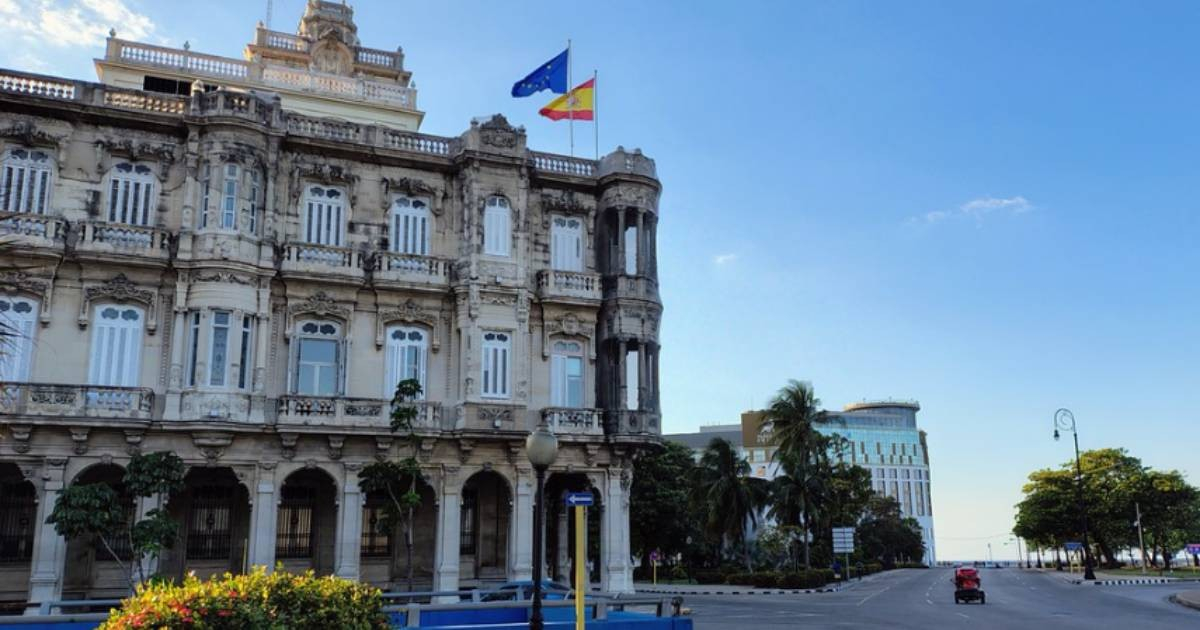
The Spanish Consulate General in Havana will open its doors on several weekends in October to facilitate certain procedures for Spanish citizens residing in Cuba or temporarily on the Island, with special hours and deadlines that must be taken into account.
The measure is related to the elections for the Congress of Deputies and the Senate of Spain, scheduled for November 29, 2026, as informed by the General Consulate of Spain in Havana in a statement.
The upcoming extraordinary service days will be on Saturday 17, Sunday 18, Saturday 24, Sunday 25, and Saturday 31 of October, from 10:00 a.m. to 2:00 p.m.
However, not all procedures will be available on the same dates, so it is important to know what applies to each group of citizens.
On Saturday, October 17, and Sunday, October 18, Spanish residents in Cuba will be able to check their registration in the electoral roll and submit claims if they detect errors, improper exclusions, or need to update certain information.
This procedure is part of the system known as CERA (Electoral Census of Absent Residents), which includes Spanish citizens who habitually reside outside of Spain and are registered for electoral purposes.
The extraordinary period to consult the census began on October 12 and will end on Monday, October 19. Therefore, those who need to verify their registration or request a correction must do so within that time frame.
The in-person consultation is conducted without the need for a prior appointment at the Palacio de Velasco, home of the Spanish Consulate General, located at Zulueta Street number 2, corner of Cárcel, in Old Havana.
During the weekdays in that period, the hours of operation are from 9:00 a.m. to 3:00 p.m., while on Saturday the 17th and Sunday the 18th, they will be from 10:00 a.m. to 2:00 p.m.
Citizens who prefer to avoid traveling will also be able to check their registration online via the electronic headquarters of the National Institute of Statistics of Spain (INE), provided they have the Cl@ve electronic identification system.
In the event that a claim is necessary, the interested party must use the official form provided by the Consular Office and accompany it with the corresponding documentation.
Among the accepted documents are a photocopy of the Spanish DNI, passport, or Spanish driver's license. Those who do not have these may present a certificate of Spanish nationality or a certificate of registration in the Consular Registry.
The 24th, 25th, and 31st of October will be reserved for another procedure, aimed at Spanish citizens who are temporarily in Cuba but maintain their usual residence in Spain.
This group uses the voting system known as ERTA (electors residing temporarily absent).
To participate from Cuba, these individuals must be listed in the electoral register of residents in Spain and be registered as non-residents in the Consular Registration Office.
Those who have not yet registered will be able to do so along with their application for electoral documentation, using the appropriate official form.
The Consulate will allow both procedures to be carried out on weekdays from 9:00 a.m. to 3:00 p.m., as well as on special days, October 17, 18, 24, 25, and 31, from 10:00 a.m. to 2:00 p.m.
The deadline to request electoral documentation through this procedure will be October 31, 2026.
It is important to distinguish between both cases: Spanish citizens who are usually resident in Cuba and are registered in the CERA do not need to request a vote in advance, whereas those who are temporarily on the Island and are using the ERTA procedure must request the necessary documentation within the established timeframe.
For voters registered in the CERA, the Electoral Census Office will send initial documentation between October 24 and October 30 to the address listed in their registration. Subsequently, the ballots will be sent out between November 4 and November 8, unless there are challenges to candidacies that delay the process.
Residents in Cuba will be able to send their vote by mail to the Consular Office until November 24, or drop it off in person at the Palacio de Velasco between November 21 and 26, from 9:00 a.m. to 5:00 p.m.
In turn, voters who are temporarily in Cuba and have completed the ERTA procedure must send their vote by certified mail to the corresponding polling station in Spain, no later than November 25.
The consular authorities advise following the official instructions for each type, as the requirements and deadlines differ.
The extraordinary opening on several weekends aims to facilitate these procedures for Spanish citizens who are unable to visit the Consulate during regular hours.
For Cubans who hold Spanish nationality and reside on the Island, the information is particularly relevant if they are registered in the Spanish electoral roll or need to verify their data before the deadline for claims closes.
The electoral process has also raised doubts among citizens who recently obtained Spanish nationality through the Law of Democratic Memory, commonly known as the Grandchildren's Law.
The guidelines on how to vote from Cuba in the elections on November 29 explain the differences between Spanish citizens residing abroad and those who are temporarily outside of Spain, as well as the procedures applicable to each group.
Additionally, the process is unfolding amid a judicial controversy related to the voting rights of certain naturalized citizens under the Grandchildren's Law. The Supreme Court rejected a petition from the State and upheld the suspension of a measure related to their electoral participation, a situation that makes it particularly important to verify the registration and applicable conditions for each voter.
However, the extraordinary attention announced specifically pertains to these electoral procedures and does not mean that the Consulate will offer all of its usual services, such as passports, nationality, or visas, during those weekends.
Related videos:
Filed under: