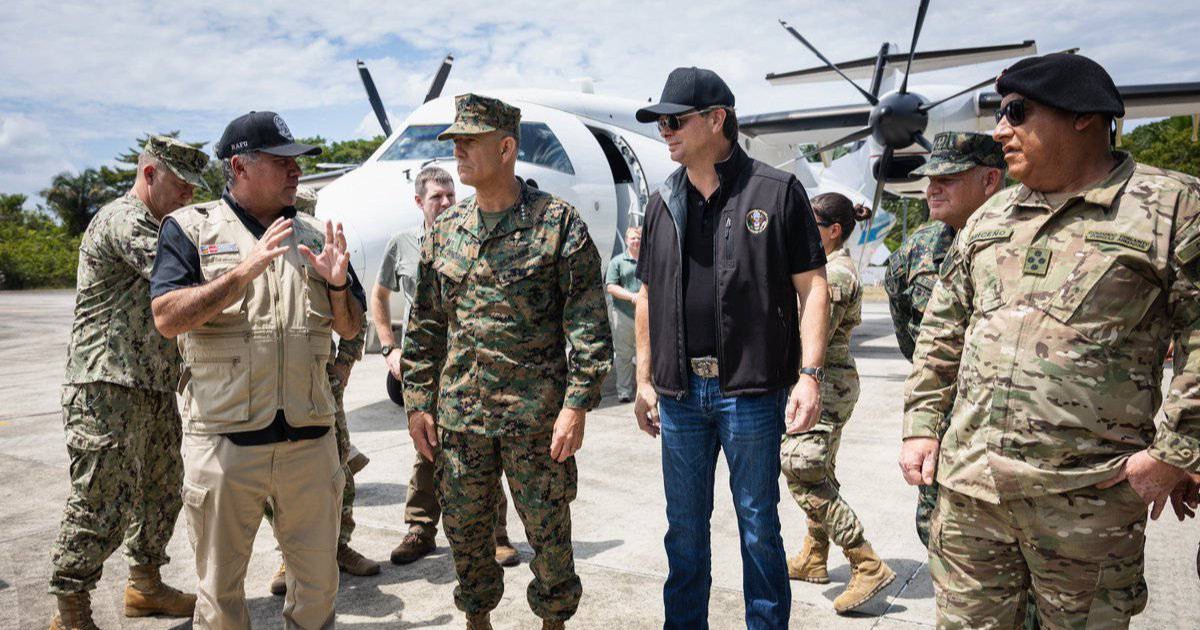
The general Francis L. Donovan, head of the United States Southern Command (SOUTHCOM), traveled this Wednesday to Iquitos, Peru, to strengthen military cooperation against the narcoterrorist networks operating in the Amazon region, during a visit that brought together high-ranking military officials from both countries and the U.S. ambassador Bernie Navarro.
Alongside Donovan, the Peruvian Minister of Defense Rafael Belaúnde Llosa and the Chief of the Joint Staff of Peru, General César Augusto Briceño Valdivia, participated.
The meeting, as reported by SOUTHCOM on its official account, aimed to lay the groundwork for joint action against the narcoterrorist networks operating in the Apurímac, Ene, and Mantaro Rivers Valley (VRAEM), the most conflict-ridden area in Peru concerning drug trafficking and terrorism.
Donovan was emphatic in describing the magnitude of the problem: "In the Western Hemisphere, the complete lack of respect by narcoterrorists for humanity, authority, or sovereignty poses one of the greatest threats to our people and communities."
The general also highlighted the strategic role of Peru within the Coalition of the Americas Against the Cartels (A3C): "Peru brings extensive experience in the fight against narco-terrorists to the coalition. Its expertise will strengthen joint efforts to enhance regional security, while the combined capabilities of the coalition will bolster Peru's efforts to protect its citizens and safeguard its sovereignty."
The A3C, initiated by the Trump administration in March 2026 during the "Shield of the Americas" summit held in Miami with 12 founding countries, currently encompasses 19 nations: the United States, Argentina, the Bahamas, Belize, Bolivia, Chile, Colombia, Costa Rica, Ecuador, El Salvador, Guatemala, Guyana, Honduras, Jamaica, Panama, Paraguay, Peru, the Dominican Republic, and Trinidad and Tobago.
Peru formally joined the coalition in September 2026, when President Keiko Fujimori confirmed it after meeting with Secretary of State Marco Rubio in Lima. Peruvian Foreign Minister Carlos Espá clarified before the Senate that the accession does not imply a binding treaty nor authorizes any state to act unilaterally on Peruvian territory.
Iquitos was chosen as the venue for the visit due to its strategic location: the Amazonian city borders Colombia, Brazil, and Ecuador, and serves as a gateway to the areas most affected by drug trafficking within the country.
Bilateral cooperation occurs at a time of intense operational activity in the VRAEM. Between January and early September, the Peruvian Armed Forces reported 3,952 patrols, seven military operations, and the seizure of more than 38,000 kilograms of cocaine hydrochloride.
In July, during the operation "Quiñones," Jhonny Curo Rojas, alias "Richard," was killed. He was identified as a member of the political bureau of the remnants of Sendero Luminoso.
Donovan's visit to Peru is part of a sustained escalation of the U.S. military strategy in the hemisphere, which includes the activation in August of the Joint Task Force for the Western Hemisphere (JTF-WHEM) and the joint designation of 25 criminal organizations as terrorist entities by 14 countries in the coalition. The U.S. also reallocated 52 million dollars in military assistance for Colombia, Ecuador, Peru, and Panama with the aim of combating narcoterrorism.
In that context, the Guantánamo Naval Base was designated in October as the first training site of the Autonomous Warfare Command of SOUTHCOM, reinforcing its role as a regional platform for advanced operations.
Related videos:
Filed under: