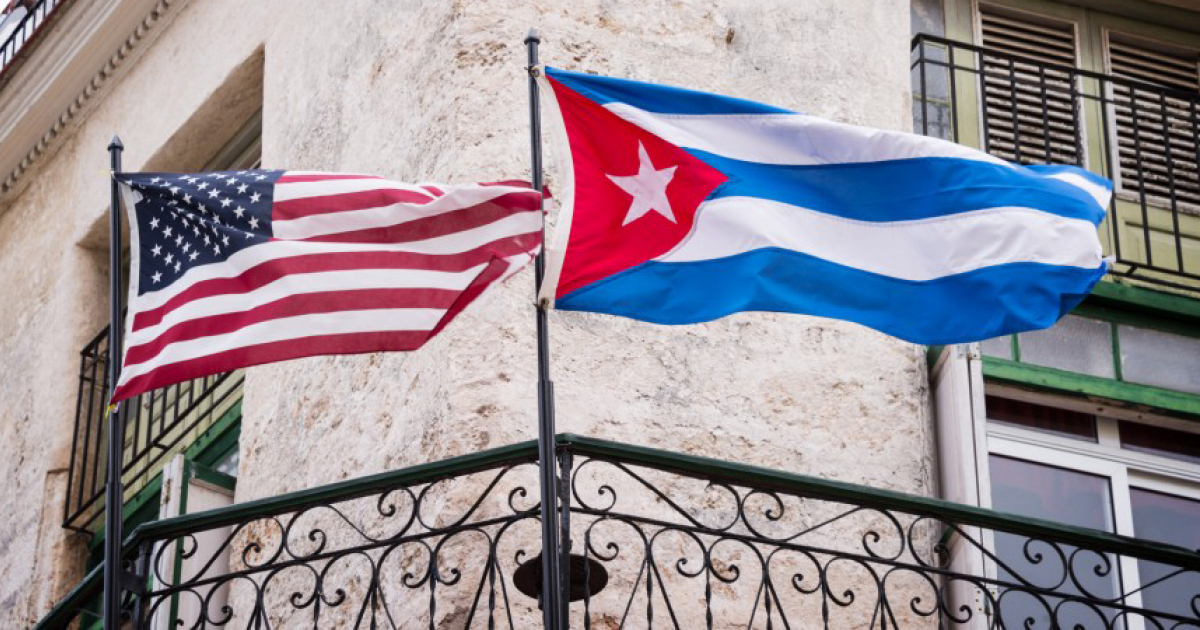
The Cuban regime acknowledged that it has maintained contacts with the Donald Trump Administration, but asserted that these exchanges have not led to progress towards a formal dialogue between Washington and Havana, while insisting that it is willing to engage in conversations without preconditions and making it clear that it will not accept challenges to its political system.
The confirmation came this Friday from Tanieris Diéguez, the second-in-command of the Cuban Embassy in the United States, who stated in an interview with the Spanish agency EFE from Washington that there have been several exchanges with U.S. representatives, although with no results that Havana considers satisfactory.
«We have had a group of contacts, but we really do not see progress toward a serious dialogue, which is what we are willing to pursue,» the diplomat stated.
His statements confirm that the channels of communication between both governments remain open, despite the hardening of U.S. policy towards Cuba and the ongoing public confrontations between their leaders.
However, Diéguez set a boundary for any potential negotiation: the regime is not willing to discuss its political structure nor to accept demands that it interprets as a threat to its continuity in power.
"We do not impose preconditions nor do we want to be subjected to any," stated the official, who added that Havana is willing to address any issue as long as its sovereignty is respected and its 'constitutional order' is not questioned.
The position reveals a central contradiction in the official Cuban discourse: while the regime calls for unconditional discussions, it sets as a limit the possibility of discussing the current political model, which is characterized by the monopoly of power held by the Communist Party and the absence of competitive multiparty elections.
The Cuban Constitution of 2019 recognizes the Communist Party as the leading political force of society and the State.
Therefore, the defense of the so-called "constitutional order" essentially involves preserving one of the fundamental pillars of the one-party system.
The diplomat also did not provide details about the dates of the contacts, the participating officials, the issues discussed, or the existence of concrete proposals. Her words confirm that there have been exchanges, but do not establish that there is a formal negotiation or an agreement in preparation.
The statements come after the U.S. president himself publicly acknowledged the existence of conversations.
On September 22, during his address to the United Nations General Assembly, Donald Trump asserted that Secretary of State Marco Rubio, was deeply involved in the negotiations with Cuba.
The difference between the two positions is significant: while Washington has spoken of negotiations, the Cuban representative prefers to refer to "contacts" and maintains that there is still no serious dialogue.
The interview also addressed the deterioration of economic and sanitary conditions in Cuba, a crisis that the diplomat attributed mainly to the U.S. restrictions on oil supply.
Diéguez described those measures as a "collective punishment" and emphasized that the fuel shortages and power outages directly impact hospitals and the execution of medical procedures.
To illustrate the situation, he provided particularly grave figures: 96,500 people are waiting for a surgical operation and 32,000 pregnant women are awaiting an ultrasound.
He also stated that infant mortality has reached nine deaths per 1,000 live births.
The Cuban health crisis is not limited to energy difficulties. Hospitals have been facing shortages of medications, medical materials, equipment, specialized personnel, and maintenance investments for years, while the government has allocated significant resources to tourism projects amid the deterioration of basic services.
Despite the figures presented, Diéguez defended the economic management of the regime and rejected Washington's criticisms regarding the administration of national resources.
“It’s not ineptitude”, he affirmed while justifying the government's ability to maintain certain services with limited resources.
His explanation attributed the worsening of the crisis to external pressures, without acknowledging specific responsibilities of the internal economic policy.
Another issue discussed was the possibility of a U.S. military intervention. When asked about this scenario, the diplomat replied that the Cuban government takes the statements from U.S. authorities seriously, whom she described as the world's leading military, nuclear, and economic power.
The representative insisted that Havana will defend its sovereignty and independence, arguments that the regime has historically used to reject international demands for political reforms and greater freedoms.
The statements come, moreover, amidst the Cuban diplomatic offensive preceding the annual United Nations vote on the U.S. embargo.
On Thursday, Miguel Díaz-Canel criticized the United States and asserted that Washington was "alone and isolated" for its efforts with other governments to change the direction of their votes in the General Assembly.
The leader accused the Trump Administration of pressuring sovereign countries, while Chancellor Bruno Rodríguez Parrilla directed similar criticisms at Marco Rubio.
Diéguez expressed his confidence that Havana will regain international support and assured that Cuba does not feel alone, despite the deterioration of relations with Washington.
Related videos:
Filed under: