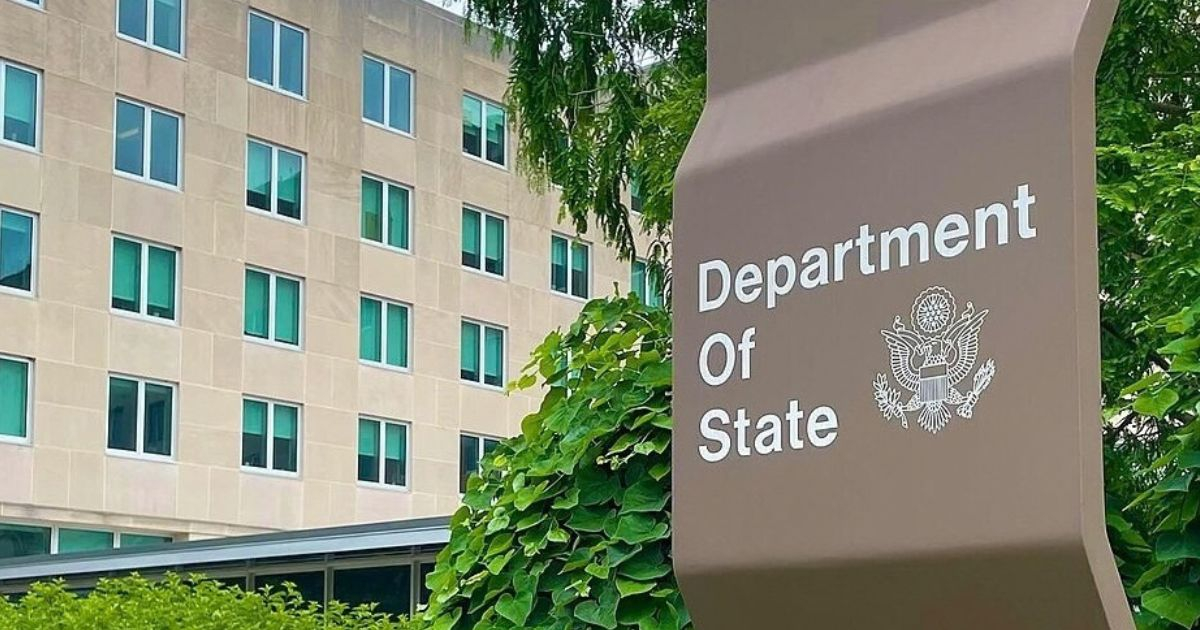
The U.S. State Department responded harshly to the version recently provided by the Cuban regime regarding the contacts between both governments, labeling as "propaganda" Havana's assertion that there are only communication channels and no negotiation process.
It doesn’t surprise us that the Cuban regime is spreading this propaganda. In fact, discussions are ongoing and, so far, the regime has not been willing to reach any agreement that would help the Cuban people and that would ultimately threaten their total control,” stated the State Department.
Washington thus introduces an element that goes beyond simply confirming that contacts remain open: it directly holds the Cuban regime responsible for the lack of an agreement so far.
The explanation provided by the State Department points to the political system of the island. According to Washington, Havana has not accepted an understanding that could benefit Cubans if that agreement ends up threatening what the United States describes as “total control” exercised by the regime.
The U.S. response comes after Lianys Torres Rivera, the chargé d'affaires at the Cuban Embassy in Washington and the regime's main diplomatic representative in the United States, stated that there are communication channels between both countries, but no formal negotiations.
In an interview granted on Monday to Reuters, Torres Rivera stated that Havana and Washington maintain "communication channels," but no formal negotiations.
According to the explanation, those contacts have included meetings, phone calls, and WhatsApp messages, although they have not progressed towards a negotiating agenda or the resumption of official talks.
"What we have with the United States are channels of communication," said the diplomat, who refrained from providing details about the dates, the topics discussed, or the officials involved.
The response from the State Department questions that characterization. Washington has also not publicly presented the contacts as a formal negotiation, but asserts that discussions are ongoing and that the main obstacle to reaching an agreement is the regime's refusal to accept conditions that may affect its power structure.
The difference between both versions is now more clearly defined: Havana narrows the scope of contacts to communication channels without a negotiating agenda, while the United States asserts that conversations are indeed underway, although so far without results due to the regime's lack of willingness to reach an agreement.
That point aligns with a red line that Cuban officials have repeatedly expressed. The vice chancellor Carlos Fernández de Cossío recently stated that Havana is not willing to discuss its internal political arrangements with the United States.
"Cuba is not willing to discuss its internal political matters with the government of the United States or any other government," said Fernández de Cossío, although he left open the possibility of discussing bilateral issues such as migration, security, trade, and regional cooperation.
The controversy arises further after an investigation by The Atlantic indicated that the contacts between Secretary of State Marco Rubio and Raúl Guillermo Rodríguez Castro, known as "El Cangrejo" and grandson of Raúl Castro, reportedly stalled when Washington proposed the departure of Miguel Díaz-Canel as a condition to move forward.
According to that publication, the regime rejected the demand and the process came to a standstill. Havana, for its part, is publicly insisting that there is no formal negotiation and is avoiding providing details about the interlocutors or the content of the contacts.
The exchange of statements also comes after several weeks of seemingly contradictory messages. President Donald Trump stated before the United Nations that Marco Rubio was "deeply involved in negotiations" with Cuba and later expressed confidence in reaching some kind of agreement without the need for military intervention.
From Miami, Sebastián Arcos, associate director of the Cuban Research Institute at Florida International University (FIU), interpreted Havana's stance as a strategy to buy time, reported Telemundo 51.
"The regime is betting that the United States will not take action, and if the United States does not move, they will remain in power, even if it's in the power of a nation that practically does not exist," Arcos stated.
The academic also argued that the humanitarian and migratory crisis could become a tool of pressure on Washington. "The humanitarian crisis that they themselves are creating in Cuba and the captive people of Cuba. That is their bargaining chip with the international community and the United States," he stated.
Ramón Saúl Sánchez, leader of the Democracy Movement, expressed a similar concern and recalled that in previous instances, migration crises from Cuba have forced Washington to react.
"Unfortunately, that has been Washington's only concern," noted Sánchez, who suggested that Havana might attempt once again to use migratory pressure as a tool against the United States.
Related videos:
Filed under: