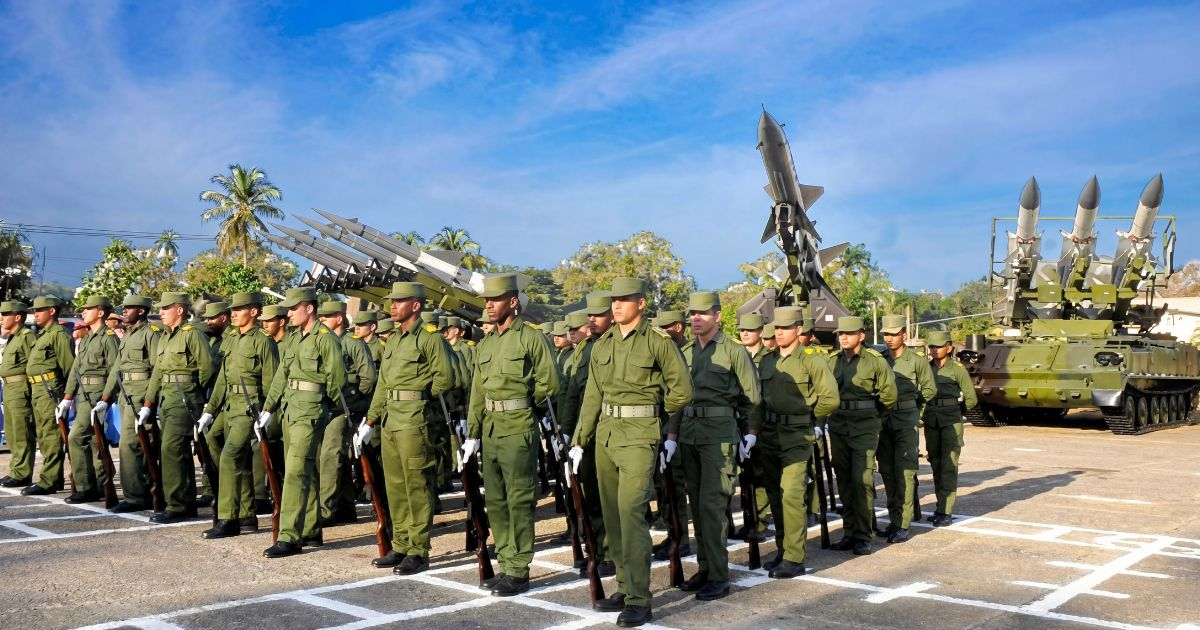
The regime assured that Cuba "is not naive" in the face of threats from President Donald Trump and stated that it has increased its defense capabilities against a potential military action from the United States.
The statement was made by Lianys Torres Rivera, Charge d'Affaires at the Cuban Embassy in Washington, during an interview granted this Monday to Reuters, in which she discussed the growing tensions between Havana and the Trump administration.
Torres stated that the regime remains open to a "respectful" dialogue with Washington, but emphasized that Cuba "is not naive" in the face of Trump's threats and that its defensive preparations have intensified.
"Cuba has always been preparing for an aggression from the United States," stated the diplomat.
"Y we are enhancing our capabilities now more than ever [...] It's for our defense," he emphasized.
The official did not detail what those additional capabilities are nor specified what specific military measures the regime has adopted in recent months, although the Havana government has widely promoted the alleged preparations.
His statements come amid escalating tensions between both governments. The Trump administration has tightened its policy towards Havana in 2026, while high-ranking Cuban officials have repeatedly insisted that they consider it necessary to prepare for the possibility of U.S. military action. Trump, for his part, stated at the end of September that the United States and Cuba "will reach an agreement" and added: "I don't think we need the military".
This speech is not new. Just two days before Torres' interview, the Deputy Foreign Minister Carlos Fernández de Cossío stated that it would be «naive» and «irresponsible» for the Cuban government not to take «very seriously» the references to a potential aggression from the United States.
Fernández had practically used the same argument days earlier when he explained that the regime pays attention to reports about potential U.S. military preparations and that Cuba would have to take on its defense alone in the event of an intervention. "We are on our own," he asserted at that time.
In March, the Deputy Minister himself had openly acknowledged that the Cuban Army was preparing for the possibility of a U.S. military action.
"Our army is always prepared and, in fact, is currently preparing for the possibility of a military aggression," he stated to NBC.
Defensive preparation has also been a declared priority by the authorities during 2026.
The regime has designated this year as “Year of Preparation for Defense” and the Revolutionary Armed Forces have conducted exercises that include training with rifles, drones, and anti-tank mines, in a context of increasing confrontation with Washington.
In May, the Cuban Foreign Ministry also warned that "if Cuba is attacked, it will exercise its right to legitimate defense", following reports about the alleged acquisition by Havana of more than 300 military drones from Russia and Iran.
In July, the National Assembly heightened its rhetoric by asserting that any U.S. military intervention would encounter a "strong and unwavering resistance" and that the country would defend its sovereignty "at all costs."
In parallel to this defensive preparation, Havana and Washington continue to maintain contacts.
In the same interview with Reuters, Torres Rivera stated that there are no formal negotiations with the United States, although there are meetings, phone calls, and messages between representatives of both governments.
As it became clear upon learning about those statements, the diplomat summarized the current relationship this way: "What we have with the United States are channels of communication."
That description contrasts with statements made by Trump before the United Nations in September, when he claimed that Secretary of State, Marco Rubio was deeply involved in negotiations with Havana.
Torres, however, stated that these contacts have not progressed toward a negotiation agenda or the resumption of official talks.
The State Department rejected that characterization and assured Reuters that the conversations are ongoing. A spokesperson accused the Cuban regime of spreading "propaganda" and maintained that Havana has so far not accepted proposals that, according to Washington, would benefit the Cuban people because they would threaten its control.
The diplomat also insisted that the Cuban political system remains outside of any possible negotiation and described it as a "red line" for the regime.
Related videos:
Filed under: