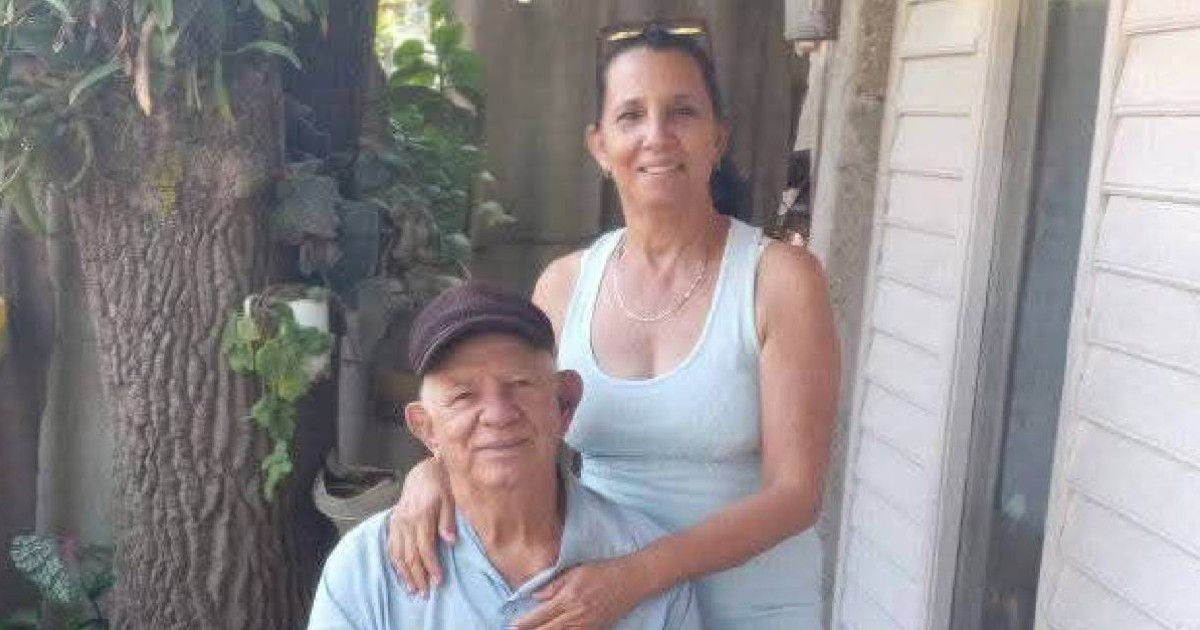
An elderly resident of the Cabrera neighborhood in the municipality of Contramaestre, Santiago de Cuba, was denied assistance at the local store when he went to collect his food module. The reason: having a daughter living in Brazil.
His son Abdel Álvarez reported the case on Facebook with a photo of the injured party and a description of the incident that he classified as abuse.
"This man here is my dad, who lives in Contramaestre. He went to pick up a module that arrived at the warehouse, and simply because he has a daughter in Brazil, they told him he wasn't eligible," Álvarez wrote in his post.
The complainant did not hide his indignation: "How long are we going to endure such repression and abuse, even towards the elderly in this miserable country?"
Álvarez also pointed out that the modules are donations from other countries and that "they must be given away," thus questioning the reasoning behind excluding a vulnerable elderly person based on the residence of a family member.
The case lacks regulatory support. There is no provision published in the Official Gazette that establishes having a relative abroad as a legal reason to deny access to a food module.
However, this is not the first episode of this kind: at the beginning of October, journalist José L. Tan Estrada reported in Camagüey that the Montecarlo supermarket required applicants to have no relatives abroad registered in their booklet in order to access subsidized oil sales. In that case, the affected individual was a grandfather whose grandson did not even send him remittances.
The pattern suggests that the exclusion criterion based on links to emigrants is applied at the discretion of different territories, without any official published instruction to support it.
Both cases occur within the framework of the new model of targeted social protection approved by the National Assembly in June 2026, which replaced universal subsidies with assistance aimed at individuals classified monthly as vulnerable by multidisciplinary groups from the popular councils.
Under this scheme, Prime Minister Manuel Marrero announced that more than 883,000 people would receive monthly a package containing five pounds of rice—donation from China, provided free of charge—one pound of sugar, and one pound of peas, guaranteed until January 2027.
In Santiago de Cuba, the authorities identified 101,359 vulnerable individuals —more than 10% of the provincial population— served by 154 designated stores across the nine municipalities. Of these, 25 are located in Contramaestre, the municipality where Álvarez's father was rejected.
At the national level, the regime selected 1,913 bodegas to distribute modules to the population classified as vulnerable. The decision of who gets access and who does not lies in the hands of those local groups, without known appeal mechanisms or clearly published criteria.
Cuba has over a million emigrants. Many of their family members on the island are financially dependent on remittances, but others—like the elderly man from Contramaestre—do not receive support from abroad and are still penalized simply for their familial connections, in a country where food scarcity has become a daily emergency.
Related videos:
Filed under: