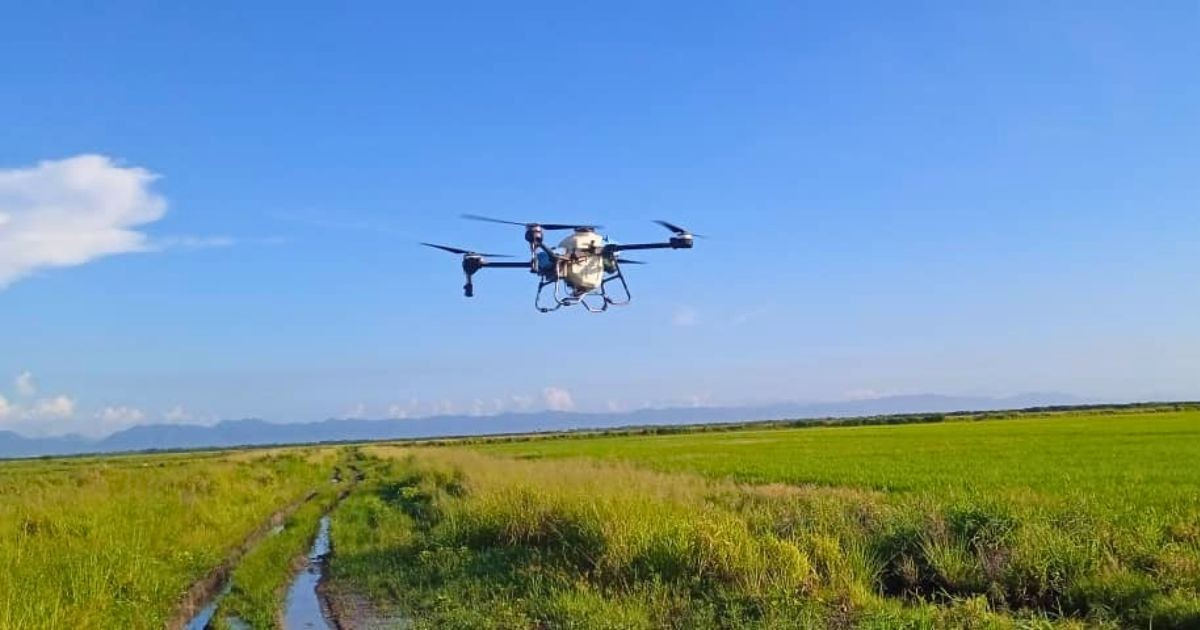
The state medium Radio Guamá celebrated this week the use of a drone to spray rice fields in the Pinar del Río municipality of Los Palacios as a milestone in agricultural modernization. The response from Cubans on social media was immediate: a mix of irony, indignation, and a question that the official report did not bother to answer: “but where is the rice?”
According to the report from the official media, an aircraft from Geo-Cuba —a Chinese-made machine with a capacity of 55 liters and autonomous operation— has sprayed agrochemicals over more than 250 hectares of rice belonging to the Cubanacán Seed Business Unit.
The usufructuary Dagoberto Remigio Echevarría described the experience with enthusiasm: "We had the opportunity to apply herbicides initially on 200 hectares, and now we are in another stage with fungicides, pesticides... The advantages are all kinds. This is already precision agriculture, and we have streamlined the work because if we had to do it manually, it would have taken us many days."
The producer added that the device sprayed 62 hectares in a single day and, in addition, compensates for the lack of nozzles, backpacks, and other tools that are scarce in the Cuban countryside. One detail that the official report mentioned almost in passing: the harvest from this campaign will not go to the warehouses or the popular market, but instead to the industrial process to produce seeds for future plantings.
The note was shared on Facebook by the newspaper Guerrillero and sparked an avalanche of comments that the authorities did not anticipate. "Soon, it will be easier to buy a drone than a sack of rice," wrote one internet user. Another was more direct: "And we continue eating imported rice. You just can’t stop making a fool of yourselves."
Critics also pointed to a pattern that Cubans know by heart. "This reminds me of the machines they presented to cut the Marabú; we never heard about them again [...]. Or the state-of-the-art truck for repairing potholes, we never heard about it again. You are selling smoke," summarized a commentator.
From Pinar del Río, a resident was more specific: "We still haven't received anything from the warehouse, and the last delivery we got [...] was said to be from Los Palacios, but of very poor quality; selecting it was horrifying." Another user reported that his two rice dryers in the area are idle — "one at half capacity and the other at 95%" — and demanded that they be addressed before celebrating drones. "Aren't they ashamed to publish this while rice is at 370 pesos," commented a forum participant.
The contrast between the announcement and reality could not be more stark. The national rice production has plummeted from 304,000 tons in 2018 to just 79,000 in 2025, according to official figures reported by the press. Cuba needs about 700,000 tons annually of this cereal, meaning its own production barely meets 11.3% of the estimated demand. Meanwhile, rice has been sold for 400 pesos per pound, and even more in certain offers, compared to an average monthly salary of 7,354 Cuban pesos in August 2026, according to the National Office of Statistics and Information (ONEI).
Vice President Salvador Valdés Mesa promised in November 2025 that Pinar del Río would achieve self-sufficiency in rice by 2026. That promise was not fulfilled. "Very nice, a lot of technology, and no rice for the people. [...] What is truly visible and tangible is the extremely high price and the hunger that runs through the streets," wrote a netizen, with a precision that no cutting-edge drone can contradict.
Related videos:
Filed under: