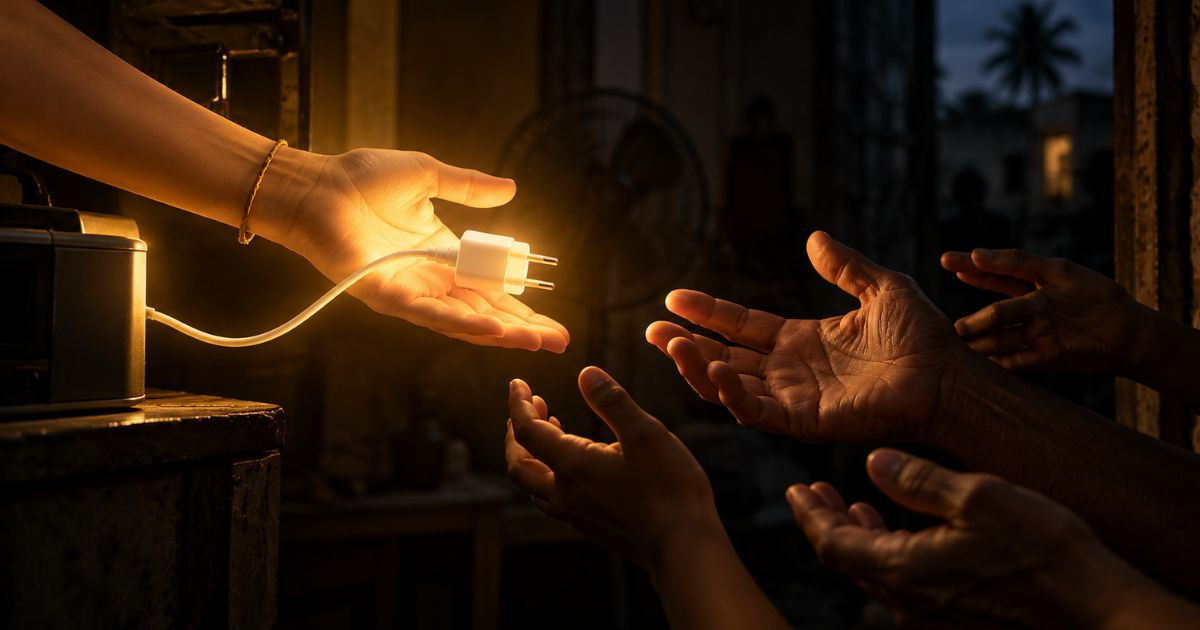
Amid the prolonged blackouts affecting the province of Matanzas, a Cuban resident in Cárdenas decided to open her home so that her neighbors can charge essential electrical devices free of charge.
Yesenia Peña Godoy shared her offering in the Facebook group Compra y Venta Cárdenas, where she explained that anyone who needs to charge rechargeable bulbs, fans, lamps, or EcoFlow portable power stations can come to her home free of charge.
"Good morning, due to the current situation in Cárdenas, anyone who needs to charge essential items such as bulbs, fans, EcoFlows, lamps, etc., can come to my house free of charge," he wrote, highlighting a gesture amid prolonged blackouts.
The woman indicated that she resides in the Brisas del Mar neighborhood, in an apartment marked with the sign of her establishment, Tienda Yesenia, and provided directions for interested individuals to find the location.
“It will be a pleasure to help you”, he concluded his message.
The initiative comes at a particularly difficult time for the residents of Matanzas, where numerous communities have accumulated dozens of consecutive hours without electrical service.
Under these conditions, keeping a fan, a lamp, or a portable battery charged can provide significant relief for a family.
The offer generated numerous reactions of gratitude on Facebook. Dozens of users praised the woman's generosity and highlighted the importance of helping each other among neighbors when blackouts hinder the most basic activities.
"Thank you very much. I think I'm going to have to take your word for it. May God repay you," commented a user, implying that she may need to visit the house to charge her devices.
Another person praised the initiative with a message of recognition: "It's great that there are still people like that with a huge heart."
"Blessings to you for such a kind gesture for those in need and without any self-interest," expressed another commenter.
Some also lamented that such acts of solidarity are not more common. "There are already few people willing to help others," noted one user, while another wrote: "A lovely gesture, there should be more people like you."
Yesenia herself responded to several of the messages with words of gratitude and well wishes, maintaining the friendly tone of her post.
One of the most significant aspects was that her initiative encouraged another neighbor to also offer her apartment so that those affected could charge their devices.
“You can also come to my apartment,” wrote the woman, who shared directions to locate her home.
Thus, a post that started as a personal offer from a resident of Cárdenas ended up sparking a second proposal for assistance, in a city where power outages have severely complicated daily life.
Although positive messages predominated, there were also some skeptical comments regarding the motives of those offering help. However, most responses were expressions of gratitude, congratulations, and blessings for the neighbors.
Solidarity takes on special significance given the severity of the electrical crisis in Matanzas. A report published this weekend documented outages of over 60 consecutive hours in numerous circuits of the province, while the towns of Manuelito and Bolondrón approached 70 hours without electricity.
According to the information provided by the official journalist Pedro Rizo Martínez from the television station TV Yumurí, several circuits in Jagüey Grande and the Bolondrón aqueduct had accumulated nearly 60 hours without power.
Other locations, including Pedro Betancourt, Güira, Los Arabos, Colón Este, México, and San José, were experiencing outages exceeding 45 hours, while Versalles, Perico, Santa Marta, and Boca de Camarioca were also facing extended cuts.
The director of the provincial electric company, Alejandro Rodríguez Aspeitía, acknowledged that the impact in Matanzas exceeded 130 megawatts, which was equivalent to the maximum load that could be taken offline at that time.
The official explained that efforts would be made to prioritize the circuits that had been without electricity for the longest time, although he warned that some facilities had additional issues when trying to restore the supply.
The situation does not represent an isolated incident. At the end of June, Matanzas had already experienced power outages exceeding 70 consecutive hours, with eight substations out of service, four of which were affected by the theft of dielectric oil from their transformers.
In July, the crisis reached even more severe levels, when interruptions of up to 96 consecutive hours were reported in some circuits, while residents questioned how government facilities were able to keep their air conditioning systems running during the outages.
Additionally, Yesenia's initiative recalls other gestures of solidarity by Cubans who have chosen to share the electricity available in their homes during emergency situations.
In November 2025, Humberto Milán, a resident of the municipality of Río Cauto in Granma, offered free electricity to his community following the devastation caused by Hurricane Melissa.
On that occasion, when much of eastern Cuba was without electricity, her niece spread a message inviting residents to charge their devices at the family home between four and six in the afternoon, free of charge.
In the same province, another young man from the municipality of Guisa made a generator available to his neighbors to charge phones, tablets, flashlights, lamps, and fans intended for small children.
The fuel needed to make it run had been donated by a friend who preferred to remain anonymous.
A year earlier, in October 2024, Daniel Nieto Vega made a similar offer in the province of Santiago de Cuba, during the collapse of the National Electric System that left numerous communities without electricity.
The young man, associated with the town of Baire in the municipality of Contramaestre, announced that he would turn on his electric generator so that others could charge their phones and lamps. He even set up two daily time slots to make it easier for those who needed the service to access it.
During that emergency, images were also circulated showing people from Santiago going to radio stations, state facilities, and private homes with generators to recharge their devices.
The three experiences, which took place in Santiago de Cuba, Granma, and now Matanzas, demonstrate how neighborly assistance has become a resource for coping with the consequences of prolonged blackouts.
Related videos:
Filed under: