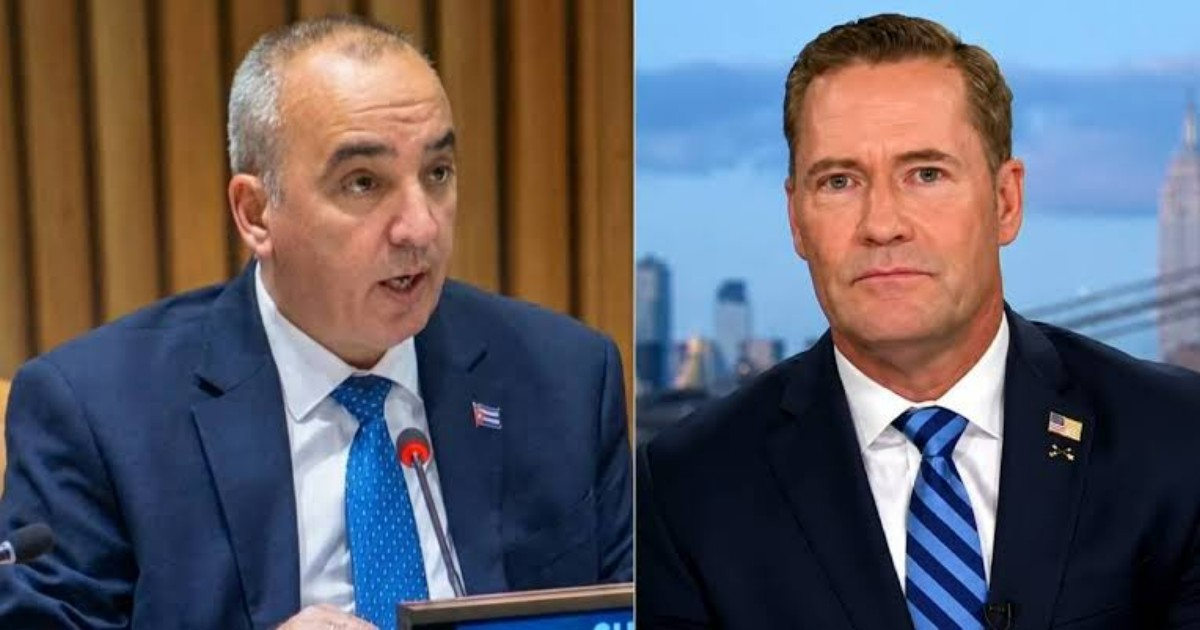
The United States Ambassador to the United Nations, Mike Waltz, addressed the criticisms from the permanent representative of the Cuban regime, Ernesto Soberón Guzmán, this Saturday, defending the pressure policy of Secretary of State Marco Rubio towards Havana with a direct personal reference to the Cuban diplomat himself.
In a post on X, Waltz responded to Soberón's complaints regarding an event organized by the U.S. mission at the UN headquarters in New York, scheduled for this Monday, October 19. The meeting, titled "Free Cuba: The Oppression That Havana Hides," will bring together former political prisoners and experts on forced labor and corruption under the regime, with restricted access for invited guests.
"The Cuban ambassador to the UN is apparently upset because we have invited former political prisoners and experts on forced labor and corruption of the regime to share their views," wrote Waltz.
He then added a phrase that points directly at Soberón: "Given that it’s the same regime that persecuted his own family, I would say that Secretary Rubio's approach in Cuba is perfectly healthy."
The day before, the Cuban diplomat had addressed the accredited press at the UN to denounce the event "in the strongest terms," labeling it a "politically motivated maneuver, organized in a questionable manner, with the clear purpose of attacking Cuba, promoting a hostile narrative against our country, and using the facilities of the United Nations to further the political agenda of the United States Government against a sovereign member state."
Soberón showed journalists a copy of the invitation and the conceptual note for the event—documents that, he said, arrived at his delegation despite not being invited—and questioned the closed nature of the meeting: "What is the reason for so much secrecy?"
The regime's representative also accused Washington of "double standards" for organizing the event while accumulating unpaid dues to the organization's budget, and asserted that Rubio has "a unhealthy obsession with Cuba" and directly pressures heads of state to change their votes on the annual resolution against the embargo, scheduled for October 27 and 28.
"Cuba will not be intimidated, blackmailed, or silenced," Soberón stated in a video released by the Cuban Ministry of Foreign Affairs.
The clash occurs amidst an escalation of diplomatic tensions leading up to this vote. Chancellor Bruno Rodríguez accused Rubio of "pressuring and blackmailing" heads of state to skew the outcome, after it was confirmed that the Secretary of State called Salvadoran President Nayib Bukele to request support on the Cuban issue, arguing that "the Cuban regime will not make the reforms that the Cuban people deserve as long as it believes that the international community is on its side."
The regime arrives at this meeting with dwindling international support: its annual resolution dropped from 187 votes in favor in 2024 to 165 in 2025, with a record of seven votes against and 12 abstentions.
This is not the first time that Waltz has confronted the regime in that building. In July 2026, during a special session convened by Havana to discuss the embargo, the ambassador read the names of political prisoners such as Luis Manuel Otero Alcántara, Maykel Castillo, and the poet Duannis León Taboada before the General Assembly, and challenged the pounding of the Cuban delegation's table with a phrase that encapsulated Washington's stance: "This is not Havana; we will speak and we will be heard, unlike your own people."
Related videos:
Filed under: