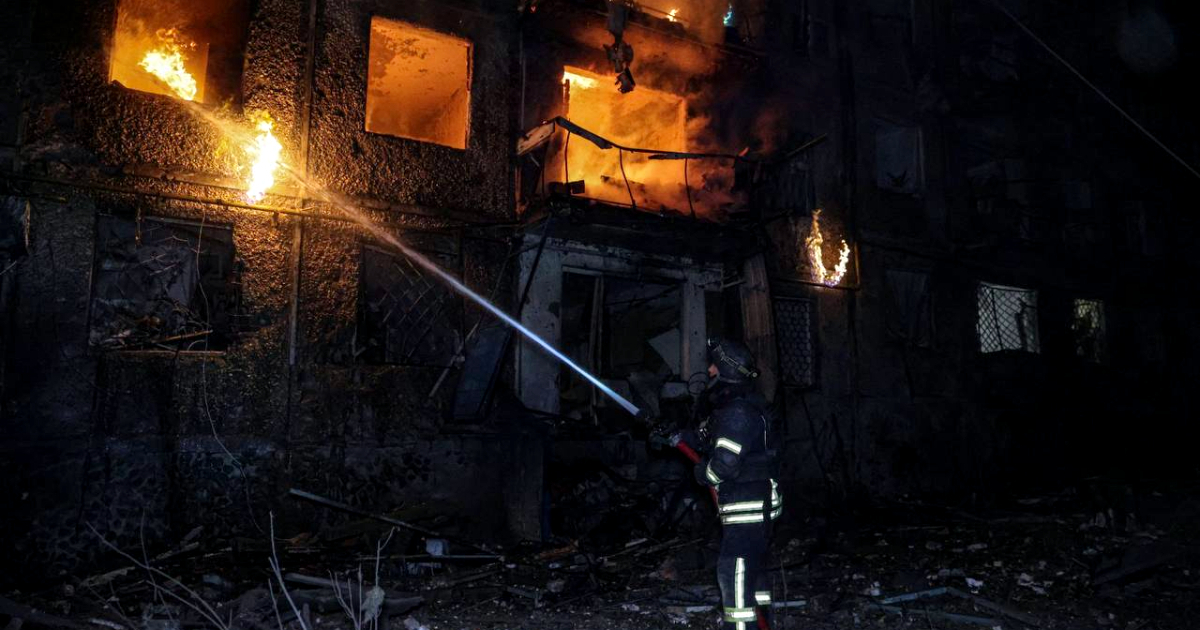
The Russian army launched a massive attack on Kiev and its region this Monday in direct response to the Ukrainian drone bombing that hit Saint Petersburg on Sunday, the second largest city in Russia and the hometown of President Vladimir Putin, according to the agency EFE from Moscow.
The Russian Ministry of Defense stated that the attack targeted military industry facilities, cruise missile and drone storage sites, and data centers in the Ukrainian capital. High-precision missiles launched from ground positions and unmanned devices were used in several night waves to carry out the operation.
The Ukrainian Air Force reported the launch of 269 drones and 16 ballistic missiles, none of which were intercepted. The preliminary toll was at least one person dead and eight injured in Kiev, with damage in three districts, more than ten energy facilities affected, and nearly 550,000 homes without electricity, according to Ukrainian President Volodymyr Zelensky.
The Russian attack occurs one day after Ukraine carried out what independent Russian media described as the largest bombing of the entire war against St. Petersburg.
That drone offensive targeted two oil terminals, data centers, e-commerce warehouses, and an electrical substation, resulting in one death and about a dozen injuries.
Pulkovo Airport suspended operations for more than seven hours, and around 20,000 people were left without electricity in the Leningrad region. The Kremlin and state television attempted to downplay the impact, but they couldn't contain the magnitude of the incident.
Kiev has accumulated nearly a month of daily attacks from Russian aviation, in an escalation that analysts suggest aims to pressure Zelenski into a negotiated surrender.
To the severity of the bombardment, there is an accusation that Zelenski has repeated for the third time in a week: Ukraine did not receive prior warning of the launch of Russian ballistic missiles.
Another Russian attack with ballistic missiles that arrived in several waves during the night, and once again there was no warning from our partners, stated the leader. The spokesperson for the Ukrainian Air Force, Yuri Ignat, confirmed on television that the first wave arrived without the usual alert.
Although neither Zelensky nor the Air Force directly pointed to Washington, the Ukrainian president has repeatedly linked these disruptions to pressures from the White House for Kyiv to cease its attacks on Russian refineries, under the threat of halting intelligence flow.
The episode is set against a backdrop of increasing tension between Zelenski and the Trump administration, which has taken positions increasingly favorable to the Kremlin despite Russia being the aggressor in this conflict.
On October 11, Trump announced a supposed "energy truce" that neither party formally confirmed; in the following week, Russia attacked Ukrainian energy infrastructure 76 times, according to Zelensky.
On October 16, Trump suspended through executive order the main sanctions planned against Moscow under the Lindsey Graham Act, two days before they were set to take effect.
Ukraine, after a three-day pause, resumed attacks on Russian refineries on October 15, leading to the massive bombing on Sunday over St. Petersburg and the retaliation on Monday against Kiev. On Sunday, Zelensky had already warned that it would be "a historic mistake and a great tragedy" for the United States to side with Russia.
Related videos:
Filed under: