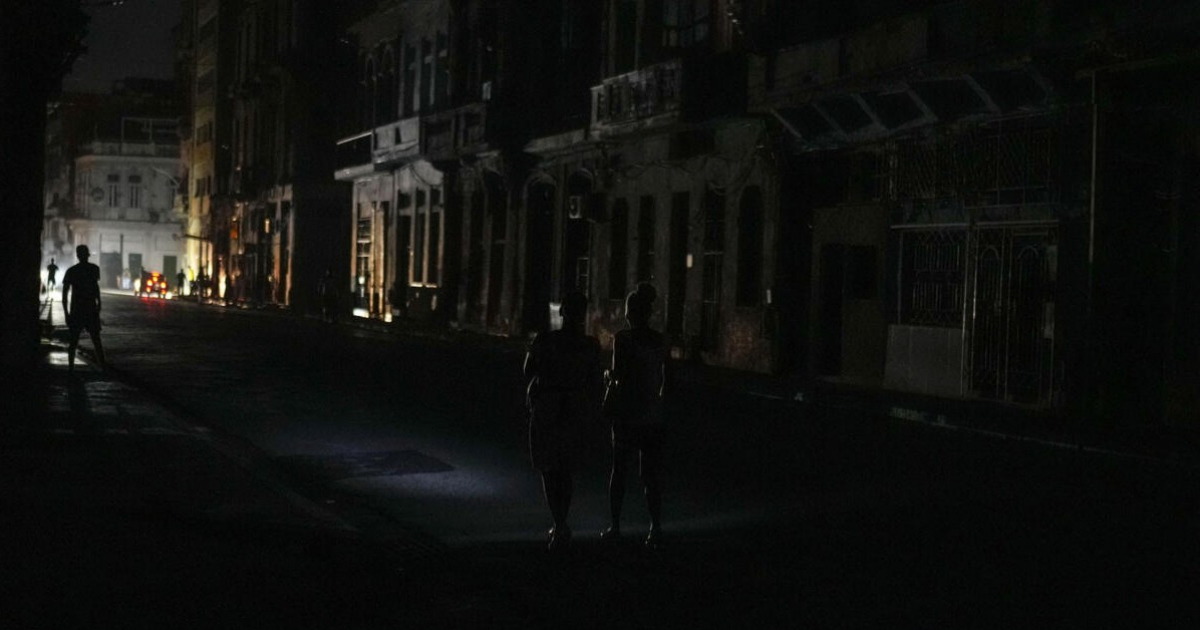
The Cuban Electric Union (UNE) forecasted a shortfall of 2,020 MW for this Monday during peak demand hours, with an availability of only 830 MW against an estimated demand of 2,820 MW, resulting in a deficit of 1,990 MW in the National Electroenergetic System.
The official report, released this morning, revealed that at 06:00 hours there were already 1,374 MW affected with a demand of 2,203 MW. By noon, the UNE estimated an impact of 1,550 MW, a figure that would escalate to 2,020 MW during the nightly peak.
Sunday was no better: the service was interrupted due to capacity shortages for 24 hours, including throughout the night. The maximum actual impact that day reached 1,961 MW at 7:10 PM.
The collapse has a name and a face in the power generation plants. According to the report from UNE for this Monday, units 5 and 8 of the Mariel Power Generation Plant, units 1 and 2 of the Santa Cruz Power Generation Plant, the unit from the Antonio Guiteras Power Generation Plant, unit 2 of the Felton Power Generation Plant, and units 3 and 6 of the Renté Power Generation Plant are out of service due to faults. Additionally, there are three units undergoing maintenance and further thermal limitations of 270 MW.
The CTE Antonio Guiteras, the largest thermoelectric plant in the country located in Matanzas with a capacity of up to 316 MW, has accumulated at least 17 unplanned outages in 2026 and has not received major maintenance since 2010, with over 38 years of operation.
While technicians tally megawatts, Cubans are counting hours in the dark. In Matanzas, the areas of Manuelito and Bolondrón, in the municipality of Pedro Betancourt, had accumulated almost 70 consecutive hours without electricity by the end of Sunday, and circuits in Jagüey Grande exceeded 60 hours.
In the Los Mangos neighborhood of the city of Matanzas, a journalist reported 44 consecutive hours without power on Sunday, following a previous period of 53 hours in the dark. A resident of the municipality of Colón claimed to have been without electricity for 56 days due to a transformer malfunction.
In Pinar del Río, the situation is equally grave. The first provincial secretary of the Communist Party, Yamilé Ramos Cordero, acknowledged on Sunday that some circuits have exceeded 90 consecutive hours without electricity, with supply restricted only to three hospitals and, occasionally, to the provincial capital's well field.
Prolonged blackouts are dragging potable water down with them. The pumping stations in Pinar del Río remained without power from 4:00 PM until 8:30 AM the following day for two consecutive days. This Monday, 52 of the 177 supply sources in the province were out of service, and some communities had gone without piped water for between 67 days and more than three months.
The Electric Company of Guantánamo also announced the day before that it would only be able to guarantee two hours of electricity per day per customer. This measure means that the population will remain without power for about 22 hours a day, in a scenario of extreme electrical supply restrictions.
October has already begun in a critical state across the country. On October 2, a maximum impact of 2,130 MW was recorded, and on October 10, a fault in the Nuevitas–Las Tunas transmission line caused a massive blackout in the eastern part of the country that left approximately 3.4 million people without electricity for over two hours.
Solar photovoltaic generation contributed 2,817 MWh this Sunday, peaking at 438 MW at noon. However, this is insufficient to offset the collapse of thermal generation during nighttime hours when demand reaches its peak and the panels do not produce.
Related videos:
Filed under: