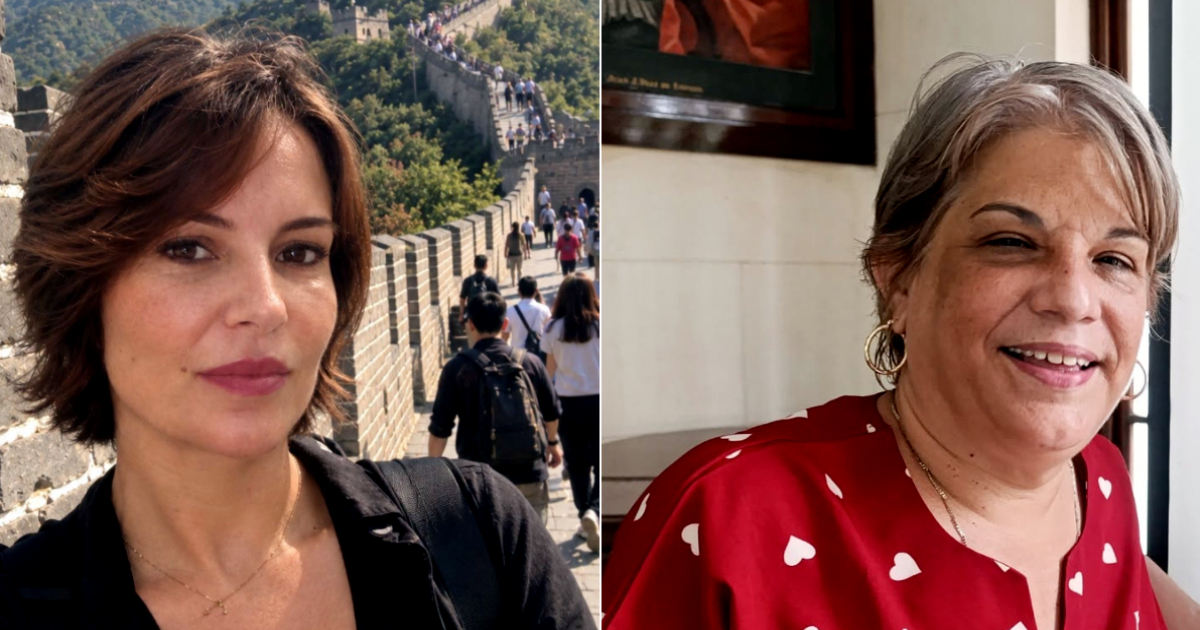
The Spanish activist Ana Hurtado, known for her support of the Cuban regime, recommended on Facebook an independent application that allows residents of Havana to receive notifications about power outages, but she took the opportunity to blame the electrical cuts on U.S. President Donald Trump and the embargo.
On her part, the pro-government Cuban journalist Ana Teresa Badía responded to the message with a remark that highlighted the needs of those who suffer daily from the lack of electricity: «It is necessary for someone human to explain and support the people».
The exchange takes place at one of the most critical moments for the National Electroenergetic System (SEN), which is facing generation deficits that are around or exceed 2,000 megawatts (MW), simultaneous outages at several thermal power plants, and a persistent fuel shortage. On October 17 alone, the maximum impact reached 2,037 MW, according to official data collected by CiberCuba.
Hurtado praised the features of ¿Hay Luz?, a free tool for Android that allows users to check service interruptions and restorations by circuits, receive notifications, and estimate the performance of solar panels.
"It is very comprehensive and user friendly," he assured. However, he concluded his recommendation by stating that the application proves useful "while the power outages caused by the Trump Administration and the genocidal blockade last".
The Spanish representative did not mention in her post the breakdowns of the thermoelectric plants, the deterioration of the energy infrastructure, the fuel shortages, or the investment and maintenance decisions made by the Cuban government.
An independent app for surviving power outages
The tool recommended by Hurtado is not a government initiative. Its website presents it as an application "made by a Cuban, for Havana," although the developer is not publicly identified.
The program processes notifications from the Electric Company of Havana and allows users to track the status of their circuits, a feature that is especially useful when outages are extended or the announced schedules are not met.
The urgency of these tools reflects the deterioration of the SEN, but the crisis is not limited to scheduled outages. In September, Cuba experienced its eighth total disconnection from the SEN so far in 2026, while prolonged blackouts also impacted telecommunications, internet access, and other essential services.
In Havana, reports from the early morning of October 19 recorded 147 circuits affected by generation deficits, some with outages nearing 13 hours.
The application helps to identify the cuts, but it cannot resolve them nor replace the explanations that need to be provided to the authorities.
"It lacks the feeling of someone who has no light."
Ana Teresa Badía's response, a journalist and university professor associated with official Cuban institutions, introduced precisely that human dimension and sense of public responsibility that was absent in Hurtado's message.
The app notifies when the power comes and goes among other features, but it doesn’t explain, wrote Badía.
And he added: "It is necessary for a human to explain and support the people. It is essential to explain over and over again, to feel as someone without light does. That’s why, in addition to the app, human support is needed".
While he maintained a cordial tone and did not directly challenge Hurtado's political explanation, his words created a contrast between suggesting tools to manage scarcity and addressing those who suffer its consequences.
The observation is also notable due to Badía's background, who has publicly questioned decisions made by the Cuban government, the dollarization of services, and the lack of institutional transparency.
In September 2025, due to the failure to meet official promises of reducing blackouts during the summer, he asked: “And is no one going to explain why the promise wasn't fulfilled?”.
The journalist has also criticized the decline of public services and has rejected the notion that all of the country's problems can be justified by the U.S. embargo.
Two ways to talk about blackouts
The exchange presents two different approaches within the network of communicators who maintain ties with the Cuban government.
Hurtado, a Spanish citizen and resident outside of Cuba, has been embroiled in numerous controversies due to her defense of communist leaders and her confrontations with Cuban opponents and activists. She is married to Senén Casas Más, the son of the late general Senén Casas Regueiro, former chief of the General Staff of the Revolutionary Armed Forces.
Badía, without breaking with the Cuban political system, has demanded explanations regarding economic decisions and unfulfilled promises from the authorities.
Badía's reaction takes on a new dimension in light of Hurtado's recent calls for the resistance and sacrifice of the Cuban people.
In early October, the Spanish author published an article in Cubadebate in which she drew on the epic of war to warn the United States about the consequences of military intervention.
Now, in the face of an electrical crisis that affects millions of citizens, he once again invokes the external enemy, this time to explain the blackouts and advise on how to cope with them.
Badía's response can also be interpreted as a sign of wear within the regime itself.
State media journalists, responsible for conveying the government's explanations, are not exempt from blackouts or the deterioration of living conditions.
That a communicator linked to those institutions claims to "feel like one who has no light" in response to the advice of a regime defender close to its military elite reveals, at the very least, a tension between the rhetoric of resistance and the everyday experiences of those who must endure its consequences.
On this occasion, the first attributed the power outages solely to external factors, while the second pointed out that merely informing when the supply is interrupted is not enough to address the needs of the population.
The difference becomes particularly significant when Cuba experiences eight national power grid collapses in 2026 and generation deficits that leave vast areas of the country without service, even for days.
Knowing when the electricity will go off or come back on allows for organizing life around blackouts; explaining why they occur, how long they will last, and what is being done to resolve them is a responsibility that no application can take on for the government.
Related videos:
Filed under: