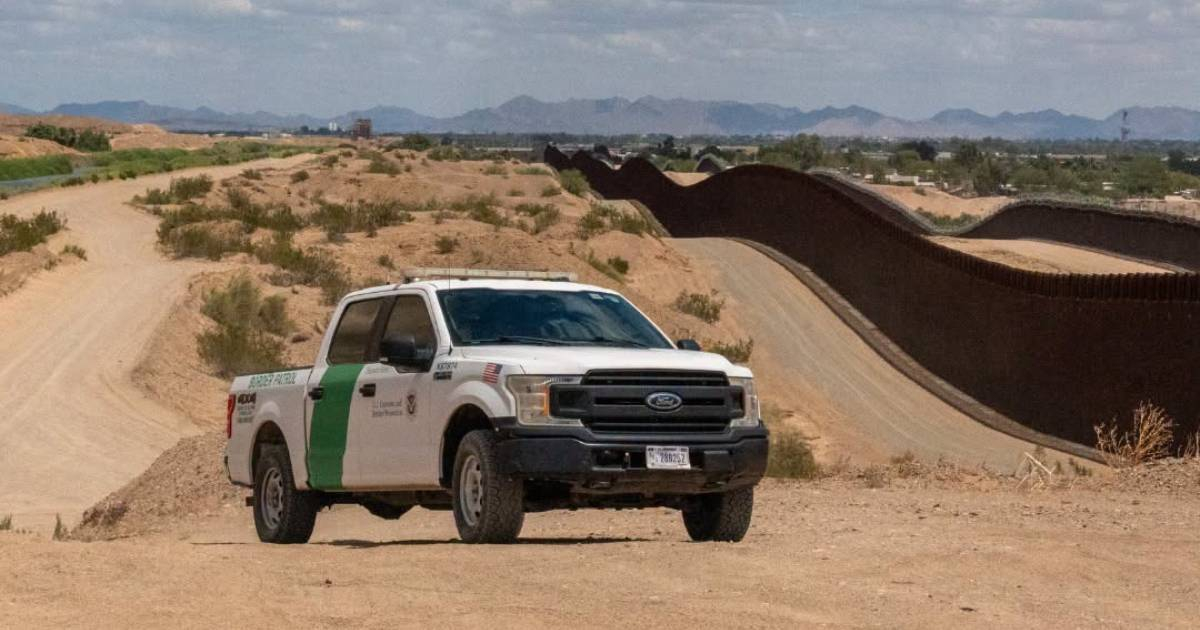
The United States concluded the fiscal year 2026 with 379,243 immigration encounters nationwide, the lowest level recorded by the Customs and Border Protection (CBP), according to preliminary data announced this Friday by the government of Donald Trump.
The figure represents a drastic reduction compared to the average of 2.7 million encounters per year recorded during Joe Biden's administration, according to the statement from the Department of Homeland Security (DHS).
The apprehensions made by the Border Patrol at the southwestern border also fell by 95% compared to the annual average of the previous administration, reaching 98,708 during the fiscal year that ended on September 30.
To illustrate the drop, the DHS highlighted that all arrests recorded at that border over the past twelve months were 60% lower than the 249,740 counted in a single month during the Biden administration.
Another relevant point is that, for the first time, the Border Patrol completed a fiscal year without releasing detained migrants at the border. September marked the seventeenth consecutive month under that policy, according to reported by CBP.
"The results could not be clearer: the strict enforcement of the law works," said Secretary of Homeland Security Markwayne Mullin while presenting the figures as a result of the measures promoted by Trump.
What do these figures reflect about Cuban migration?
The decline is particularly significant for Cubans, who were part of one of the largest migratory exoduses in the recent history of the Island between 2022 and 2024.
According to the CBP statistics on migrant encounters, U.S. authorities recorded 224,607 encounters with Cuban citizens in fiscal year 2022, another 200,287 in 2023 and 217,615 in 2024.
However, in the fiscal year 2025, the figure decreased to 33,056, a decline of nearly 85% compared to the previous period.
The decline continued throughout 2026. The nationality breakdown data available until August shows only 1,762 encounters with Cubans in the first eleven months of the fiscal year, including 156 in August.
These statistics account for encounters with immigration authorities, not necessarily different individuals, as the same person may be recorded more than once.
The zero-release policy of the Border Patrol also reflects the tightening of immigration processing, although it does not mean that all detained individuals are automatically deported or that all possibilities for legal protection have disappeared.
For Cubans, the reduction of border crossings coincides with increased restrictions on regular immigration channels.
Since January 1, 2026, the Presidential Proclamation 10998 restricts the issuance of immigrant visas for Cuban citizens, including categories for immediate family members of U.S. citizens, although certain exceptions apply.
In addition, the termination of the Cuban Family Reunification Program (CFRP) went into effect on December 15, 2025.
The impact of these measures is not limited to the border. An analysis by the Cato Institute revealed that the monthly reduction in legal entries to the United States was 2.7 times greater than that of irregular entries, according to figures available up to February 2026.
The study also noted that border arrests had already decreased significantly during Biden's last year in office, although the decline has continued under the current administration.
The new data from the DHS comes just a few weeks before the U.S. legislative elections on November 3, as the Trump administration defends its tough immigration policies as one of the key outcomes of its governance.
Related videos:
Filed under: