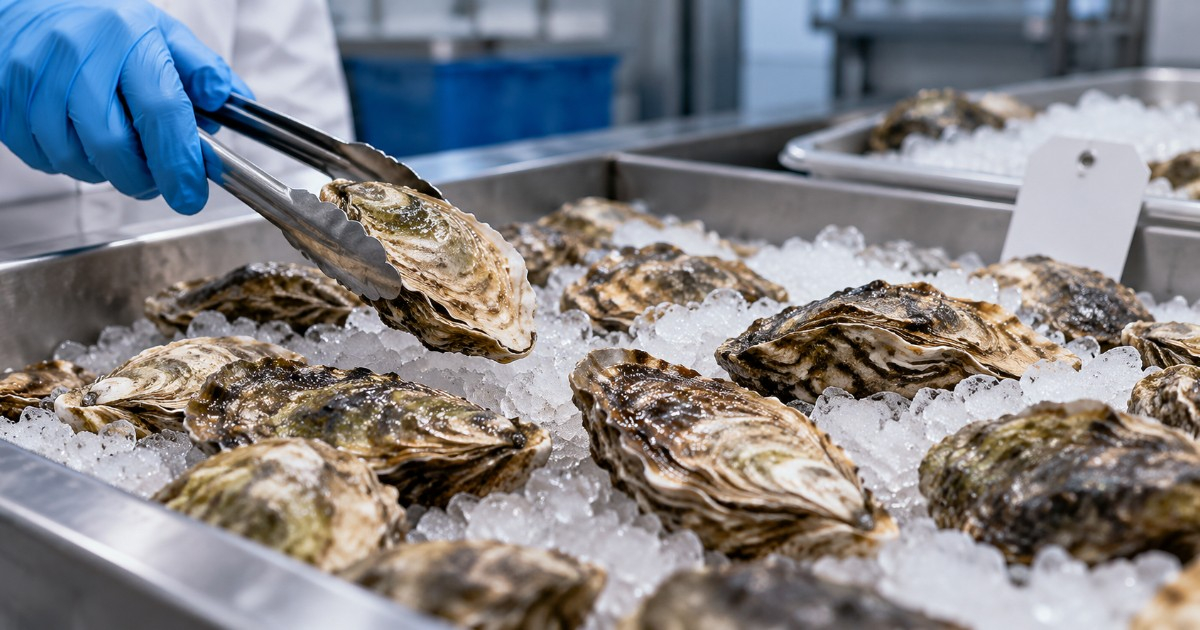
The United States Food and Drug Administration (FDA) has issued a warning regarding the distribution in Florida of whole oysters in shell from Little Wicomico Oyster Company, identified by code VA-1421-SP, linked to an investigation of a salmonella outbreak.
Authorities recommend that consumers do not eat them and that restaurants and businesses immediately suspend their sale and service.
The safety alert issued by the FDA this Monday identifies the shellfish harvested between September 18 and October 8, 2026 in the areas of Little Wicomico River and Little Wicomico River Lower, in Virginia, as affected.
Florida is explicitly listed among the destinations where the recalled oysters were distributed. The warning is directed both at the establishments that may have received them and at those who purchased or consumed them, due to the risk of contamination with the bacterium Salmonella.
The FDA notes that the affected oysters were sent to restaurants and retail establishments in California, Colorado, Connecticut, Florida, Georgia, Illinois, Maryland, Missouri, North Carolina, New Jersey, Nevada, New York, Pennsylvania, Texas, Virginia, and the District of Columbia.
The agency warns that they may also have been distributed to other locations later, so the list should not be interpreted as necessarily definitive.
The inclusion of Florida confirms the distribution of the product in the state, but it does not mean that there have been reported cases of salmonella associated with these oysters.
The consulted federal notices do not identify specific establishments that have received them, nor do they specify the existence of sick individuals in Florida.
How to identify affected oysters?
The warning does not cover all oysters sold in the United States nor all those originating from Virginia. It pertains to a specific product, from a particular company, and harvested during a specific period.
- Company: Little Wicomico Oyster Company.
- Establishment Identifier: VA-1421-SP.
- Product: whole shellstock oysters.
- Collection dates: from September 18 to October 8, 2026, inclusive.
- Extraction zones: Little Wicomico River and Little Wicomico River Lower, Virginia.
These are the essential details that restaurants, distributors, and retailers should verify on their labels, receiving records, and provenance documentation.
Consumers who have oysters of questionable origin should consult the establishment where they purchased them to confirm whether they belong to the recalled products.
The FDA warns that food contaminated with Salmonella may have a normal appearance, smell, and taste. Therefore, it is not possible to determine if these oysters are safe just by looking at them or tasting them.
A voluntary withdrawal prior to the federal alert on Monday
The product withdrawal did not begin on October 19.
According to the Centers for Disease Control and Prevention (CDC), Little Wicomico Oyster Company voluntarily recalled the affected oysters on October 9, 2026 and notified its customers.
The company also suspended shellfish harvesting in the affected area and began collaborating with health authorities.
On that same October 9, the Virginia Department of Health ordered the temporary closure of the Little Wicomico River extraction area as a precautionary measure.
The news this Monday is the publication of federal notices from the FDA and the CDC, detailing the distribution of the product and explaining its connection to an investigation into salmonella infections.
Authorities clarify that the oysters harvested in other areas of Virginia are not part of this recall.
What is known about the salmonella outbreak?
The research began with the identification of diseases associated with the consumption of oysters from the affected areas.
According to the FDA, the Pennsylvania Department of Agriculture detected an outbreak of infections caused by Salmonella Telelkebir linked to the consumption of oysters harvested from Little Wicomico River and Little Wicomico River Lower.
Federal authorities explain that these illnesses are part of a group of 27 infections caused by Salmonella Telelkebir that are currently under investigation by the CDC, FDA, and state health authorities.
However, that figure does not mean that the 27 individuals necessarily consumed oysters from Little Wicomico Oyster Company, nor that all cases are confirmed as being caused by the recalled product.
The research aims to determine the scope of the outbreak and clarify the connections between the affected individuals and the foods consumed.
The FDA indicated that it continues to collaborate with the CDC and state authorities and will update the warning when new information becomes available.
What should consumers and restaurants in Florida do?
Federal recommendations are clear: oysters included in the recall should not be eaten, sold, or served, regardless of whether they appear normal.
The CDC recommends that consumers discard the product or return it to the corresponding establishment.
For restaurants, merchants, and distributors, the FDA advises removing the affected oysters and disposing of them or contacting the supplier to coordinate their destruction.
Additionally, authorities recommend cleaning and disinfecting containers, utensils, surfaces, and other items that may have come into contact with potentially contaminated shellfish.
The CDC indicates that objects and surfaces exposed should be washed with hot water and soap or a dishwasher when appropriate, while establishments should implement their cleaning and disinfection procedures.
These precautions aim to prevent cross-contamination, that is, the transfer of bacteria from one food item to other products or preparation surfaces.
What are the symptoms of salmonella?
Salmonellosis is a bacterial infection that can be contracted by consuming contaminated food. Some of the most common symptoms identified by the CDC include:
- Diarrhea.
- Fever.
- Cramps or abdominal pain.
Some individuals may develop more severe cases, particularly young children, the elderly, and those with weakened immune systems.
Health authorities recommend that those who have consumed the recalled oysters or display symptoms consistent with the infection consult a healthcare professional.
In particular, the CDC advises seeking immediate medical attention for severe symptoms such as bloody diarrhea, high fever accompanied by diarrhea, persistent vomiting, or signs of dehydration.
Not all exposed individuals necessarily develop an infection, but the absence of visible alterations in the oysters does not guarantee that the food is safe.
The alert is especially important for residents of Florida who recently purchased oysters and for restaurants that have seafood products stored or prepared for sale.
Other recent food alerts in Florida
In recent weeks, U.S. health authorities have reported additional food recalls distributed in Florida, linked to various risks of bacterial contamination.
At the beginning of September, a mixture of frozen organic fruits from the Great Value brand, sold at Walmart, was recalled due to possible contamination with a strain of E. coli.
The product had been distributed in 16 states, including Florida, amid an investigation into infections linked to frozen blueberries.
At the end of that same month, it was reported about the recall of two batches of frozen pasta Bettergoods Authentic Italian Lemon Alfredo Fettuccine, sold at Walmart, due to the possible presence of Listeria monocytogenes. The notice had been published by the FDA on September 15, and until then, no illnesses associated with the product had been reported.
More recently, a batch of cold-smoked Norwegian salmon from the brand Starfish Seafood was voluntarily recalled due to the risk of contamination with Listeria.
The product had been distributed in Florida and five other states, although no illnesses related to its consumption had been confirmed at the time of the announcement.
Related videos:
Filed under: