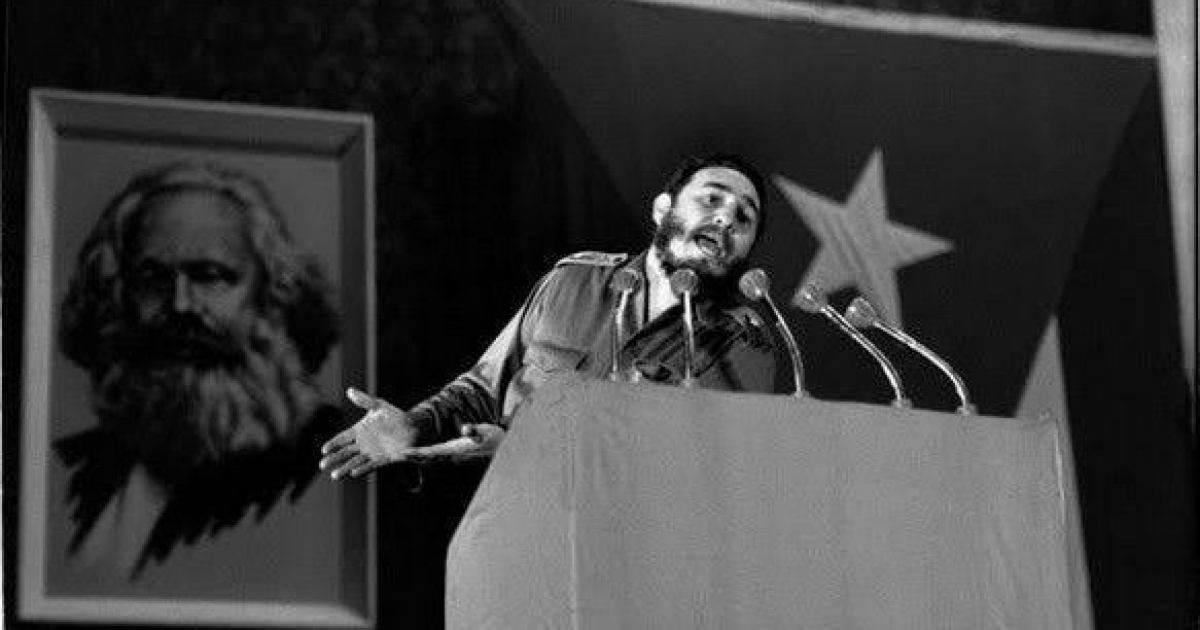
There are ideas that emerge promising to free humanity but end up justifying new forms of subjugation. Marxism deserves to be examined precisely from this contradiction: the gap between the just society it promises and the reality of the regimes that have attempted to build it.
Three works help to understand its foundations: The Communist Manifesto (1848) by Karl Marx and Friedrich Engels; Das Kapital, with its first volume published in 1867, written by Marx; and The Holy Family (1845), also by Marx and Engels. These are not the only foundational texts of this movement, but they allow for an examination of its political, economic, and philosophical roots.
The Communist Manifesto: Struggle as the Engine of History
Marx and Engels interpreted history through the lens of class struggle. Their proposal was to overcome the capitalist order through proletarian revolution and the transformation of property relations. The problem arises when the fight against a dominant class becomes a justification to seize power without establishing effective limits on those who wield it.
When a party declares itself the exclusive representative of the workers, who can challenge it without being accused of serving the enemies of the people? The experience of numerous communist regimes demonstrates the danger of that logic: the concentration of power, the persecution of dissent, and the subordination of individual rights to supposed collective interests.
The promised emancipation thus concludes in a paradox: the citizen no longer depends on certain private owners, but may still be subjected to a State that controls employment, production, and a good part of their daily life.
Capital: Criticism alone is not enough to build prosperity
In "Capital," Marx conducted a deep analysis of the workings of capitalism, the exploitation of labor, and the accumulation of wealth. His work remains significant in the history of economic thought. Critically engaging with it requires recognizing its contributions while not automatically accepting all its conclusions.
The problem arises when the intention is to replace economic coordination through markets, prices, and decentralized decisions with central planning that concentrates decision-making in the hands of officials.
The historical experience of various centrally planned economies has shown recurring difficulties: shortages, low productivity, insufficient incentives, and inefficient resource allocations. These outcomes cannot be attributed to a single cause, nor were all socialist countries alike. However, they reveal a fundamental problem: the State can dictate production on paper, but this does not guarantee that the necessary goods will reach the population in a timely manner.
The economy does not thrive on slogans. It needs information, initiative, responsibility, investment, and mechanisms that allow for correcting mistakes. When economic decisions are subordinated to political obedience, recognizing a failure can become a threat to those in power. As a result, the error is not corrected but rather prolonged.
The Sacred Family: From Philosophical Critique to Politics
Published in 1845, 'The Holy Family' was a critique primarily aimed at the young Hegelians and their philosophical positions. It is not, by itself, a manual of communist governance. Its significance in this analysis lies in the early development of Marx and Engels' thought and in their critique of the prevailing ideas of their time.
But no philosophy is exempt from examination regarding its intentions. When a political doctrine is presented as the definitive explanation of society, it risks turning its postulates into unquestionable truths. If it also controls the institutions, education, the press, and the judiciary, dissent ceases to be a contribution to knowledge and becomes viewed as a threat.
That is one of the greatest dangers of Marxism when it becomes a system of power: that the ideology seeks to replace reality and that the failure of its policies is always attributed to external enemies, sabotage, or insufficient revolutionary commitment.
Who pays the bill?
Here lies the moral contradiction. Leaders who speak on behalf of the poor do not necessarily share their hardships. In authoritarian systems, the lack of democratic controls and a free press facilitates the emergence of privileged elites, while the citizenry lacks effective tools to demand accountability.
Cuba presents a particularly illustrative case: more than six decades of communist rule have not resulted in the promised prosperity, citizen autonomy, or well-being. Persistent shortages, the deterioration of services, and mass emigration compel a closer examination of internal decisions, the planning system, political repression, and also the impact of U.S. sanctions, without allowing any single factor to serve as an absolute explanation.
The tragedy lies in the fact that the ordinary citizen bears the consequences of decisions, while those who make them can remain in power without undergoing genuine accountability.
And why is there insistence on that path? Because a doctrine can survive its failures when it becomes an identity, a tool of control, and a source of privileges. For some, abandoning the ideology means giving up a conviction; for those who benefit from it, it can mean losing power.
The truth before doctrine
I do not assert that all criticism of capitalism is incorrect, nor that all Marxists pursue the same goals. I maintain something more specific: no promise of equality justifies sacrificing freedom, and no theory deserves immunity from the results of its application.
A society needs social justice, opportunities, and protection for the most vulnerable. But it also requires personal property and autonomy, independent institutions, political pluralism, freedom of expression, and limits on state power.
History should not judge a doctrine solely by what it proclaims, but also by what happens when its supporters have the power to implement it.
When an ideology promises to liberate the people but requires them to renounce their freedom to achieve it, the question is not how long it will take to reach utopia. The question is who benefits from that promise never being fulfilled.
Related videos:
Filed under:
Opinion piece: Las declaraciones y opiniones expresadas en este artículo son de exclusiva responsabilidad de su autor y no representan necesariamente el punto de vista de CiberCuba.