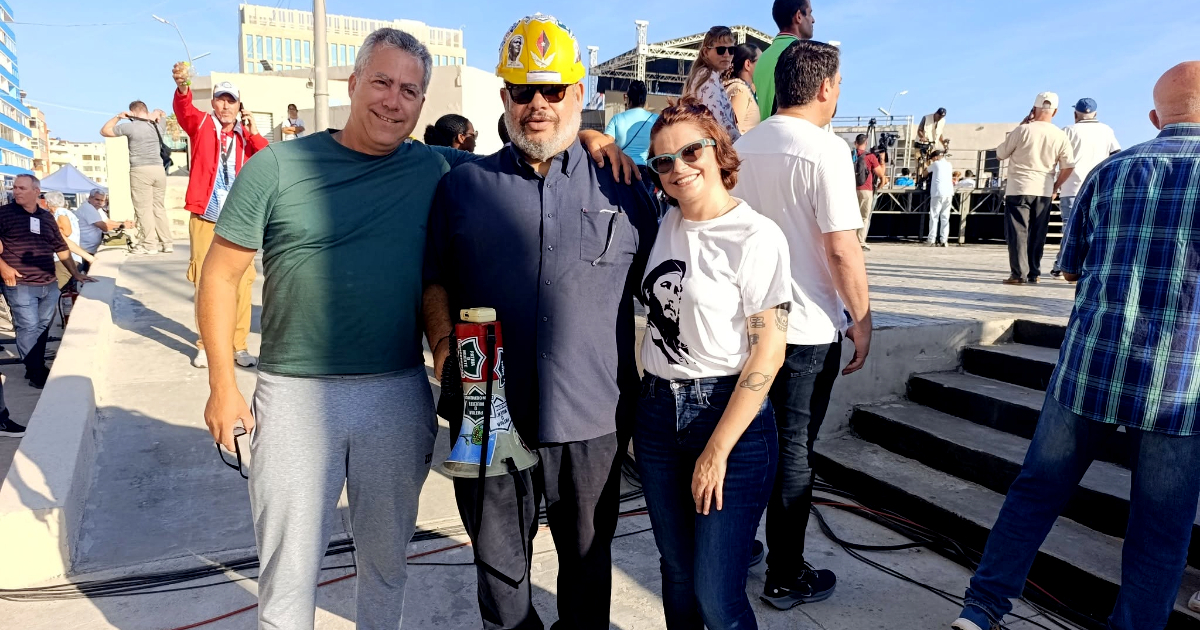
The Spanish propagandist Ana Hurtado reiterated her unwavering loyalty to Raúl Castro this Tuesday, who is facing two criminal charges in the United States for the downing of Hermanos al Rescate aircraft in 1996.
To accomplish this, the "passionflower of continuity" resorted to a slogan by the official artist Alexis Leyva Machado, known as Kcho, another veteran of political devotion to the ruling family.
"How Kcho said, Trouble with Raúl, Trouble with Me," wrote Hurtado in a post on Facebook, accompanied by a photograph of the former leader, dressed in military uniform and surrounded by young people.
"And I am sure that any Cuban revolutionary and those around the world would say exactly the same," she added, along with the hashtag #RaúlEsRaúl.
The statement comes just four days after a Florida judge signed a new arrest warrant against the former Cuban ruler. However, for Hurtado, the murder allegations seem to carry much less weight than the obligation to rally around the Castro surname.
The phrase that was retrieved is not a recent occurrence either. Kcho used it in a tribute for the 95th birthday of Raúl Castro, celebrated on June 3rd, through an artistic activity that involved several children.
In a video shared on their social media and reproduced by Diario de Cuba, the minors are seen pressing their paint-covered hands on a white wall in Havana, around the slogan “Trouble with Raúl, trouble with me,” written in large red letters.
The happening by Kcho camouflaged behind childhood innocence a surrendered tribute to a dictator with blood-stained hands. With dozens of little hands painted in colors applied to the white wall, the message of loyalty and submission to power was already written.
Kcho: From Contemporary Art to Devotion for the Castros
Alexis Leyva Machado, born in the Isle of Youth in 1970, is a visual artist with an international career whose closeness to Fidel and Raúl Castro has been both public and enduring.
Former member of the National Assembly, accompanied Raúl Castro during his visit to Pope Francis in the Vatican in May 2015, and personally welcomed Fidel Castro in his studio in Romerillo, Havana, in January 2014.
In an interview granted to the BBC, he summarized his convictions with a statement that is hard to surpass in ideological enthusiasm: «I am 100% a product of the revolution and I am 3,000% revolutionary».
His loyalty has not known many boundaries between artistic creation, political activism, and personal reverence for leaders.
In March 2018, Kcho visited the grave of the dictator Fidel Castro at the Santa Ifigenia cemetery in Santiago de Cuba, and stood in front of the gravestone with a military salute.
On his social media, he then explained that he considered Fidel his commander, his friend, and his father, and that his teachings had marked his entire existence.
Months later, in an interview with the state newspaper 5 de Septiembre, he reiterated his pride in his identification with the Revolution and declared himself willing to take on any task assigned to him by Miguel Díaz-Canel and Raúl Castro.
"I am ready to take on any task," he assured.
The phrase illustrates to what extent the artist has conceived of their public activity as an extension of their commitment to political power. Their work may circulate in galleries and international exhibitions, but their militant discourse remains anchored in obedience to the leaders of the so-called "revolution" Dictatorship.
His career has not been without controversies. In 2017 and 2018, CiberCuba reported on his temporary disappearance from the public scene, his time in rehabilitation, and the loss of his parliamentary seat, amidst various scandals and accusations.
Despite those episodes, Kcho later regained visibility in the state media and continued to publicly display his loyalty to Castroism.
Ana Hurtado: revolution as discourse and family connection
The journey of Ana Hurtado Martínez shows a similar fervor, although primarily developed in social media, propaganda outlets, and the political communication spaces of the regime.
The Spanish entity, established in Cuba since October 2022, has made the defense of Castroism a permanent public activity. Its discourse combines attacks on the United States, praise for Cuban leaders, and a persistent denial of the regime's internal responsibilities in the national crisis.
Its proximity to power is not limited to political statements either.
According to a study published by CiberCuba, Hurtado married Senén Casas Más, son of the late general Senén Casas Regueiro, former head of the General Staff of the Revolutionary Armed Forces and a close associate of Raúl Castro.
Casas Más has been identified as a person connected to the circle of Alejandro Castro Espín, the son of the former president and a key figure in the Cuban security apparatus.
The family connection helps to understand Hurtado's closeness to the circles of power he publicly defends. This is not just about a foreign supporter captivated by a distant revolution: her personal life is also intertwined with the environment of the Cuban military elite.
In April of this year, the propagandist published an article titled "Cuba, a dictatorship?" in Cubadebate, in which she denied that the one-party political system could be classified as dictatorial.
To defend his position, he argued that the existence of a single party did not necessarily mean the absence of freedoms and presented the Armed Forces and the Ministry of the Interior as expressions of the uniformed people.
The interpretation is particularly striking in a country whose Constitution enshrines the Communist Party as the leading force of society and the State, while independent human rights organizations document arbitrary detentions and political persecution.
The economic crisis has not managed to dampen their enthusiasm either.
In August 2025, Hurtado celebrated Cuba's supposed oil sovereignty on Telesur, presenting the results of the national industry as a strategic advance, despite the country's dependence on fuel imports and the blackouts that plagued the population.
The energy sovereignty described in his articles was still far more visible in propaganda than in the electrical outlets of Cuban homes.
And just two days ago, he sparked a new controversy when he blamed Donald Trump and the U.S. embargo for the blackouts.
Her message prompted a response from the official journalist Ana Teresa Badía, who called for greater sensitivity towards those who daily suffer from the lack of electricity.
The exchange exposed an uncomfortable contradiction for the propaganda: even among communicators who have not broken with the official stance, the ease with which certain defenders of the regime distribute explanations, slogans, and calls for sacrifice is beginning to irritate, while millions of Cubans endure the consequences of the crisis.
Hurtado has also turned to the epic of war. In an article published this October in Cubadebate, titled "The Living Will Envy the Dead," he invoked the wars in Vietnam, Afghanistan, and Iraq to warn Washington about the consequences of a potential military intervention in Cuba.
From its particular propaganda trench, the Spanish seems to feel entitled both to interpret the everyday suffering of Cubans and to transform a hypothetical war into a new revolutionary epic.
Raúl Castro, facing two criminal cases for the shooting down of Brothers to the Rescue
Hurtado Martínez's new display of loyalty coincides with a particularly delicate judicial moment for Raúl Castro.
On October 16, Judge Ariana Fajardo Orshan signed a state arrest warrant against the former leader in Miami for conspiracy to commit first-degree murder, connected to the downing of two planes belonging to Brothers to the Rescue.
The case adds to the federal charges filed on May 20, 2026, which include seven charges against Raúl Castro: four for murder, two for destruction of aircraft, and one for conspiracy, along with five Cuban military personnel.
The state accusation presents an important particularity: a potential federal presidential pardon would not apply to the crimes prosecuted under Florida law.
The events occurred on February 24, 1996, when aircraft from the Cuban Air Force shot down two civilian Cessna 337 planes belonging to Brothers to the Rescue over international waters of the Florida Straits.
Armando Alejandre Jr., Mario Manuel de la Peña, Carlos Costa, and Pablo Morales died in the attack. Their bodies were never recovered.
Raúl Castro remains in Cuba and is considered a fugitive in the federal case.
Thirty years after that crime, while the U.S. justice system seeks to establish criminal responsibility, Kcho and Ana Hurtado continue to assert a personal loyalty that doesn’t seem to allow for many questions.
“Trouble with Raúl, trouble with me”: a slogan that both repeat with pride, although neither has explained exactly what it means to take on as their own the judicial problem of a leader accused of participating in the assassination of four civilians.
Related videos:
Filed under: